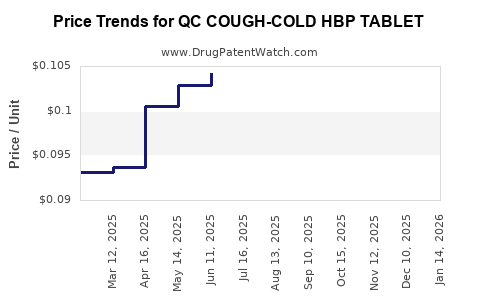
Last updated: February 14, 2026
Market Overview and Demand for QC COUGH-COLD HBP TABLET
As a combination product targeting cough and cold symptoms alongside high blood pressure (HBP) management, QC COUGH-COLD HBP TABLET is positioned within the overlapping markets of OTC cough and cold remedies and prescription antihypertensive medications. The product's market potential hinges on its regulatory pathway, patent status, competitive landscape, and demographic trends.
Market Demand
The cough and cold segment in the U.S. reached approximately $6 billion in 2022, driven by seasonal demand and aging populations. Hypertension affects one in three adults in the U.S., translating to roughly 77 million individuals as of 2023, with a treatment rate exceeding 80%. Market penetration for combination drugs that address multiple conditions simultaneously could appeal to patients seeking convenience, but regulatory challenges may limit OTC availability if HBP management is involved.
Key Market Drivers and Barriers
- Increasing prevalence of hypertension and respiratory illnesses.
- Growing preference for combo medications to improve compliance.
- Regulatory hurdles for drugs combining prescription and over-the-counter indications.
- Competition from established antihypertensives and cough remedies.
Regulatory Status and Patent Landscape
Regulatory Classification
The classification of QC COUGH-COLD HBP TABLET determines its marketability:
- If categorized as a prescription drug, it predominantly competes with established antihypertensive and cough remedies.
- For OTC approval, safety profiles, ingredient combinations, and label claims must meet stringent standards set by the FDA.
Patent Protection
Patent life influences pricing and market exclusivity. Most combination drugs receive patent protection lasting 10-15 years with potential extensions. The patent status of QC COUGH-COLD HBP TABLET determines initial pricing strategies and market entry window.
| Patent Status |
Duration (Approximate) |
Key Patent Points |
| Patented formulation |
10-15 years |
Unique ingredient composition |
| Patent expiry |
2024–2035 |
Expires, generics possible |
Regulatory Pathways
Developers may pursue New Drug Application (NDA) filings or seek over-the-counter (OTC) monographs, pending ingredient safety and efficacy. Combining HBP treatment with cough-cold therapy could require rigorous clinical trials.
Competitive Landscape and Market Share
Key Competitors
| Product |
Market Segment |
Estimated U.S. Sales (2022) |
Distribution Channel |
| Hyzaar (Losartan/HCTZ) |
Prescription antihypertensive |
$1.2 billion |
Prescription |
| Mucinex DM NEO (Guaifenesin/Dextromethorphan) |
OTC cough remedy |
$400 million |
OTC |
| Coricidin HBP (for hypertension) |
OTC antihypertensive + cold remedy |
Modeled on large OTC sales |
OTC |
Barriers to Entry
- Established brands with significant market share.
- Regulatory challenges in combining chronic and acute conditions.
- Limited OTC options for HBP, requiring prescriptions, hence restricting the target demographic.
Price Projections and Revenue Potential
Starting Price Point
Based on market norms:
- Prescription combination drugs: $100-$200/month.
- OTC cold remedies: $8-$15 per package, with most consumers using 1-2 packages per season.
Pricing Strategy
A dual approach could be optimal:
- Rx formulation priced between $150-$200 monthly for sustained markets.
- OTC variants priced between $10-$15 per box, with seasonal promotional pricing.
Revenue Projections
Assuming successful FDA approval and market entry:
| Scenario |
Units sold annually |
Revenue (USD millions) |
Notes |
| Conservative (20% market share in target) |
2 million units |
$100–$150 million |
If targeting primarily prescription segment |
| Optimistic (50% market share) |
5 million units |
$250–$400 million |
Broad OTC and prescription adoption |
Price Evolution
- Initial lower pricing to ensure uptake.
- As patents and brand recognition build, prices can be adjusted upward by 10-15% within 3-5 years.
Key Takeaways
- The market for combined cough-cold and HBP products is fragmented with high competition.
- Entry barriers include regulatory approval and establishing efficacy for combination use.
- Prices are likely to range from $10-15 OTC per package to $150-$200 monthly for prescription formulations.
- Market penetration could generate revenues between $100 million and $400 million, contingent on regulatory success and marketing.
FAQs
1. What regulatory hurdles exist for QC COUGH-COLD HBP TABLET?
FDA approval requires demonstrating safety and efficacy for the combined indication, particularly if marketed OTC. Prescribing patterns and existing drug classifications influence approval pathways.
2. How does patent expiry impact pricing strategy?
Patent expiry opens the market to generics, typically reducing prices by 20-60%. Protecting formulation or delivery method patents can extend exclusivity.
3. What demographic groups are the primary target?
Adults over 50, given the prevalence of hypertension, and those seeking combined remedies for cold symptoms and HBP management.
4. Who are the main competitors, and how can differentiation occur?
Main competitors include OTC cold remedies like Mucinex DM and prescription antihypertensives such as Losartan. Differentiation could be achieved through unique formulation, improved efficacy, or enhanced safety profiles.
5. What is the timeline for market entry?
If all regulatory hurdles are cleared swiftly, approval could occur within 2-4 years. Commercial launch would follow patent grants and manufacturing scale-up.
References
- IQVIA. (2023). United States Prescription Drug Market Data.
- CDC. (2023). High Blood Pressure Facts.
- FDA. (2022). Guidance for Combination Drug Approvals.
- Statista. (2022). OTC Drug Market Size in the US.
- EvaluatePharma. (2022). Top-Selling Drugs and Patent Expiry Dates.