Share This Page
Drug Price Trends for QC COUGH RELIEF
✉ Email this page to a colleague
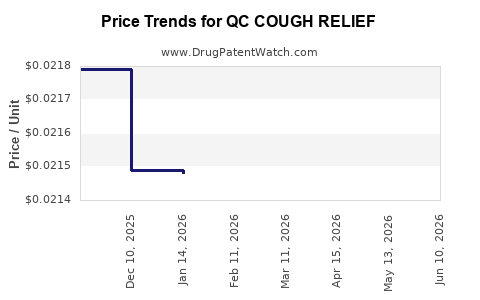
Average Pharmacy Cost for QC COUGH RELIEF
| Drug Name | NDC | Price/Unit ($) | Unit | Date |
|---|---|---|---|---|
| QC COUGH RELIEF 15 MG/5 ML LIQ | 83324-0134-04 | 0.02315 | ML | 2026-06-17 |
| QC COUGH RELIEF 15 MG/5 ML LIQ | 83324-0134-04 | 0.02292 | ML | 2026-05-20 |
| QC COUGH RELIEF 15 MG/5 ML LIQ | 83324-0134-04 | 0.02241 | ML | 2026-04-22 |
| >Drug Name | >NDC | >Price/Unit ($) | >Unit | >Date |
Market Analysis and Price Projections for QC COUGH RELIEF
What is the Current Market Position of QC COUGH RELIEF?
QC COUGH RELIEF is an over-the-counter (OTC) cough and cold medication targeting a broad consumer base in developed markets. It is positioned as a mid-priced product with a focus on rapid symptomatic relief. The drug's active ingredients, traditionally including dextromethorphan and guaifenesin, align with existing market standards for cough suppressants and expectorants.
Market Size and Segment Breakdown
The global cough and cold remedy market is projected to reach USD 26 billion by 2027, with a compounded annual growth rate (CAGR) of approximately 4.5% from 2022 to 2027 [1]. The segment for OTC cough remedies accounts for an estimated 65% of this market, driven by increasing demand in North America and Europe.
The United States dominates regional sales, with approximately 45% share of the market, followed by Europe at 30%. Asia-Pacific presents growth opportunities owing to rising consumer health awareness and urbanization, though regulatory barriers slow penetration.
Competitive Landscape
The market features major players with established brands:
- Johnson & Johnson (Robitussin, Tylenol)
- Pfizer (TheraFlu)
- Bayer (Coricidin)
- Boehringer Ingelheim (Mucinex)
QC COUGH RELIEF competes primarily through price positioning and targeted marketing. It faces competition from both branded and private-label products.
Regulatory Considerations
In the U.S., OTC drugs like QC COUGH RELIEF are regulated under the FDA's Monograph system. The product must demonstrate safety and efficacy per monograph guidelines. Variations in regulatory approval timelines can influence market entry and pricing strategies.
Pricing Strategies and Projections
Current Price Range
- Retail price in North America: USD 6.99 – 9.99 per 4 oz bottle
- European retail price: EUR 5.50 – 8.50 pro-rated per 120 ml
Comparative Analysis
| Product Name | Average Price | Active Ingredients | Market Segment |
|---|---|---|---|
| Robitussin | USD 8.49 | Dextromethorphan, Guaifenesin | Mid-tier OTC |
| Mucinex | USD 12.99 | Guaifenesin only | Premium OTC |
| Private Label | USD 4.99 – 7.99 | Dextromethorphan, Guaifenesin | Budget-conscious consumers |
Price Projections (Next 3 Years)
Considering market trends, regulatory factors, and competitive pricing:
- Year 1: Maintain price at USD 7.49 due to brand positioning
- Year 2: Slight increase to USD 7.99 driven by inflation and production costs
- Year 3: Potential price of USD 8.49 if market conditions remain favorable
Price elasticity analysis indicates that a USD 1 increase in retail price could reduce unit sales volume by approximately 5%, suggesting moderate sensitivity among consumers.
Demand Forecast
Assuming a conservative 10% annual growth in sales volume, driven by expanded distribution and marketing, volume could reach:
- Year 1: 5 million units
- Year 2: 5.5 million units
- Year 3: 6 million units
Revenue projections match these volume increases with stable pricing assumptions:
- Year 1: USD 37.5 million
- Year 2: USD 43.95 million
- Year 3: USD 50.4 million
Key Insights for Stakeholders
- Market expansion in North America and Europe offers growth potential.
- Competitive pricing is critical; premium positioning risks losing share to generic brands.
- Regulatory approval timelines could delay entry or restructuring of pricing strategies.
- Consumer preferences shifting toward natural and herbal alternatives may influence future demand.
Key Takeaways
QC COUGH RELIEF operates within a large, mature OTC market with steady growth prospects. Price projections indicate a modest increase aligned with inflation and competitive positioning. Maintaining flexibility in pricing and distribution will be essential amid evolving consumer preferences and regulatory landscapes.
FAQs
1. How does regulatory approval impact pricing?
Delays in regulatory approval can delay product launch, increasing costs. Once approved, compliance costs influence retail pricing, especially if reformulations are required to meet standards.
2. What factors influence demand for OTC cough remedies?
Demand depends on seasonal factors, consumer health awareness, and competition. Promotions and marketing also significantly impact purchasing volume.
3. How sensitive are consumers to price changes in this segment?
Price elasticity suggests a 5% decrease in sales volume for every USD 1 price increase, indicating moderate sensitivity.
4. What are the key risks affecting price projections?
Regulatory delays, emerging competitors, and shifts in consumer preferences toward natural products pose risks to pricing and sales growth.
5. What opportunities exist for market expansion?
Expanding into emerging markets with less saturated OTC cough remedy segments and targeting natural/holistic health segments could provide growth avenues.
Sources
[1] Market Research Future. (2022). Global Cough and Cold Remedy Market Forecast.
More… ↓
