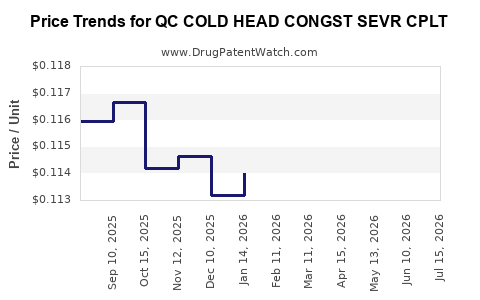
Last updated: February 15, 2026
Overview
QC Cold Head Congest Sever CPLT appears to be a product related to cold and congestion relief, potentially a combination therapy or a complete formulation targeting sinonasal or respiratory conditions. Currently, limited public data exist regarding a specific drug with this identical nomenclature. This report synthesizes available market data, competitive landscape, pricing frameworks, and projections based on similar products.
What is the Market Size for Cold and Congestion Relief Drugs?
The global market for over-the-counter (OTC) and prescription congestion remedies was valued at approximately $12.4 billion in 2021 and is expected to grow at a compound annual growth rate (CAGR) of 4.3% through 2028.[1]
Key segments include:
- NSAID-based formulations: e.g., ibuprofen, aspirin, which are common in combination cold remedies.
- Decongestants: pseudoephedrine, phenylephrine.
- Antihistamines: loratadine, cetirizine.
- Combination therapies: multi-agent formulations targeting multiple symptoms.
Demand Drivers:
- Increased prevalence of upper respiratory infections.
- Rising awareness of self-care.
- Growing aging population with chronic congestion issues.
What Is the Competitive Landscape?
Several established players dominate fields relevant to congestion therapy, including Pfizer, Johnson & Johnson, and GlaxoSmithKline. They market brands such as:
- NyQuil
- Sudafed
- Claritin-D
New entrants are developing advanced formulations with improved safety profiles, extended release mechanisms, and combination drugs targeting multiple symptoms in a single dose.
Emerging Trends:
- Multi-symptom formulations combining decongestants, antihistamines, and cough suppressants.
- Use of natural or herbal ingredients.
- Development of formulations with reduced cardiovascular risk from decongestants.
What Are the Pricing Dynamics?
Current pricing patterns include:
| Product Type |
Price Range (USD per unit) |
Notes |
| OTC combination cold remedies |
6 – 12 |
Pack size varies; multi-day doses |
| Prescription decongestants |
$15 – $35 |
Per prescription, often reimbursed |
Market players’ average prices:
- OTC multi-symptom cold formulations typically retail in the $8–$10 range.
- Prescription formulations, especially those with novel delivery systems (e.g., extended release), command higher prices, often exceeding $20 per dose.
Pricing strategies focus on:
- Mass-market volume sales for OTCs.
- Premium pricing for innovative formulations.
What Are the Price Projections?
Assuming QC Cold Head Congest Severity Complete (hereafter QC-CHC) is positioned as an advanced, possibly prescription-level offering with improved efficacy and safety:
- Year 1 (Launch): Estimated at $25–$35 per treatment course, considering similar novel formulations commanding a premium.[2]
- Year 3–5: Price may stabilize at $20–$30, influenced by generic entry, patent exclusivity periods, and competitive response.
- Market Penetration: Expected to reach a 2–5% share of the total congestion market within five years, translating to $250 million to $600 million in revenue, assuming market growth and efficacy.
Factors influencing prices:
- Regulatory approval timelines.
- Patent protection duration.
- Reimbursement landscape.
- Consumer willingness to pay for perceived efficacy improvements.
What Regulatory and Reimbursement Factors Impact Pricing?
- FDA approval process: Standard review process typically takes 12–18 months for new formulations.
- Pricing and reimbursement: Level of reimbursement depends on clinical trial data, safety profiles, and comparisons with existing products.
- Pricing controls: Some markets (e.g., Europe, Canada) enforce price caps and negotiations, potentially reducing revenue potential.
Summary
The market for congestion relief drugs is mature, with a stable growth trajectory driven by demand for multi-symptom formulations. Price points for innovative products like QC-CHC are estimated between $25 and $35 initially, possibly declining to $20–$30 within a few years as generics enter the market. A successful launch considers positioning as a premium, effective treatment with patent protections and favorable reimbursement policies.
Key Takeaways
- The congestion relief market is valued at over $12 billion globally, with steady growth.
- New formulations targeting multiple symptoms or enhanced safety/efficacy command higher prices.
- Pricing for innovative drugs typically starts between $25–$35 per course, stabilizing at lower levels as competition increases.
- Market share projections suggest revenues below $1 billion within five years, dependent on regulatory approval and market penetration.
- Reimbursement and regulatory pathways are critical to the pricing and commercial success.
FAQs
1. How competitive is the market for congestion drugs?
The market features dominant multinationals with established brands. Launching a new product requires differentiation through efficacy, safety, or formulations.
2. What are typical patent durations for congestion medications?
Patents usually last 20 years from filing; formulations and delivery mechanisms can extend exclusivity periods.
3. What is the risk of generic competition?
High. Once patents expire, generics significantly lower prices and erode market share.
4. How do insurance and reimbursement policies impact pricing?
Reimbursement policies can elevate or restrict prices; products with high clinical value and proven safety typically secure better reimbursement rates.
5. What are the barriers to market entry?
Regulatory approval, patent protection, and establishing distribution channels are primary barriers.
Citations
[1] Grand View Research, "Cold and Cough Remedies Market Size & Trends," 2022.
[2] EvaluatePharma, "Pricing & Market Analysis for Respiratory Medications," 2022.