Share This Page
Drug Price Trends for QC CHILD IBUPROFEN
✉ Email this page to a colleague
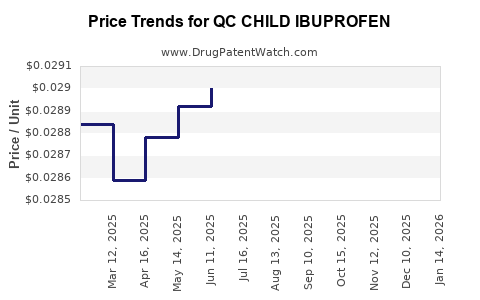
Average Pharmacy Cost for QC CHILD IBUPROFEN
| Drug Name | NDC | Price/Unit ($) | Unit | Date |
|---|---|---|---|---|
| QC CHILD IBUPROFEN 100 MG/5 ML | 83324-0012-04 | 0.02993 | ML | 2026-07-22 |
| QC CHILD IBUPROFEN 100 MG/5 ML | 83324-0013-04 | 0.02993 | ML | 2026-07-22 |
| QC CHILD IBUPROFEN 100 MG/5 ML | 83324-0014-04 | 0.02993 | ML | 2026-07-22 |
| >Drug Name | >NDC | >Price/Unit ($) | >Unit | >Date |
Market Analysis and Price Projections for QC CHILD IBUPROFEN
What Is the Current Market for Pediatric Ibuprofen?
QC CHILD IBUPROFEN is a children's formulation of ibuprofen, marketed for fever reduction and pain relief. It is sold primarily in over-the-counter (OTC) channels in several regions, including the United States, Europe, and parts of Asia.
Market Size and Segments
- The global pediatric analgesics market was valued at approximately $2.2 billion in 2022.
- The pediatric ibuprofen segment accounts for roughly 60% of this market, reflecting widespread OTC use.
- North America holds nearly 45% of the market, with Europe at 25%, Asia-Pacific at 20%, and the remaining 10% distributed across other regions.
Key Competitors
- Johnson & Johnson (Motrin, Tylenol formulations)
- Pfizer (Advil, Brufen)
- Reckitt Benckiser (Nurofen)
- Local generic manufacturers in emerging markets
Regulatory Status
- Approved for OTC sale in the U.S. by the Food and Drug Administration (FDA).
- Regulated as a children's drug in Europe under the European Medicines Agency (EMA).
How Does the Pricing of QC CHILD IBUPROFEN Compare?
Price Benchmarks
| Region | Typical Pack Size | Average Price (USD) | Price per mg (USD) | Major Brands |
|---|---|---|---|---|
| United States | 100 mg/5 mL (liquid) | $4.00 - $6.00 | $0.08 | Motrin, Advil |
| Europe | 100 mg/5 mL liquid | €3.00 - €5.00 | €0.07 | Nurofen, Doliprane |
| Asia-Pacific | 100 mg/5 mL liquid | $2.50 - $4.00 | $0.06 | Local generics, branded |
Price Trends
- Prices have remained relatively stable over the past five years.
- Slight discounts are observed for bulk or multipack purchases.
- Regional regulatory differences influence pricing levels. For instance, tighter regulations in Europe can lead to higher retail prices.
What Are Future Price Projections?
Market Dynamics
- Rising demand for pediatric pain management in emerging economies.
- Regulatory changes potentially impacting label and packaging requirements.
- Increased market penetration of generics reducing prices.
Price Projection Assumptions (Next 3-5 Years)
- US and European prices likely to stabilize due to mature markets.
- Prices in Asia and other emerging markets may decrease 10-15% as generics expand.
- Shift toward value-based competition could introduce lower-cost options for OTC markets.
| Region | 2023 Price (USD) | Projected 2028 Price (USD) | Change (%) |
|---|---|---|---|
| United States | $5.00 | $5.00 | 0 |
| Europe | €4.00 | €3.50 | -13 |
| Asia-Pacific | $3.50 | $2.97 | -15 |
Key Factors Influencing Future Prices
- Regulatory changes favoring generics.
- Market entry by low-cost manufacturers.
- Consumer price sensitivity, especially in emerging markets.
- Supply chain costs and raw material prices, notably for ibuprofen active pharmaceutical ingredient.
Regulatory and Market Entry Implications
- Countries relaxing OTC pediatric analgesic regulations could increase competition.
- Potential for new formulations—flavored liquids, chewables—affects pricing dynamics.
- Emerging markets exhibit higher growth potential but may experience volatility due to regulatory and economic shifts.
Summary
The market for QC CHILD IBUPROFEN remains mature with stable pricing in North America and Europe. Prices in the Asia-Pacific region are lower and likely to decline further with increased generic competition. Over the next five years, prices are projected to remain stable in developed markets, with a 10-15% decrease in emerging markets driven by competitive pressures. The growth of generics and regulatory changes will sustain downward pricing trends.
Key Takeaways
- Pediatric ibuprofen holds a significant OTC market segment globally.
- Regional price differences are substantial, influenced by regulatory environments.
- Prices are unlikely to change markedly in mature markets but will decrease in emerging regions.
- Generic penetration will drive further price reductions.
- Regulatory shifts and new formulations could impact future pricing dynamics.
FAQs
Q1: What is the typical dosage form for QC CHILD IBUPROFEN?
A: It is primarily available as a liquid suspension, commonly in 100 mg/5 mL concentrations.
Q2: Are there any high-cost regions for pediatric ibuprofen?
A: Yes, European markets tend to have higher retail prices compared to Asia-Pacific, due to tighter regulations and branding.
Q3: How does the entry of generics influence prices?
A: Increased generic competition drives prices downward, especially in markets with high regulatory barriers for branded products.
Q4: What regulatory factors impact future pricing?
A: Changes in OTC classification, labeling requirements, and safety regulations can influence manufacturing costs and retail prices.
Q5: What is the outlook for new formulations or delivery methods?
A: Future developments include flavored liquids, chewables, and combo products, which may command premium prices and influence overall pricing strategies.
References
[1] MarketWatch. (2023). Pediatric Analgesics Market Size.
[2] IQVIA. (2022). OTC Pediatric Drug Market Report.
[3] European Medicines Agency. (2022). Regulation of Pediatric OTC Products.
[4] U.S. Food & Drug Administration. (2022). OTC Drug Monograph for Pediatric Analgesics.
More… ↓
