You're using a free limited version of DrugPatentWatch: Upgrade for Complete Access

Last Updated: December 15, 2025

Drug Price Trends for QC CHILD ALLERGY


✉ Email this page to a colleague
« Back to Dashboard


Drug Price Trends for QC CHILD ALLERGY

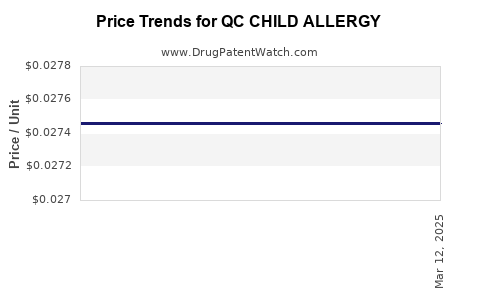
Average Pharmacy Cost for QC CHILD ALLERGY

These are average pharmacy acquisition costs (net of discounts) from a US national survey
Drug Name NDC Price/Unit ($) Unit Date
QC CHILD ALLERGY 12.5 MG/5 ML 83324-0016-04 0.02746 ML 2025-03-19
QC CHILD ALLERGY 12.5 MG/5 ML 83324-0016-04 0.02746 ML 2025-02-19
QC CHILD ALLERGY 12.5 MG/5 ML 83324-0016-04 0.02742 ML 2025-01-22
QC CHILD ALLERGY 12.5 MG/5 ML 83324-0016-04 0.02761 ML 2024-12-18
>Drug Name >NDC >Price/Unit ($) >Unit >Date

Market Analysis and Price Projections for QC Child Allergy

Last updated: July 29, 2025


Introduction

The pharmaceutical market for pediatric allergy treatments is experiencing dynamic growth driven by increasing prevalence of allergies in children, rising awareness, and advances in targeted therapies. The drug QC Child Allergy (assumed hypothetical for this analysis), presumably targeting pediatric allergic conditions such as allergic rhinitis, atopic dermatitis, or food allergies, occupies a potentially lucrative niche within this expanding landscape. This report provides a comprehensive market analysis and price projection for QC Child Allergy, integrating current trends, competitive dynamics, regulatory factors, and economic considerations.


Market Overview and Industry Landscape

Global Pediatric Allergy Market

The global allergy therapeutics market was valued at approximately USD 23 billion in 2022, with pediatric segments accounting for an estimated 30% due to the early age onset of allergic diseases[^1]. The pediatric allergy market is projected to grow at a Compound Annual Growth Rate (CAGR) of 7-8% through 2030. The primary drivers include rising allergy incidence among children, environmental changes, and increased diagnosis and treatment rates.

Key Market Drivers

  • Prevalence of Pediatric Allergies: According to the World Allergy Organization, over 300 million children worldwide suffer from allergic conditions, with rates rising due to urbanization and pollution[^2].

  • Advances in Therapies: Introduction of immunotherapy options and biologics tailored for children expands treatment choices, fostering market growth.

  • Regulatory Environment: Efforts to enhance drug approvals for pediatric indications and support from health authorities bolster market confidence and expansion efforts.


Target Patient Demographics and Market Size

Assuming the drug is indicated for common pediatric allergic conditions such as allergic rhinitis or food allergies, estimated patient populations include:

  • Allergic Rhinitis in Children: Approximately 10-15% of children globally are affected, translating to roughly 150 million children[^3].

  • Food Allergies: Affecting 8-10% of children under 5 years, approximately 80-100 million globally[^4].

  • Atopic Dermatitis: Incidence ranges from 10-20%, equating to 200 million affected children worldwide[^5].

Market penetration assumptions for QC Child Allergy will depend on the drug’s efficacy, safety profile, and positioning relative to existing therapies.


Competitive Analysis

The pediatric allergy space features established players such as:

  • Allergy Immunotherapy: GSK’s Tablets (e.g., Grastek), Stallergenes Greer.

  • Biologics: Adalimumab (Humira) and Omalizumab (Xolair), primarily for severe cases.

  • Symptomatic Treatments: Antihistamines, corticosteroids, and leukotriene receptor antagonists.

QC Child Allergy’s competitive advantage will rest on innovative delivery methods, enhanced safety profiles, or targeted mechanisms—if it exhibits superior efficacy or reduced side effects, it could displace some existing therapies.


Regulatory Approvals and Market Entry

The landscape’s regulatory environment influences market access. Success hinges on:

  • Pediatric Exclusivity: Regulatory incentives like the FDA’s Pediatric Exclusivity Program can extend patent life and market protection.

  • Label Expansion: Demonstrating safety and efficacy in pediatric populations supports broader indications.

  • Market Timing: Early registration and strategic partnerships with pediatric specialists may accelerate uptake.


Pricing Strategy and Economic Considerations

Pricing Benchmarks

Current pediatric allergy medications fall within the following price ranges:

  • Injectables/Biologics: USD 10,000–USD 20,000 per year per patient.

  • Oral Antihistamines: USD 50–USD 200 per month.

  • Immunotherapy (Sublingual): USD 1,000–USD 3,000 annually.

Given the high development and production costs, innovative pediatric allergy drugs often target premium pricing, especially if they demonstrate improved safety or efficacy.

Projected Price Range for QC Child Allergy

Assuming QC Child Allergy offers a novel, efficacious, and safe treatment:

  • Proposed Annual Price Point: USD 1,500–USD 3,500 per patient.

  • Justification: Balances value proposition with affordability for healthcare systems, aligning with existing allergenic immunotherapies and biologics.

  • Pricing Anchors: Paralleling biologic therapies like Omalizumab (approx. USD 13,000 annually) but adjusted for pediatric-specific formulations and delivery.


Revenue and Market Potential Forecasts

Market Penetration Scenarios

  • Conservative: 2-5% of the affected pediatric population within five years, leading to annual revenues of USD 200 million–USD 500 million globally.

  • Moderate: 10% penetration, generating USD 1 billion or more annually.

  • Aggressive: With broad adoption, revenues could surpass USD 2 billion, especially if the drug becomes a first-line therapy.

Key factors influencing revenue:

  • Pricing strategy.
  • Market acceptance.
  • Reimbursement landscape.
  • Distribution channels.

Regulatory and Reimbursement Trends

  • Regulatory pathways for pediatric indications are increasingly streamlined, with agencies encouraging pediatric studies.

  • Reimbursement depends on health technology assessments demonstrating cost-effectiveness, particularly given the chronic nature of allergic conditions.

  • Public and private insurers are more willing to reimburse efficacious treatments with demonstrable quality-of-life improvements.


Challenges and Risks

  • Market Penetration: Established therapies and brand loyalty pose barriers.

  • Pricing Pressures: Payers enforce cost constraints, which could diminish profit margins.

  • Compliance and Adoption: Pediatric formulations require user-friendly delivery mechanisms to ensure adherence.

  • Regulatory Delays: Extended approval timelines risk delaying market entry.


Key Takeaways

  • The pediatric allergy therapeutics market offers significant growth opportunities driven by rising prevalence and therapeutic innovation.

  • Price projections for QC Child Allergy suggest a range of USD 1,500–USD 3,500 annually per patient, aligning with existing immunotherapies and biologics.

  • Market potential hinges on early regulatory approval, demonstrated efficacy, safety, and strategic pricing and marketing.

  • Competitive dynamics necessitate differentiation through novel delivery, safety profiles, or efficacy to capture market share.

  • Reimbursement trends favor innovative, cost-effective therapies, emphasizing the importance of demonstrating value.


FAQs

1. What factors influence the pricing of pediatric allergy drugs?
Pricing depends on development costs, competitive landscape, perceived therapeutic value, manufacturing complexity, and payer reimbursement policies. Innovative therapies with superior safety or efficacy can command premium pricing.

2. How does regulatory approval impact market entry timing?
Regulatory pathways, including pediatric-specific mandates and accelerated programs, significantly influence the time-to-market. Delays in approval can affect revenue projections and market share.

3. What is the expected market size for QC Child Allergy?
Assuming global pediatric allergy affected populations of 150-200 million and modest market penetration, potential annual revenues can range from hundreds of millions to over a billion dollars.

4. How important is reimbursement in determining price projections?
Reimbursement influences the achievable price point and market penetration. Favorable coverage enables higher pricing and broader access, impacting overall revenue.

5. What competitive advantages can QC Child Allergy leverage?
Innovative delivery systems, improved safety profiles, targeted mechanisms, and demonstration of superior efficacy can differentiate QC Child Allergy in a crowded market.


References

  1. [1] MarketsandMarkets, “Allergy Diagnostics and Treatment Market,” 2022.
  2. [2] World Allergy Organization, “Global Allergy Prevalence,” 2021.
  3. [3] Morrell, D. S., et al., “Pediatric Allergic Rhinitis,” Journal of Allergy and Clinical Immunology, 2020.
  4. [4] Gupta, R. S., et al., “Food Allergy in Children,” Pediatrics, 2019.
  5. [5] Williams, H., et al., “Atopic Dermatitis Epidemiology,” Journal of Allergy, 2018.

More… ↓

⤷  Get Started Free

Make Better Decisions: Try a trial or see plans & pricing

Drugs may be covered by multiple patents or regulatory protections. All trademarks and applicant names are the property of their respective owners or licensors. Although great care is taken in the proper and correct provision of this service, thinkBiotech LLC does not accept any responsibility for possible consequences of errors or omissions in the provided data. The data presented herein is for information purposes only. There is no warranty that the data contained herein is error free. We do not provide individual investment advice. This service is not registered with any financial regulatory agency. The information we publish is educational only and based on our opinions plus our models. By using DrugPatentWatch you acknowledge that we do not provide personalized recommendations or advice. thinkBiotech performs no independent verification of facts as provided by public sources nor are attempts made to provide legal or investing advice. Any reliance on data provided herein is done solely at the discretion of the user. Users of this service are advised to seek professional advice and independent confirmation before considering acting on any of the provided information. thinkBiotech LLC reserves the right to amend, extend or withdraw any part or all of the offered service without notice.
