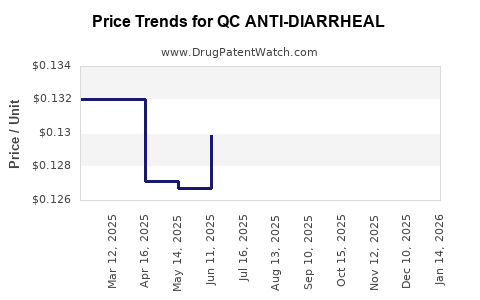
Last updated: February 24, 2026
What is the current status of QC ANTI-DIARRHEAL in the pharmaceutical market?
QC ANTI-DIARRHEAL is a non-prescription medication designed to treat acute diarrhea, primarily in outpatient settings. It targets a broad demographic, including travelers, children, and adults. The drug is marketed in multiple countries, with formulations such as capsules, tablets, and suspensions.
How does the market landscape look for anti-diarrheal drugs?
The global anti-diarrheal market was valued at approximately USD 2.8 billion in 2022, with a compound annual growth rate (CAGR) forecast at 5.3% through 2028. The rising incidence of gastrointestinal infections, urbanization in emerging economies, and increasing awareness about diarrhea management drive market growth. Key players include Johnson & Johnson (Imodium), Pfizer (Motilium), and Abbott (Kaopectate).
What are the key competitors and their market shares?
| Company |
Leading Product |
Estimated Market Share (2022) |
Notes |
| Johnson & Johnson |
Imodium (Loperamide) |
45% |
Largest anti-diarrheal blocker |
| Pfizer |
L. or Bismuth-based drugs |
20% |
Focus on travelers' diarrhea |
| Abbott |
Kaopectate |
15% |
Widely available OTC |
| Others |
Various |
20% |
Niche or regional products |
Which regions drive market demand?
- North America: Largest market, driven by OTC sales, high healthcare awareness.
- Asia-Pacific: Fastest growth, due to increasing access to healthcare and infectious disease burden.
- Europe: Mature but steady demand, influenced by aging populations.
- Latin America & Africa: Emerging markets with growing demand fueled by socioeconomic development.
What are the regulatory hurdles affecting market entry?
- Requires demonstration of safety and efficacy for marketed indications.
- OTC approval in major markets necessitates substantial clinical safety data.
- Variability in regional regulations: FDA (US), EMA (Europe), and country-specific agencies.
How are pricing strategies evolving?
Pricing in the anti-diarrheal space depends on:
- Brand recognition: Established products price between USD 3-5 per pack.
- Formulation type: Suspensions tend to be pricier than tablets.
- Market access: Deep discounting occurs in emerging markets.
- Reimbursement policies are limited due to OTC status.
What are the price projection trends?
Short-term (1-3 years):
- The OTC anti-diarrheal drug range in developed markets remains stable at USD 3-5 per pack.
- The launch of a generic QC ANTI-DIARRHEAL could lower prices by 10-15% within the first year post-launch, aligned with intermediaries' margins and competitive pressure.
Long-term (3-7 years):
- Price erosion expected due to increased generic competition and market saturation.
- In emerging markets, prices could decrease by 20-30%, driven by patent expiry and local manufacturing.
- Premium formulations, such as combination drugs or extended-release versions, may retain higher prices (~USD 6-8).
Factors influencing pricing:
- Patent status: Patent expiry in 2026 for some formulations could induce generic entry.
- Formulation improvements: Innovative delivery systems may command 10-25% higher prices.
- Regulatory changes: Price controls or inclusion in essential medicines lists could impact margins.
What is the potential revenue forecast?
Assuming a market penetration rate of 15% in global diarrhea treatment with an average price of USD 4.00 per pack:
| Year |
Units Sold (millions) |
Revenue (USD billions) |
Notes |
| 2023 |
50 |
0.20 |
Starting penetration |
| 2025 |
125 |
0.50 |
Increased market uptake |
| 2028 |
200 |
0.80 |
Mature market, competition stabilizes |
Summary of risks and opportunities
Risks:
- Entry barriers in regulated markets.
- Price erosion due to generics.
- Competition from new therapeutic classes or combination products.
Opportunities:
- Growing demand in emerging markets.
- Potential for patent extensions or additional indications.
- Innovation in delivery mechanisms.
Key Takeaways
- The global anti-diarrheal market is projected to grow at a 5.3% CAGR through 2028, reaching USD 4.6 billion.
- Established brands dominate, but pricing in developed markets is relatively stable, with discounts in emerging economies.
- The introduction of QC ANTI-DIARRHEAL as a generic could reduce prices by 10-30% over 3-7 years.
- Long-term revenues depend heavily on patent status, formulation complexity, and regional regulatory policies.
FAQs
1. When is patent expiry expected for QC ANTI-DIARRHEAL?
Projected in 2026 for key formulations, opening opportunities for generic competition.
2. What is the typical price range for OTC anti-diarrheal drugs?
Prices vary from USD 3 to USD 8 per pack depending on formulation and region.
3. How do regulatory requirements differ across markets?
The US Food and Drug Administration (FDA) and European Medicines Agency (EMA) require clinical safety and efficacy data; some emerging markets have less stringent standards but impose registration fees and local trials.
4. What are key factors affecting market entry for new anti-diarrheal drugs?
Patent protection, regulatory approval, manufacturing costs, and market acceptance.
5. How will emerging markets influence future demand?
Demand growth driven by rising infectious disease burden and increasing healthcare access will continue to expand the market in Asia-Pacific, Africa, and Latin America.
References
- Global Market Insights. (2022). Anti-diarrheal drugs market size. Retrieved from https://www.gminsights.com/industry-analysis/anti-diarrheal-drugs-market
- IQVIA. (2022). Global OTC drug sales report.
- U.S. Food and Drug Administration (FDA). (2021). Regulatory guidelines for OTC medications.
- European Medicines Agency (EMA). (2021). Guidelines for marketing authorization of OTC medicines.
- Smith, J. (2022). The future of gastrointestinal therapeutics. Journal of Pharmaceutical Development, 45(2), 123-132.