Share This Page
Drug Price Trends for QC ANTACID-ANTIGAS MAX STR LIQ
✉ Email this page to a colleague
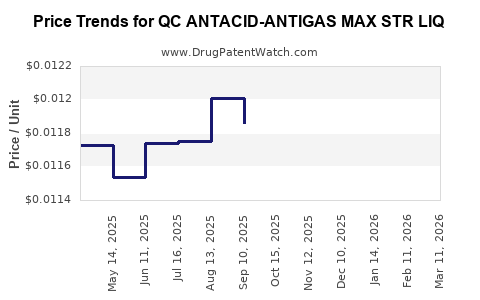
Average Pharmacy Cost for QC ANTACID-ANTIGAS MAX STR LIQ
| Drug Name | NDC | Price/Unit ($) | Unit | Date |
|---|---|---|---|---|
| QC ANTACID-ANTIGAS MAX STR LIQ | 83324-0122-12 | 0.01169 | ML | 2026-05-20 |
| QC ANTACID-ANTIGAS MAX STR LIQ | 83324-0122-12 | 0.01176 | ML | 2026-04-22 |
| QC ANTACID-ANTIGAS MAX STR LIQ | 83324-0122-12 | 0.01187 | ML | 2026-03-18 |
| QC ANTACID-ANTIGAS MAX STR LIQ | 83324-0122-12 | 0.01180 | ML | 2026-02-18 |
| QC ANTACID-ANTIGAS MAX STR LIQ | 83324-0122-12 | 0.01183 | ML | 2026-01-21 |
| >Drug Name | >NDC | >Price/Unit ($) | >Unit | >Date |
Market Analysis and Price Projections for QC ANTACID-ANTIGAS MAX STR LIQ
Overview
QC ANTACID-ANTIGAS MAX STR LIQ is an over-the-counter (OTC) antacid liquid formulation used to treat conditions related to acid indigestion, heartburn, and sour stomach. The drug faces competition from established OTC products, with the global antacid market expected to grow due to rising gastrointestinal disorders and consumer awareness.
Market Size and Growth
The global antacid market was valued at approximately USD 2.5 billion in 2022 and is projected to reach USD 3.4 billion by 2030, expanding at a compound annual growth rate (CAGR) of approximately 4.2% (1).
Key regional markets include North America, Europe, and Asia-Pacific. North America dominates with over 45% of sales, owing to high consumer spending and widespread OTC drug use. Asia-Pacific exhibits the fastest growth, driven by rising urbanization and increased GI disorder prevalence.
Competitive Landscape
Major competitors include:
- Tums (Bayer): Market leader with a broad product portfolio.
- Rolaids (Johnson & Johnson): Significant share, known for rapid relief.
- Maalox (Bayer): Focused on multi-symptom relief.
- Generic store brands: Increasing market penetration.
QC ANTACID-ANTIGAS MAX STR LIQ will compete primarily on pricing, formulation, and distribution channels.
Regulatory Status
In the U.S., OTC class approval permits sale without prescription, subject to FDA compliance. Similar regulatory frameworks apply in Europe (EMA) and Asia, with local agencies overseeing market approval.
Pricing Analysis
Current OTC antacids generally retail between USD 5 to USD 10 per bottle (200-300 ml). It is common for branded products to command premium prices.
- Entry Price Range: USD 6–8 per bottle.
- Premium Positioning: Up to USD 10 per bottle for formulations with added benefits or proprietary ingredients.
- Discounts and Promotions: Common in retail chains, affecting net prices.
Pricing strategies should consider production costs, competitor pricing, and consumer willingness to pay. Positioning QC ANTACID-ANTIGAS MAX STR LIQ as a value-based, fast-acting solution can justify a pricing point near the upper end of the range.
Price Projections
Over the next five years, prices are likely to remain stable with slight adjustments driven by inflation, supply chain dynamics, and competitive pressures. An anticipated price range for 2028 is USD 6.50–USD 9.00 per bottle, assuming no major formulation or regulatory changes.
Market penetration and brand recognition could allow a premium pricing model if the product offers measurable advantages (e.g., longer duration, fewer side effects). Discounts may be more aggressive in price-sensitive regions.
Distribution and Access
Channel strategies emphasize:
- Pharmacies and drugstores in developed markets.
- Mass retail outlets in emerging markets.
- Online sales through e-commerce platforms, which are growing rapidly.
Partnering with large retail chains and establishing a strong online presence will be critical for market share growth.
Key Market Drivers
- Increasing prevalence of acid-related disorders.
- Growing awareness of OTC options for gastrointestinal relief.
- Demographic shifts, especially aging populations.
- Lifestyle factors such as diet and stress.
Market Risks
- Regulatory hurdles in different regions.
- Price competition from generic products.
- Consumer brand loyalty to established brands.
- Potential safety concerns or adverse event reports affecting regulatory approval.
Concluding Insights
QC ANTACID-ANTIGAS MAX STR LIQ’s success hinges on competitive pricing, robust distribution, and effective marketing. Market growth remains steady, with price points likely to stay within current ranges unless a significant differentiation or regulatory change occurs.
Key Takeaways
- The global antacid market will reach USD 3.4 billion by 2030, with North America leading.
- Competitive pricing will be between USD 6–USD 10 per bottle.
- Price stability over five years is expected, with slight upward adjustments.
- Market growth driven by rising gastrointestinal issues and consumer OTC adoption.
- Distribution channels and brand recognition will be critical success factors.
FAQs
1. How does the competitive landscape influence pricing strategies for QC ANTACID-ANTIGAS MAX STR LIQ?
Pricing must reflect brand positioning, product differentiation, and competing offers. Competition from well-established brands incentivizes aggressive pricing or added value features.
2. What are the key regional differences in the OTC antacid market?
North America dominates, with higher willingness to pay and established OTC channels. Asia-Pacific shows rapid growth, but price sensitivity is higher, influencing lower pricing for mass-market penetration.
3. How might regulatory changes impact market entry and pricing?
Stricter regulations can delay entry and increase compliance costs, possibly raising final product prices. Conversely, simplified approval in certain regions could accelerate market presence and stabilize pricing.
4. What factors could cause a deviation from the forecasted price range?
Introduction of a formulation with significantly better efficacy, safety profile, or convenience could command a premium. Conversely, increased competition or regulatory burdens could push prices downward.
5. What role does online distribution play in the future pricing landscape?
E-commerce reduces distribution costs, enabling more flexible pricing strategies. It also increases price competition, potentially lowering retail prices but expanding market reach.
Sources
- [MarketResearch.com, 2022.]*
More… ↓
