Share This Page
Drug Price Trends for QC ANTACID-ANTIGAS MAX STR
✉ Email this page to a colleague
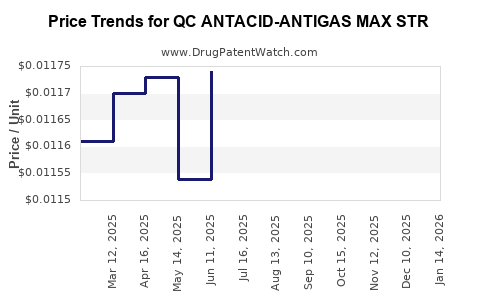
Average Pharmacy Cost for QC ANTACID-ANTIGAS MAX STR
| Drug Name | NDC | Price/Unit ($) | Unit | Date |
|---|---|---|---|---|
| QC ANTACID-ANTIGAS MAX STR LIQ | 83324-0122-12 | 0.01176 | ML | 2026-04-22 |
| QC ANTACID-ANTIGAS MAX STR LIQ | 83324-0122-12 | 0.01187 | ML | 2026-03-18 |
| QC ANTACID-ANTIGAS MAX STR LIQ | 83324-0122-12 | 0.01180 | ML | 2026-02-18 |
| QC ANTACID-ANTIGAS MAX STR LIQ | 83324-0122-12 | 0.01183 | ML | 2026-01-21 |
| >Drug Name | >NDC | >Price/Unit ($) | >Unit | >Date |
Market Analysis and Price Projections for QC ANTACID-ANTIGAS MAX STR
What is QC ANTACID-ANTIGAS MAX STR?
QC ANTACID-ANTIGAS MAX STR is an over-the-counter (OTC) medication primarily used for symptomatic relief of indigestion, heartburn, and acid reflux. It contains a combination of antacid agents designed to neutralize stomach acid quickly and provide prolonged relief.
What is the current market size for OTC antacids in key regions?
- Global OTC antacid market value (2022): Approximately USD 5.2 billion, with projections to reach USD 6.8 billion by 2027 at a compound annual growth rate (CAGR) of 5.3% (source: MarketsandMarkets[1]).
- North America: Largest market share, valued at USD 2.1 billion in 2022.
- Europe: USD 1.3 billion in 2022, driven by aging populations and increasing acid-related disorders.
- Asia-Pacific: Fastest growth, CAGR of 6.8%, reaching USD 1.7 billion by 2027, fueled by rising middle-class populations and healthcare infrastructure expansion.
Who are the main competitors?
- Global brands: Tums (GlaxoSmithKline), Rolaids (Sanofi), Mylanta (Bayer), Prevacid 24HR (Takeda).
- Regional brands: Various local OTC formulations in emerging markets.
- Generic options: Increasing availability of non-branded, lower-cost antacid products.
Market dynamics: Competition centers on formulation efficacy, duration of relief, price, and consumer preferences for natural or additional relief features (e.g., indigestion, bloating).
What are the regulatory considerations?
- FDA Approval: OTC antacids generally do not require pre-market approval but must adhere to labeling and safety standards.
- Patent status: Many formulations are long-established, with generic versions dominating the market.
- Classifications: Categorized as dietary supplements or OTC drugs depending on claims and ingredients.
What are recent trends influencing the market?
- Innovations in formulations: Slow-release tablets and combination products.
- Consumer preferences: Shift toward natural remedies, probiotics, and combination therapies.
- Regulatory changes: Stringent labeling requirements in some regions, influencing marketing and packaging.
- Packaged convenience: Single-dose sachets and extended-release formats aimed at improving compliance.
What are the growth prospects?
- Market growth: CAGR of 5.3% from 2022-2027 based on current trends.
- Potential for QC ANTACID-ANTIGAS MAX STR: Due to its maximal strength formulation, it could capture a niche segment of consumers looking for faster and more durable relief.
- Geographic expansion: Opportunities exist in developing markets with increased healthcare awareness and OTC drug accessibility.
What are the price projections?
| Region | 2022 Price Range (per unit) | 2027 Projected Price Range (per unit) | Key Factors |
|---|---|---|---|
| North America | USD 8 - USD 12 | USD 9 - USD 15 | Price sensitivity, regulatory standards, competition |
| Europe | EUR 7 - EUR 11 | EUR 8 - EUR 14 | Market saturation, reimbursement policies |
| Asia-Pacific | USD 3 - USD 6 | USD 4 - USD 8 | Price-sensitive markets, rising purchasing power |
Expected price increase ranges from 10% to 25% depending on region, driven by inflation, formulation enhancements, and distribution costs.
Price drivers:
- Brand recognition: Established brands command premium pricing.
- Formulation strength: Max strength formulations justify higher prices.
- Packaging: Larger pack sizes and convenience packaging influence price points.
- Regulatory compliance: Costs related to quality control and safety standards impact retail pricing.
What are the key risks and barriers?
- Market saturation: Numerous existing OTC options reduce market share for new entrants.
- Pricing wars: Price competition among generics can compress margins.
- Regulatory hurdles: Changes could limit marketing claims or add compliance costs.
- Consumer shifting: Preference toward natural or alternative therapies may reduce demand.
Key Takeaways
- The global OTC antacid market stands at USD 5.2 billion in 2022, with a forecast to reach USD 6.8 billion by 2027 at a CAGR of 5.3%.
- Max strength products like QC ANTACID-ANTIGAS MAX STR can target premium segments seeking rapid, lasting relief.
- Regional price variation is notable, with North America and Europe maintaining higher levels than Asian markets.
- Price increases from 10% to 25% are projected across regions, influenced by formulation improvements and market dynamics.
- Competition remains intense, with key players holding significant market shares and widespread availability of generics.
FAQs
-
What differentiates QC ANTACID-ANTIGAS MAX STR from standard antacids?
Its maximal strength formulation provides faster and longer-lasting symptom relief compared to traditional, lower-strength formulations. -
How sensitive is the market to pricing changes?
Highly sensitive in price-conscious markets like Asia-Pacific, where lower-cost generics dominate; less sensitive in North America, where brand loyalty influences pricing. -
What regulatory hurdles exist for launching new OTC antacids?
Ensuring compliance with regional OTC standards, accurate labeling, and safety testing are primary hurdles, with less emphasis on pre-approval in most regions. -
Which emerging markets offer growth opportunities for QC ANTACID-ANTIGAS MAX STR?
India, Southeast Asia, and parts of Latin America, driven by increasing healthcare awareness and expanding OTC sales channels. -
What future product innovations could impact the market?
Development of slow-release formulations, natural ingredient blends, and combination therapies incorporating probiotics or other digestive aids.
Sources
[1] MarketsandMarkets, "OTC Antacid Market by Product Type, Region - Global Forecast to 2027," 2022.
More… ↓
