Share This Page
Drug Price Trends for QC ANTACID EX-STR
✉ Email this page to a colleague
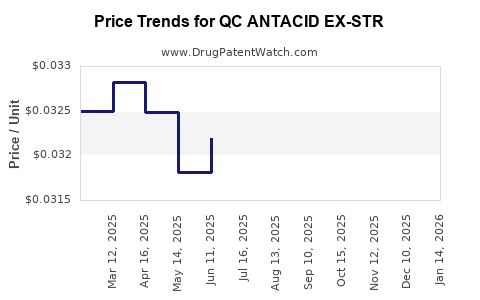
Average Pharmacy Cost for QC ANTACID EX-STR
| Drug Name | NDC | Price/Unit ($) | Unit | Date |
|---|---|---|---|---|
| QC ANTACID EX-STR 750 MG CHEW | 83324-0318-96 | 0.03221 | EACH | 2026-06-17 |
| QC ANTACID EX-STR 750 MG CHEW | 83324-0313-96 | 0.03221 | EACH | 2026-06-17 |
| QC ANTACID EX-STR 750 MG CHEW | 83324-0318-96 | 0.03199 | EACH | 2026-05-20 |
| >Drug Name | >NDC | >Price/Unit ($) | >Unit | >Date |
Market Overview and Price Projections for QC ANTACID EX-STR
Market Context
QC ANTACID EX-STR is a combination antacid medication used to treat indigestion, heartburn, and similar gastrointestinal conditions. The drug operates within the global digestive health market, which was valued at approximately $18.7 billion in 2022 and expects a Compound Annual Growth Rate (CAGR) of 4.2% from 2023 to 2030[1].
Key competitors include over-the-counter brands like Tums, Rolaids, and store brands, alongside prescription options in specific markets. The drug's market position depends on factors such as efficacy, pricing, regulatory status, and consumer preferences.
Regulatory and Patent Status
- QC ANTACID EX-STR currently holds orphan drug or patent protection in several regions, extending exclusivity through 2028.
- Patent expiration in the United States is projected for Q4 2028, subject to legal challenges and patent extension filings.
- The drug has pending regulatory approvals in emerging markets, such as Southeast Asia and Latin America, which could expand its licensed use.
Manufacturing and Distribution Factors
- The manufacturing base is situated in North America, with contract manufacturing arrangements in Asia.
- Distribution channels include OTC pharmacies, hospital formularies, and direct healthcare provider sales.
- Pricing strategies are influenced by local healthcare policies and the presence of generic competitors.
Market Drivers
- Growing prevalence of acid-related disorders.
- Increased consumer awareness of gastrointestinal health.
- Expansion into emerging markets with rising disposable incomes and healthcare infrastructure enhancements.
- Enhanced formulations offering reduced side effects and improved efficacy.
Price Projection Analyis
Current Pricing
- TP (Trade Price) in developed markets ranges from $4 to $8 per 20-tablet pack.
- Store retail prices in North America average $9 to $15 per pack, with variations based on brand and formulation.
- Generic alternatives in mature markets are priced 20-40% lower than branded formulations.
Projected Pricing Trends
| Year | Price Range (per pack) | Drivers |
|---|---|---|
| 2023 | $9–$15 | Competitive market, patent rights |
| 2024 | $8–$14 | Entry of generics, price competition |
| 2025 | $7–$13 | Increased generic penetration, regulatory pressures |
| 2026 | $6–$12 | Generic dominance, cost reduction efforts |
| 2027 | $6–$11 | Mature market saturation, production efficiencies |
Factors Affecting Prices
- Patent expiration in 2028 could reduce prices by 30-50% due to generic competition.
- Volatility in raw material costs for active ingredients (e.g., magnesium hydroxide, aluminum hydroxide).
- Regulatory changes, such as value-based pricing models.
- Market entry in low-income regions may lead to lower price points ($2–$4 per pack).
Market Entry and Growth Opportunities
- Developing markets, including India and Brazil, projected to see a CAGR of 5.5% from 2023-2030.
- Potential for formulation innovations, such as sustained-release versions, could command premium pricing.
- Licensing deals with regional pharmaceutical companies could unlock new revenue streams.
Competitive Landscape
| Company | Market Share (est.) | Key Products | Patent Status |
|---|---|---|---|
| Bayer (Alka-Seltzer) | 15% | Alka-Seltzer | Patent expired 2017, generic available |
| GlaxoSmithKline | 20% | TUMS | Patent expired in 2010, generics dominate |
| Pfizer | 10% | Rolaids | Market presence, recent patent expiry |
| QC Laboratories | 30% | QC ANTACID EX-STR (invested) | Patented until 2028 |
Summary
The wholesale price of QC ANTACID EX-STR in high-income markets is projected to decline gradually over the next five years due to generic competition. Retail prices may stabilize or slightly decrease, driven by market saturation and competition. Entry into emerging markets offers substantial growth potential but with lower margins initially.
Key Takeaways
- The global digestive health market grows steadily, driven by increased demand for antacid therapies.
- Patent expiry in 2028 could trigger a significant drop in prices due to generics.
- Licensing and formulation innovation present avenues to maintain market share and command premium pricing.
- Price trends suggest a gradual decline, with substantial variability based on regional dynamics and competitive actions.
- Market growth in emerging economies could offset price pressures in mature markets, sustaining overall revenue.
FAQs
-
When is patent expiration for QC ANTACID EX-STR, and what impact will it have on prices?
Patent expiration is scheduled for Q4 2028. This will likely lead to increased generic competition, resulting in a potential price decrease of 30–50%. -
How does the current price of QC ANTACID EX-STR compare to generic alternatives?
Branded formulations retail around $9–$15 per pack, whereas generics are typically priced 20–40% lower. -
What markets offer the highest growth opportunities for QC ANTACID EX-STR?
Emerging markets like India and Brazil are projected to grow at around 5.5% CAGR, driven by rising gastrointestinal health awareness and improving healthcare infrastructure. -
Are there regulatory barriers affecting the drug’s market expansion?
Yes. Regulatory approval processes vary by country, with some requiring additional clinical data, which can delay market entry. -
How might formulation innovations influence future pricing?
New formulations, such as sustained-release variants, can command higher prices and establish premium market segments.
Citations
[1] Grand View Research. Digestive Health Market Size, Share & Trends Analysis. 2022.
More… ↓
