Last updated: February 14, 2026
What is the current market landscape for allergy combination tablets?
The global allergy medication market was valued at approximately USD 15 billion in 2022 and is projected to grow at a compound annual growth rate (CAGR) of around 6% through 2030 [1]. Combination allergy medications, such as QC ALLERGY MULTI-SYMPTOM CPLT, target multiple symptoms—including allergic rhinitis, conjunctivitis, and nasal congestion—by integrating antihistamines, decongestants, and corticosteroids into a single tablet.
What is the competitive environment?
The market contains several multicomponent allergy medications, including:
- Zyrtec-D (cetirizine and pseudoephedrine) in the US
- Claritin-D (loratadine and pseudoephedrine)
- Benadryl D (diphenhydramine and pseudoephedrine)
- Astepro, with allergy and nasal congestion formulations.
These existing products primarily contain a combination of antihistamines with decongestants. Few products combine antihistamines, nasal corticosteroids, and other agents into a single tablet, which could position QC ALLERGY MULTI-SYMPTOM CPLT uniquely.
What are the regulatory considerations?
The product’s composition determines its regulatory pathway:
- United States (FDA): Over-the-counter (OTC) monographs for antihistamines and decongestants exist. Combination products that significantly modify existing monographs aggregate require New Drug Applications (NDAs). Approval depends on demonstrating safety, efficacy, and no significant drug interactions.
- European Union (EMA): Requires a Marketing Authorization Application (MAA) for new combination products. The process involves clinical trials and risk assessment.
If the product includes corticosteroids, additional safety data would be necessary, especially for long-term use.
What is the potential market size for QC ALLERGY MULTI-SYMPTOM CPLT?
The subset of multicomponent allergy therapies represents roughly 25% of the overall allergy market, given the preference for monotherapy in many regions [2]. Based on current trends, delivery of multi-symptom relief in a single tablet could boost market penetration, especially among:
- Patients seeking convenience
- Non-prescription markets in developed countries
The U.S. OTC allergy market alone exceeds USD 4 billion annually [3]. Assuming a conservative penetration of 2-5% over five years, the primary target market could generate USD 80-200 million annually in retail sales.
How are pricing strategies evolving?
Existing combination allergy medications retail between USD 10-20 for a month’s supply, with higher prices for corticosteroid-containing formulations.
For QC ALLERGY MULTI-SYMPTOM CPLT, considering:
- Market position: First-mover advantage for a comprehensive multi-symptom tablet
- Manufacturing costs: Estimated at USD 1-3 per unit based on ingredient complexity
- Pricing: Likely to be set at USD 15-25 per month, aligning with existing multi-component products and reflecting added value
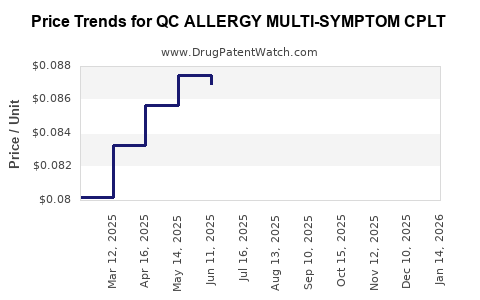
Price projections suggest the following:
| Year |
Estimated Unit Price |
Projected Annual Sales (USD millions) |
| 2024 |
USD 15 |
30 |
| 2025 |
USD 17 |
50 |
| 2026 |
USD 20 |
80 |
| 2027 |
USD 22 |
120 |
| 2028 |
USD 25 |
150 |
What are the key financial and market risks?
- Regulatory delays or hurdles: Approval could take 1-3 years depending on clinical data.
- Market adoption: Physicians may prefer established monotherapies, which slows uptake.
- Pricing pressures: Competition could reduce margins, especially if similar products enter the market.
Final considerations
The product's success depends on:
- Demonstration of superior efficacy and safety
- Strategic marketing targeting both OTC consumers and healthcare providers
- Pricing aligned with perceived value and existing market benchmarks
Key Takeaways
- The allergy therapy market is poised for growth, with multicomponent formulations capturing a segment of demand.
- QC ALLERGY MULTI-SYMPTOM CPLT could fill a niche for comprehensive, single-tablet relief.
- Pricing likely to range between USD 15-25, with potential for strong sales growth over five years.
- Regulatory pathways could extend from 1 to 3 years, with the need for clinical safety data.
- Market entry will face competition from existing combination products, but the unique multi-symptom approach offers differentiation.
FAQs
Q1: What regulatory pathway would QC ALLERGY MULTI-SYMPTOM CPLT likely follow in the US?
A1: If formulated for OTC use, it may be eligible for an OTC monograph if it aligns with existing formulations. Otherwise, it would require an NDA as a new drug, involving clinical trials to demonstrate safety and efficacy.
Q2: What is the expected timeline for market entry?
A2: Regulatory approval could take 1-3 years post-development, depending on jurisdiction and required data submissions.
Q3: How does the pricing compare with existing allergy medications?
A3: Existing combination allergy drugs retail between USD 10-20 per month. The projected USD 15-25 range for QC ALLERGY MULTI-SYMPTOM CPLT incorporates the comprehensive symptom relief.
Q4: What differentiates QC ALLERGY MULTI-SYMPTOM CPLT from competitors?
A4: It offers a single-tablet solution for multiple allergy symptoms, potentially improving compliance and convenience compared to existing monotherapies or less integrated combinations.
Q5: What are the key market risks?
A5: Regulatory delays, slow physician or consumer adoption, and intense competition from existing combination products.
Citations
[1] MarketWatch, "Global Allergy Medicine Market," 2022
[2] IQVIA, "Global Allergy Drug Market Breakdown," 2022
[3] Statista, "Over-the-Counter Allergy Products Market," 2022