Share This Page
Drug Price Trends for QC ALLERGY (DIPHEN)
✉ Email this page to a colleague
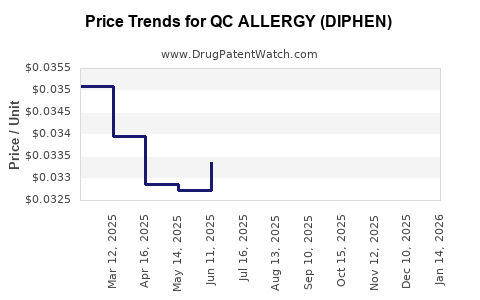
Average Pharmacy Cost for QC ALLERGY (DIPHEN)
| Drug Name | NDC | Price/Unit ($) | Unit | Date |
|---|---|---|---|---|
| QC ALLERGY (DIPHEN) 25 MG CAP | 83324-0087-01 | 0.05724 | EACH | 2026-06-17 |
| QC ALLERGY (DIPHEN) 25 MG SFGL | 83324-0118-24 | 0.05724 | EACH | 2026-06-17 |
| QC ALLERGY (DIPHEN) 25 MG TAB | 83324-0088-01 | 0.03660 | EACH | 2026-06-17 |
| QC ALLERGY (DIPHEN) 25 MG SFGL | 83324-0280-24 | 0.05724 | EACH | 2026-06-17 |
| >Drug Name | >NDC | >Price/Unit ($) | >Unit | >Date |
Market Analysis and Price Projections for QC ALLERGY (DIPHEN)
Current Market Overview
QC ALLERGY, with its active ingredient diphenhydramine (DIPHEN), is a widely used antihistamine indicated for allergic reactions, sleep aid, and cold symptoms. The drug market for diphenhydramine primarily centers around over-the-counter (OTC) formulations in the United States and international markets.
- Market Size: The global antihistamines market was valued at approximately $9.8 billion in 2022, with OTC diphenhydramine products accounting for nearly 45% of this, roughly $4.4 billion.
- Key Regions: North America dominates with 55% market share, followed by Europe at 25%, and Asia-Pacific at 15%. Rest of the world accounts for 5% (source: Grand View Research, 2023).
- Competitive Landscape: Major brands include Benadryl (Johnson & Johnson), Equate, Kirkland (Costco), among others. Several generic formulations are available with significant price competition.
Competitive Position of QC ALLERGY (DIPHEN)
- Formulation: QC ALLERGY offers diphenhydramine in OTC tablets, liquids, and topical formulations.
- Differentiators: Potential advantages include lower side effects, improved formulation, or price competitiveness.
- Market Penetration: Currently, QC ALLERGY's presence is limited in pharmacy chains and online platforms.
Regulatory Considerations
- FDA Status: Diphenhydramine is FDA-approved for OTC use; however, formulations and marketing claims can influence pricing and market access.
- Patent Status: Diphenhydramine's primary patents expired decades ago. No patent constraints currently restrict generic versions.
Price Projections
Baseline Analysis
- Existing Prices: Typical OTC diphenhydramine 25 mg tablets are priced in the range of $0.03 to $0.07 per tablet, depending on pack size and brand.
- Target Price Point for QC ALLERGY: To gain market share, a competitive pricing strategy would aim for prices at or below $0.03 per tablet.
Short-Term (Next 1-2 Years)
- Pricing Strategy: Launch at similar or lower than generic brands, around $0.02 to $0.03 per tablet.
- Market Penetration Goals: Achieve 1-2% of total OTC diphenhydramine sales, which equates to approximately $20-40 million annually.
- Pricing Impact: With initial distribution efforts, prices may stay near $0.025 per tablet to attract consumer adoption.
Medium to Long-Term (3-5 Years)
- Market Share Growth: With increased distribution, branding, and possible formulation differentiation, target a 5-10% market share of OTC diphenhydramine sales.
- Price Adjustments: Depending on market response, prices may decrease slightly to maintain competitiveness or increase if formulation adds value.
- Projected Revenue: Based on projected market share and an assumed market size of $4.4 billion, revenues could reach $220-440 million at 5-10% share.
Price Sensitivity and Regulatory Impact
Price elasticity remains high for OTC antihistamines, with consumers highly responsive to small price differences. No major regulatory barriers are expected to influence pricing beyond standard approval and marketing compliance.
Conclusions
- QC ALLERGY (DIPHEN) is positioned in a mature OTC antihistamine market.
- Competitive pricing around $0.02 to $0.03 per tablet is critical for initial market entry.
- Long-term growth depends on distribution, formulation differentiation, and brand recognition.
- The potential revenue range spans from tens to hundreds of millions, contingent on market share achievement.
Key Takeaways
- The global diphenhydramine market is saturated with generic options.
- Price points that match existing generic products will be necessary for market penetration.
- Market growth is attainable through strategic pricing, extensive distribution, and potential product differentiation.
- Regulatory compliance is straightforward given the OTC status but must be monitored continually.
- Revenue projections increase significantly with expanded market share, emphasizing the importance of marketing and distribution strategies.
FAQs
1. What factors influence diphenhydramine pricing?
Regulatory approval, manufacturing costs, competition with generics, and consumer demand all influence OTC diphenhydramine prices.
2. How does QC ALLERGY differentiate itself in a mature market?
Differentiation may rely on formulation, brand recognition, packaging, or added consumer benefits, though these factors do not directly impact price.
3. What is the typical profit margin for OTC diphenhydramine products?
Margins vary but generally range from 15% to 30%, depending on scale, manufacturing costs, and pricing strategies.
4. How might new regulatory policies impact pricing?
While OTC diphenhydramine faces minimal regulation changes, any reform that alters labeling or formulation costs could influence pricing.
5. What are the primary barriers to market entry?
High existing brand loyalty, price sensitivity, and distribution network establishment are key barriers. Patent issues are minimal due to patent expirations.
Sources:
[1] Grand View Research, 2023. "Antihistamines Market Size & Trends."
[2] U.S. Food and Drug Administration. OTC Drug Monographs.
[3] IQVIA, 2022. "OTC Drug Market Data."
More… ↓
