Share This Page
Drug Price Trends for QC ADULT TUSSIN CF LIQUID
✉ Email this page to a colleague
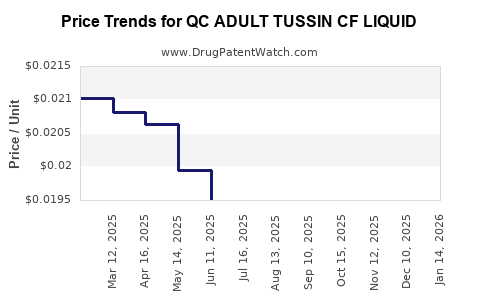
Average Pharmacy Cost for QC ADULT TUSSIN CF LIQUID
| Drug Name | NDC | Price/Unit ($) | Unit | Date |
|---|---|---|---|---|
| QC ADULT TUSSIN CF LIQUID | 83324-0155-04 | 0.02073 | ML | 2026-07-22 |
| QC ADULT TUSSIN CF LIQUID | 83324-0155-04 | 0.02070 | ML | 2026-06-17 |
| QC ADULT TUSSIN CF LIQUID | 83324-0155-04 | 0.02085 | ML | 2026-05-20 |
| QC ADULT TUSSIN CF LIQUID | 83324-0155-04 | 0.02096 | ML | 2026-04-22 |
| >Drug Name | >NDC | >Price/Unit ($) | >Unit | >Date |
QC ADULT TUSSIN CF LIQUID: Market Analysis and Price Projections
This analysis examines the market landscape, competitive positioning, and projected pricing for QC Adult Tussin CF Liquid. The product is a multi-symptom cough and cold remedy containing guaifenesin, dextromethorphan hydrobromide, and phenylephrine hydrochloride. The market is characterized by established over-the-counter (OTC) competitors, evolving consumer preferences for ingredient transparency, and regulatory considerations.
What is the current market size and growth trajectory for cough and cold remedies?
The global cough and cold remedies market was valued at approximately USD 25.6 billion in 2022 [1]. Projections indicate a compound annual growth rate (CAGR) of 3.5% from 2023 to 2030, reaching an estimated USD 34.3 billion by 2030 [1]. This growth is driven by factors including an aging global population, increasing prevalence of respiratory illnesses, and the rising incidence of common colds and seasonal allergies [2]. The North American segment holds a significant market share, estimated at 30% of the global market in 2022 [1].
Factors Influencing Market Growth:
- Aging Demographics: Older adults are more susceptible to respiratory conditions, increasing demand for symptom relief.
- Seasonal Fluctuations: Annual influenza seasons and the prevalence of the common cold directly correlate with demand spikes.
- Increased Air Pollution: Environmental factors contributing to respiratory distress elevate the need for cough and cold medications.
- Consumer Demand for Combination Products: Patients often seek single-dose solutions for multiple symptoms, favoring multi-symptom formulations like QC Adult Tussin CF Liquid.
Who are the key competitors for QC Adult Tussin CF Liquid?
QC Adult Tussin CF Liquid competes within the crowded OTC cough and cold segment. Its primary competitors include established brands offering similar multi-symptom formulations.
Major Competitive Brands:
- Vicks VapoRub/DayQuil/NyQuil (Procter & Gamble): These brands offer a broad range of cough, cold, and flu products, including multi-symptom relief. Vicks DayQuil/NyQuil Severe Cold & Flu Liquid is a direct competitor, often containing similar active ingredients.
- Robitussin (Pfizer): Robitussin DM Max (guaifenesin and dextromethorphan) and Robitussin Cold+Flu Multi-Symptom are prominent competitors.
- Mucinex (Reckitt Benckiser): While primarily known for guaifenesin-based expectorants, Mucinex also offers multi-symptom cold and flu relief products.
- Theraflu (GlaxoSmithKline): Theraflu products, often powder-based, target cold and flu symptoms with various combinations of active ingredients.
- Store Brands: Private label offerings from major retailers (e.g., CVS, Walgreens, Walmart) represent significant competition, often priced lower than national brands.
Competitive Landscape Analysis:
QC Adult Tussin CF Liquid's competitive advantage will depend on its pricing strategy, brand recognition within its target demographic, and the effectiveness and perceived safety of its ingredient profile. The presence of phenylephrine hydrochloride, a decongestant, positions it against products targeting nasal congestion, alongside cough relief from dextromethorphan and expectorant action from guaifenesin.
What is the proposed pricing strategy and projected price range for QC Adult Tussin CF Liquid?
The pricing of OTC medications is influenced by ingredient costs, manufacturing overhead, marketing expenses, competitive pricing, and perceived value. Based on current market data for comparable multi-symptom cough and cold liquids, QC Adult Tussin CF Liquid can be projected to fall within the following range.
Ingredient Cost Analysis (Estimated per unit of 12 fl oz):
- Guaifenesin: $0.50 - $1.50
- Dextromethorphan Hydrobromide: $1.00 - $2.50
- Phenylephrine Hydrochloride: $0.75 - $1.75
- Excipients, Flavoring, Sweeteners: $0.20 - $0.60
- Packaging (Bottle, Cap, Label): $0.30 - $0.80
Estimated Variable Cost per 12 fl oz bottle: $2.75 - $7.15
Manufacturing and Distribution Costs:
These costs are highly variable and depend on scale, location, and supply chain efficiency. They can add an estimated 15-30% to the variable cost.
- *Estimated Manufacturing & Distribution Cost per 12 fl oz bottle: $3.16 - $9.30
Competitive Pricing Benchmarking (12 fl oz Equivalent):
- National Brand Multi-Symptom Liquids: $8.99 - $15.99
- Store Brand Multi-Symptom Liquids: $6.99 - $10.99
Projected Retail Price Range for QC Adult Tussin CF Liquid:
Considering ingredient costs, manufacturing, distribution, and competitive benchmarks, QC Adult Tussin CF Liquid is projected to be priced between $8.50 and $13.50 for a standard 12 fluid ounce bottle.
Pricing Tiers:
- Introductory/Value Tier: $8.50 - $9.99. This strategy would position QC Adult Tussin CF Liquid as a competitive, value-oriented option against national brands and comparable to or slightly above premium store brands.
- Standard/Competitive Tier: $10.00 - $12.50. This range aligns with the pricing of many established national brand multi-symptom cold and flu liquids.
- Premium Tier (Less Likely without significant brand equity): $12.50 - $13.50. This would require demonstrated superior efficacy, unique formulation benefits, or strong brand loyalty.
The choice of pricing tier will depend on the company's overall brand strategy, target consumer segment, and marketing investment. A value-oriented approach could capture market share from budget-conscious consumers, while a competitive pricing strategy would aim for parity with leading brands.
What are the potential revenue projections based on market share assumptions?
Revenue projections are contingent upon market penetration and sales volume. Assuming a successful launch and consistent market share acquisition, revenue can be estimated.
Market Share Assumptions:
- Conservative (1-2% of US OTC Cough & Cold Market): Given the size of the US OTC cough and cold market (estimated at over $10 billion annually), this represents a significant revenue stream.
- Moderate (3-5% of US OTC Cough & Cold Market): Achievable with effective marketing and distribution.
- Aggressive (6-10% of US OTC Cough & Cold Market): Requires substantial investment, strong product differentiation, and rapid market acceptance.
Revenue Projection Scenarios (Annual, US Market):
Using an average projected retail price of $11.00 per 12 fl oz bottle and estimating annual unit sales based on market share:
-
Conservative Scenario (1.5% Market Share):
- Total US Market Value: ~$10 Billion
- Target Market Value: $150 Million
- Units Sold (at $11.00/unit): ~13.6 Million units
- Projected Revenue: ~$150 Million
-
Moderate Scenario (4% Market Share):
- Target Market Value: $400 Million
- Units Sold (at $11.00/unit): ~36.4 Million units
- Projected Revenue: ~$400 Million
-
Aggressive Scenario (8% Market Share):
- Target Market Value: $800 Million
- Units Sold (at $11.00/unit): ~72.7 Million units
- Projected Revenue: ~$800 Million
These projections do not account for channel markups (distributor, retailer margins), which will reduce net revenue for the manufacturer. The gross margin will be a critical factor in determining profitability at these revenue levels.
What are the regulatory and patent considerations for QC Adult Tussin CF Liquid?
The regulatory landscape for OTC drugs is governed by agencies like the U.S. Food and Drug Administration (FDA). Patent considerations are crucial for market exclusivity and competitive advantage.
Regulatory Overview (US):
- FDA Oversight: QC Adult Tussin CF Liquid, containing established APIs, falls under the FDA's purview for Over-the-Counter (OTC) drug products.
- Monograph System: The active ingredients (guaifenesin, dextromethorphan HBr, phenylephrine HCl) are generally recognized as safe and effective (GRASE) for their intended uses under existing FDA monographs for cough and cold remedies. This simplifies the approval process compared to new molecular entities.
- Labeling Requirements: Strict adherence to FDA labeling regulations is mandatory, including accurate ingredient disclosure, dosage instructions, warnings, and indications.
- Manufacturing Standards: Compliance with Current Good Manufacturing Practices (cGMP) is essential for all drug manufacturing facilities.
Patent Landscape:
- Active Pharmaceutical Ingredients (APIs): The individual APIs (guaifenesin, dextromethorphan HBr, phenylephrine HCl) are long off-patent. Generic production of these individual compounds is widespread.
- Formulation Patents: While the individual APIs are generic, novel formulations, delivery systems, or combinations that offer a unique advantage could be patentable. However, a standard combination of these three APIs is unlikely to be novel enough for a strong formulation patent.
- Manufacturing Process Patents: Specific, innovative manufacturing processes for producing or combining these ingredients might be patentable, offering some protection.
- Exclusivity: Without novel patent protection on the formulation or a significant aspect of the product, market exclusivity will be limited. Competition from generic manufacturers and private label brands is expected.
Implication: The absence of strong, novel patent protection for the specific combination or formulation of QC Adult Tussin CF Liquid means that market competition will primarily be driven by cost, branding, and distribution, rather than patent-derived market exclusivity. This reinforces the importance of a competitive pricing strategy and effective market differentiation.
What are the key factors influencing consumer purchasing decisions in this market segment?
Consumer decisions for OTC cough and cold remedies are multi-faceted, driven by efficacy, price, brand trust, and convenience.
Primary Purchasing Drivers:
- Efficacy: Consumers prioritize products that effectively alleviate their specific symptoms. For a multi-symptom product like QC Adult Tussin CF Liquid, clear communication of its benefits for cough, congestion, and mucus is critical.
- Price: OTC medications are often sensitive to price, especially for common ailments. Value for money is a significant consideration, leading many consumers to opt for store brands or promotions.
- Brand Trust and Familiarity: Established brands often benefit from consumer trust built over years through consistent product performance and marketing. Brand recognition can be a powerful differentiator.
- Ingredient Transparency and Safety: Growing consumer awareness regarding ingredients and potential side effects influences choices. Clear, understandable ingredient lists and prominent safety warnings are important.
- Format and Ease of Use: Liquid formulations are preferred by some demographics (e.g., children, elderly) or for specific symptoms requiring rapid onset. Ease of administration and taste are also considerations.
- Recommendation: Pharmacist recommendations and physician advice, though less frequent for OTC products, can influence purchasing.
Impact on QC Adult Tussin CF Liquid:
- Demonstrating Efficacy: Clinical data or strong anecdotal evidence will be crucial to support claims of effectiveness.
- Strategic Pricing: A competitive price point, especially relative to national brands with similar ingredients, will be essential.
- Building Brand Awareness: A robust marketing strategy will be required to build recognition and trust.
- Clear Labeling: Transparent and easy-to-understand labeling about the active ingredients and their benefits will resonate with health-conscious consumers.
Key Takeaways
- The global cough and cold remedies market is substantial and projected for steady growth, with North America as a key region.
- QC Adult Tussin CF Liquid faces intense competition from established national brands and cost-effective private labels.
- A projected retail price range of $8.50 to $13.50 for a 12 fl oz bottle is anticipated, with pricing strategy critical for market penetration.
- Revenue projections range from $150 million to $800 million annually, contingent on market share acquisition.
- The product's active ingredients are off-patent, limiting patent-derived market exclusivity and emphasizing competition on price and brand.
- Consumer purchasing decisions are primarily driven by efficacy, price, brand trust, and ingredient transparency.
Frequently Asked Questions
-
What is the primary indication for QC Adult Tussin CF Liquid? QC Adult Tussin CF Liquid is indicated for the temporary relief of cough, nasal congestion, and to loosen mucus (phlegm) associated with the common cold, flu, or other breathing irritations.
-
Are the active ingredients in QC Adult Tussin CF Liquid generally recognized as safe and effective by regulatory bodies? Yes, guaifenesin, dextromethorphan hydrobromide, and phenylephrine hydrochloride are active ingredients that have been reviewed and are generally recognized as safe and effective (GRASE) by the U.S. Food and Drug Administration (FDA) for specific OTC uses when formulated and labeled according to established monographs.
-
What is the typical shelf life for OTC liquid cough and cold medications like QC Adult Tussin CF Liquid? The typical shelf life for OTC liquid cough and cold medications is generally between two and three years when stored at room temperature, away from direct sunlight and heat. Specific expiration dates are determined by stability testing and are printed on the product packaging.
-
Does QC Adult Tussin CF Liquid contain any allergens or artificial sweeteners? Information regarding specific allergens (e.g., gluten, soy, nuts) and artificial sweeteners (e.g., aspartame, sucralose) would be detailed on the product's packaging and accompanying information leaflet. Manufacturers are required to disclose significant allergens and other potentially problematic ingredients.
-
How does QC Adult Tussin CF Liquid compare to other multi-symptom cold and flu medications in terms of active ingredient ratios? The precise ratios of guaifenesin, dextromethorphan hydrobromide, and phenylephrine hydrochloride can vary between different multi-symptom products. Consumers should always compare the "Drug Facts" label on each product to ensure the active ingredients and their corresponding strengths align with their needs and physician recommendations.
Citations
[1] Grand View Research. (2023). Cough & Cold Remedies Market Size, Share & Trends Analysis Report By Product Type (Prescription, OTC), By Distribution Channel (Hospital Pharmacies, Retail Pharmacies, Online), By Region (North America, Europe, Asia Pacific, Latin America, Middle East & Africa), And Segment Forecasts, 2023 - 2030.
[2] Statista. (2023). Cough and Cold Remedies Market - Worldwide.
More… ↓
