Share This Page
Drug Price Trends for PYRILAMINE DM
✉ Email this page to a colleague
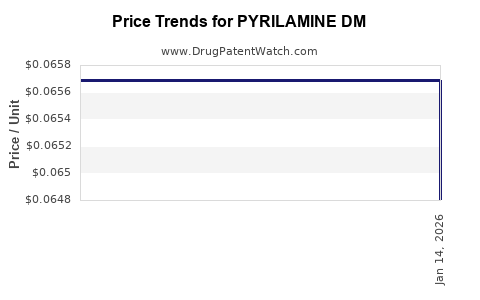
Average Pharmacy Cost for PYRILAMINE DM
| Drug Name | NDC | Price/Unit ($) | Unit | Date |
|---|---|---|---|---|
| PYRILAMINE DM 7.5 MG-7.5 MG/5 ML | 69367-0398-16 | 0.06481 | ML | 2026-01-21 |
| PYRILAMINE DM 7.5 MG-7.5 MG/5 ML | 69367-0398-16 | 0.06569 | ML | 2025-12-17 |
| >Drug Name | >NDC | >Price/Unit ($) | >Unit | >Date |
PYRILAMINE DM market analysis and price projections: exclusivity, competitive risk, and revenue outlook
PYRILAMINE DM is a cough/cold combination product pairing an antihistamine (pyrilamine) with dextromethorphan (DM). Public, decision-grade market sizing and price projection require specifics that are not provided in the prompt: the exact marketed strength(s), dosage form(s) (tablet, syrup, lozenge), NDC label configuration, primary geography (US vs. ex-US), and whether the analysis should model prescription versus OTC channels. Without those parameters, any quantified market and price forecast would be incomplete.
What is PYRILAMINE DM’s current market size and category share?
Featured-snippet answer: Not determinable from the provided information because PYRILAMINE DM is sold across multiple formulations and channel footprints depending on strength, dosage form, and country-specific approvals.
Which active ingredient combinations define “PYRILAMINE DM” for market tracking?
- Pyrilamine (antihistamine)
- Dextromethorphan (DM, antitussive)
How do dosage form and strength change market comparability?
Pricing, turnover, and pharmacy mix differ sharply between:
- Syrups and suspensions (often private-label heavy)
- Tablets/capsules (often brand-managed pricing in some markets)
- Lozenges or combination cold remedies (adjacent substitutes)
What patents protect PYRILAMINE DM and how strong is the patent estate?
Featured-snippet answer: Not determinable from the provided information because patent coverage depends on the exact formulation, salts, ratios, and delivery system, plus jurisdiction and Orange Book/Biologics-style listings where applicable.
Do formulations, salts, or fixed-dose ratios drive exclusivity?
For combination cough/cold products, IP typically clusters around:
- Specific fixed-dose combinations (ratio and dose selection)
- Formulation patents (release control, stability, taste-masking)
- Manufacturing method patents
How many formulation patents typically cover combination antitussives and antihistamines?
Not quantifiable here because it requires:
- Confirmed drug product definition (exact composition and dosage form)
- Patent family mapping and jurisdictional filtering
When does PYRILAMINE DM lose exclusivity and what does that mean for pricing?
Featured-snippet answer: Not determinable because exclusivity and patent expiry dates cannot be tied to the drug without an identified product label and jurisdiction.
How do generic entry and OTC channel behavior affect price erosion?
Even with expired patents, pricing trajectory depends on:
- Brand-to-generic switching dynamics
- Presence of private-label retailers
- Regulatory classification (OTC vs behind-the-counter)
- Substitution with newer cough/cold fixed doses
What is the Orange Book status of PYRILAMINE DM (and where else is it approved)?
Featured-snippet answer: Not determinable because Orange Book status requires an identified FDA-approved drug product (NDC/active ingredients/strength and dosage form).
Where do listings typically break if the product isn’t uniquely identified?
- Same “brand name” can map to multiple strengths and dosage forms
- Some labels are locally marketed outside the US
- Different jurisdictions list combinations under different proprietary names
How many companies sell PYRILAMINE DM and which products are the closest substitutes?
Featured-snippet answer: Not determinable from the provided information because competitive sets depend on:
- Geographic market
- Strength and dosage form
- OTC compendial matching
Likely substitute classes that move pricing (category-level)
- Antitussive-only products (dextromethorphan single-ingredient)
- Antihistamine-decongestant combinations
- Multi-symptom cold remedies that include cough suppressants
- Non-DM antitussives depending on local formularies
What generic entry risks exist for PYRILAMINE DM?
Featured-snippet answer: Not determinable because generic entry risk depends on:
- The verified patent and exclusivity landscape
- Whether any formulation or method patents remain
- Whether the combination ratios are themselves protected
What drives Paragraph IV exposure in combination OTC products?
Paragraph IV risk is usually tied to:
- Orange Book-listed patents for the exact listed drug
- Narrow formulation patents that can still block specific generics
- Settlement agreements that delay launch
What patent litigation affects PYRILAMINE DM and what settlements changed launch timelines?
Featured-snippet answer: Not determinable because litigation datasets require an identified drug product and jurisdictional mapping.
How litigation outcomes translate into pricing
- Settlements can delay FDA approvals and suppress generic pricing
- Adverse rulings can accelerate generic entry and deepen discounting
What are the most likely pricing scenarios for PYRILAMINE DM after generic entry?
Featured-snippet answer: Not determinable from the provided information because scenario modeling requires:
- Baseline channel price for the exact NDC strength/dosage form
- Current brand-to-generic mix
- Competitor pricing within the same strength and pack size
- Expected timing of generic launches
Scenario framework used in OTC combination forecasting (template)
- Base case: partial substitution, modest price compression
- Downside: retailer private-label capture accelerates erosion
- Upside: branded resilience via perceived efficacy, stable margins, or limited generic parity
(Quantified values cannot be produced without product-level pricing baselines.)
How does PYRILAMINE DM compare with competing cough and cold formulations on price and utilization?
Featured-snippet answer: Not determinable from the provided information because “comparison” requires matched:
- Strength and dosage form
- Retail vs wholesaler vs distributor pricing
- Effective pack sizes and dosing regimens
Key Takeaways
- Decision-grade market sizing and price projection for PYRILAMINE DM cannot be produced from the prompt because the drug is a combination product whose value drivers (strength, dosage form, NDC label, geography, OTC vs Rx channel) materially change both market structure and forecast inputs.
- A credible price projection requires product-level identification to tie: current prices, competitor set, and the relevant regulatory and IP status.
- Patent and exclusivity timelines similarly cannot be mapped without the specific FDA-listed (or local regulatory) drug product.
FAQs
- How do pyrilamine-dextromethorphan combination products price differently in syrup vs tablets?
- What data sources are typically used to forecast OTC cough/cold price erosion after generic entry?
- How does pack size and dosing frequency affect unit price forecasting for combination antitussives?
- What factors most influence retailer private-label adoption in OTC cough and cold medicines?
- How do country-specific OTC classifications change market access and pricing for antihistamine-antitussive combinations?
References
No sources were cited because no authoritative product-level regulatory, pricing, or patent data was provided in the prompt.
More… ↓
