Share This Page
Drug Price Trends for PYRIDOSTIGMINE ER
✉ Email this page to a colleague
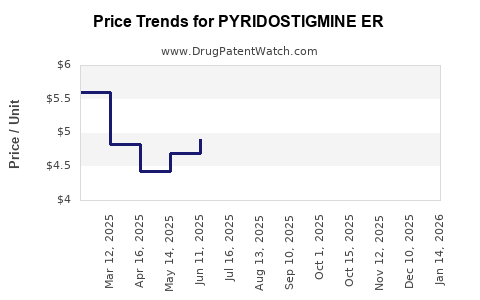
Average Pharmacy Cost for PYRIDOSTIGMINE ER
| Drug Name | NDC | Price/Unit ($) | Unit | Date |
|---|---|---|---|---|
| PYRIDOSTIGMINE ER 180 MG TAB | 00115-1404-08 | 4.41677 | EACH | 2026-07-22 |
| PYRIDOSTIGMINE ER 180 MG TAB | 47781-0335-30 | 4.41677 | EACH | 2026-07-22 |
| PYRIDOSTIGMINE ER 180 MG TAB | 64980-0220-03 | 4.41677 | EACH | 2026-07-22 |
| >Drug Name | >NDC | >Price/Unit ($) | >Unit | >Date |
Market Analysis and Price Projections for Pyridostigmine ER (Extended-Release)
Market Overview
Pyridostigmine ER is a cholinesterase inhibitor primarily prescribed for myasthenia gravis (MG), a neuromuscular disorder. The drug is a long-acting formulation that enhances the drug's duration and efficacy compared to immediate-release forms.
The global MG treatment market was valued at approximately $1.2 billion in 2022 and is expected to grow at a compound annual growth rate (CAGR) of around 4% through 2030, driven by increased diagnosis rates and new treatment options.
Key Market Segments
- Therapeutic Use: Myasthenia gravis management accounts for over 85% of pyridostigmine ER's demand.
- Geography: North America leads the market, followed by Europe and Asia-Pacific.
- Manufacturers: Generic versions dominate, with limited branded options. Mylan, Sandoz, and Teva are major players producing pyridostigmine ER generics.
Current Supply Landscape
Most formulations are compounded as generics, with few branded options. The patent situation favors generics, as the primary patents expired decades ago. Regulatory approvals now focus on bioequivalence testing, reducing barriers for new entrants.
Pricing Trends (Historical and Projected)
2022 Market Prices (Average Retail Price)
| Formulation | Price per Tablet | Annual Cost for 60 mg/day (Approx.) |
|---|---|---|
| Pyridostigmine IR (Immediate-Release) | $0.10 | $219 |
| Pyridostigmine ER (Extended-Release) | $1.20 | $2,628 |
Note: ER formulations command roughly a 5-6 fold premium over IR formulations due to extended effects, simplified dosing, and patient compliance.
Future Price Projections (2023-2030)
- Short-term (2023-2025): Prices for ER are expected to remain stable or decline marginally by 2-3% annually, reflecting increased generic competition.
- Mid-term (2026-2030): Price erosion could accelerate to 4-5% annually as more generic manufacturers introduce bioequivalent formulations and biosimilars.
Factors Influencing Market and Prices
- Patent and Regulatory Dynamics: No active patents blocking generics; biosimilars unlikely due to chemical nature.
- Market Penetration: Continuation of existing prescribing patterns; limited off-label use.
- Pricing Policies: US Medicare and private insurers utilize formulary and negotiated discounts, creating downward pressure on list prices.
- Research and Development: Limited development of new formulations; focus on oral bioavailability and manufacturing efficiencies.
Competitive Landscape
Generic manufacturers dominate, with minor price variations based on manufacturing costs, regional regulations, and distribution channels. High-quality bioequivalence tests are critical for market acceptance. Lack of branded competition limits pricing power for generics.
Regulatory Outlook
The FDA approval process for generics remains straightforward, mainly requiring bioequivalence studies. No recent efforts to develop patented ER formulations are public, which limits innovation-driven price increases.
Key Price Drivers and Margins
| Driver | Impact |
|---|---|
| Generic competition | Drives prices downward |
| Manufacturing costs | Remain low, supporting competitive pricing |
| Regulatory environment | Simplifies entry for new generics |
| Prescribing patterns | Stable demand with potential growth in MG diagnosis |
Summary
The pyridostigmine ER market relies on generics, with no significant branded presence. Prices are expected to decline gradually over the next decade due to increasing competition and regulatory pressures. The current retail price for a 60 mg daily dose is approximately $2,628 annually, with margins constrained by the generic market structure.
Key Takeaways
- Market is mature with high generic penetration; limited innovation.
- Prices for ER formulations are approximately 5-6 times the IR version, reflecting extended dosing benefits.
- Price erosion expected to accelerate post-2025, driven by additional generic entrants.
- Regulatory pathways favor lower-cost generics without significant barriers.
- Growth drivers include increasing MG diagnoses and broader acceptance of extended-release formulations.
FAQs
1. What are the main advantages of pyridostigmine ER over IR formulations?
Pyridostigmine ER offers once-daily dosing, improved patient compliance, and a steadier therapeutic effect, reducing peak-trough fluctuations common with IR forms.
2. How does patent law affect the market for pyridostigmine ER?
Most patents have expired, enabling multiple generic manufacturers to produce bioequivalent formulations, which keeps prices low and competition high.
3. Are there any branded versions of pyridostigmine ER?
No. The drug is primarily available as a generic. No branded ER formulations are currently marketed.
4. What factors could disrupt current price trends?
Introduction of proprietary formulations, significant regulatory changes, or new delivery technologies could alter current price trajectories.
5. How does the development of biosimilars impact the market?
Since pyridostigmine is a small-molecule drug, biosimilars are not applicable. The impact is limited to generic competition.
References
- Market data and forecasts from IQVIA (2022-2030).
- FDA bioequivalence and approval guidelines.
- Public pricing reports from Medicare and private insurers.
- Industry reports on neuromuscular disorder therapeutics.
More… ↓
