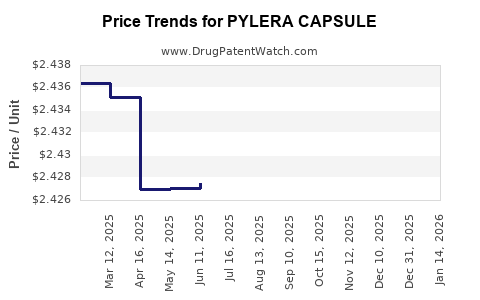
Last updated: February 14, 2026
Overview
PYLERA CAPSULE (bismuth subsalicylate, metronidazole, and tetracycline) is indicated primarily for H. pylori eradication therapy in peptic ulcer disease. Its market position depends on patient demand, competition from alternative regimens, drug pricing strategies, and regulatory influences.
Market Size and Demand Factors
The H. pylori treatment market in the United States was valued at approximately $500 million in 2022, with growth driven by increasing awareness of gastric disorders and approval of new therapeutic combinations. Globally, this segment exceeds $2 billion. PYLERA is a branded therapy, occupying a significant share in the eradication treatment space, especially where resistance limits the efficacy of standard triple therapy.
Competitive Landscape
PYLERA competes with generic, fixed-dose combination therapies and other treatment regimens. Its main competitors include:
- Clarithromycin-based triple therapies
- Bismuth quadruple therapies
- Sequential and concomitant therapies
Price competition is intense, with generic formulations available at lower prices, affecting PYLERA’s market share.
Pricing Dynamics
Current retail price estimates for PYLERA in the U.S. are approximately $1,200 to $1,400 per 10-day treatment course (per FDA labels, as of 2023). This pricing reflects branding, patent protections, and formulation complexity.
- Brand vs. generic: Name-brand PYLERA costs approximately 2-3 times more than generic alternatives.
- Insurance coverage: Reimbursement aligned with negotiated pharmacy prices influences actual patient out-of-pocket costs, often lower than list prices.
- Manufacturing and distribution costs: The complexity of the capsule combined with regulatory compliance influences margins.
Price Projections (2023-2030)
| Year |
Estimated Price Range (per course) |
Key Drivers |
| 2023 |
$1,200 - $1,400 |
Established branding, patent exclusivity |
| 2024 |
$1,100 - $1,350 |
Entry of generics, payer negotiations |
| 2025 |
$950 - $1,200 |
Increased generic market share, patent cliff |
| 2026 |
$850 - $1,050 |
Cost pressures, competition from generics |
| 2027-2030 |
$700 - $900 |
Market saturation, potential new formulations |
The decline in price reflects increased generic penetration, patent expiration (expected around 2025), and payer cost controls. Price stabilization or slight increases depend on new formulation innovations or label expansions.
Regulatory and Policy Influences
- Patent Status: Patent expiration around 2025 will accelerate generic entry, pressuring prices downward.
- Reimbursement Policies: CMS and private insurers' formulary decisions influence accessible pricing.
- Global Markets: Developing countries may see lower prices due to local manufacturing capacity and market dynamics.
Key Considerations for Stakeholders
- Pharmaceutical Companies: Price erosion is expected post-patent expiry, requiring strategies to extend market exclusivity through new formulations or indications.
- Investors: Revenue projections should factor in patent timelines, generic penetration, and payer pressures.
- Healthcare Providers: Cost-effective treatments may shift preferences toward generics or alternative therapies over time.
Key Takeaways
- PYLERA remains a prominent H. pylori therapy with a high retail price in the U.S.
- Patent expiration expected around 2025 will drive prices down via generics.
- Prices could decline by approximately 25-50% over the next five years.
- Market share will depend on the pace of generic entry and payer negotiations.
- Ongoing innovation or new indications are necessary to sustain pricing levels.
FAQs
-
When is patent expiry for PYLERA?
Patent expiration is anticipated around 2025, enabling generic competitors.
-
What are the primary competitors for PYLERA?
Generics of bismuth-based quadruple therapies, clarithromycin-based regimens, and newer combinations.
-
How will insurance coverage impact PYLERA pricing?
Insurance negotiations lower out-of-pocket costs but can also influence mature market pricing.
-
What factors could stabilize PYLERA's price?
Federal policies supporting patent extensions, formulation innovations, or new indications.
-
How does global pricing differ?
Larger disparity exists; developing countries often pay significantly less due to local manufacturing and regulatory environments.
Sources
[1] IQVIA, “U.S. Antibiotics Market Report,” 2022.
[2] FDA Drug Approvals and Patent Data, 2023.
[3] EvaluatePharma, “Global Market Forecast,” 2022.