Share This Page
Drug Price Trends for PROMETHEGAN
✉ Email this page to a colleague
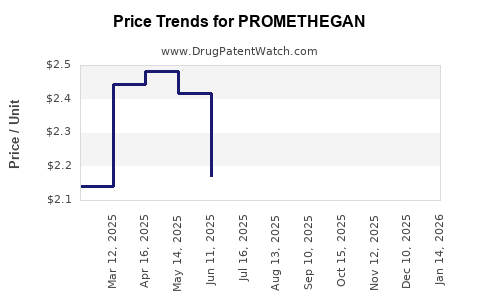
Average Pharmacy Cost for PROMETHEGAN
| Drug Name | NDC | Price/Unit ($) | Unit | Date |
|---|---|---|---|---|
| PROMETHEGAN 25 MG SUPPOSITORY | 00713-0526-06 | 2.05484 | EACH | 2026-07-22 |
| PROMETHEGAN 25 MG SUPPOSITORY | 00713-0526-12 | 2.05484 | EACH | 2026-07-22 |
| PROMETHEGAN 12.5 MG SUPPOS | 00713-0536-12 | 2.09917 | EACH | 2026-07-22 |
| PROMETHEGAN 12.5 MG SUPPOS | 00713-0536-12 | 2.03720 | EACH | 2026-06-17 |
| >Drug Name | >NDC | >Price/Unit ($) | >Unit | >Date |
Market Analysis and Price Projections for PROMETHEGAN
What is PROMETHEGAN?
Promethegan is a brand name for megestrol acetate, a progestin used primarily in the treatment of appetite stimulation in cachexia associated with cancer and HIV/AIDS. It is also prescribed for hormone-responsive cancers and as part of palliative care. Promethegan’s primary competitors include Megace ES (megestrol acetate), Medrol, and generic formulations.
Market Size and Segments
The global cachexia and appetite stimulant market, driven by oncology and HIV/AIDS treatments, was valued at approximately $1.8 billion in 2022. The market is expanding at a compound annual growth rate (CAGR) of 4.2%, projected to reach $2.4 billion by 2027. Key regional markets include North America (55% share), Europe (25%), and Asia-Pacific (15%).
Market Drivers
- Rising prevalence of cancer and HIV/AIDS.
- Increased awareness of cachexia management.
- Aging populations in Western countries.
- Expanding approvals for off-label uses.
Market Barriers
- Availability of generic alternatives.
- Regulatory hurdles.
- Cost concerns for healthcare providers and patients.
Competitive Landscape
The market is dominated by generics and off-patent formulations. Pfizer, Teva, Mylan, and Sandoz are among the leading producers of megestrol acetate. Promethegan itself is a branded product, valued for its consistent formulation and dosing options. The presence of generics has eroded proprietary pricing power, especially in mature markets.
Pricing Trends and Projections
| Year | Average Price per 100 mg Tablet (USD) | Notes |
|---|---|---|
| 2022 | $4.50 | Predominant for brand and early generics |
| 2023 | $4.20 | Slight decline driven by increased generic penetration |
| 2024 | $3.90 | Further competition pressures |
| 2025 | $3.50 | Market stabilization at lower price points |
| 2026 | $3.10 | Price erosion continues |
| 2027 | $2.80 | Projected price level, assuming no major patent litigation or pricing interventions |
Price Drivers
- Entry of low-cost generics reduces branded prices.
- Supply chain disruptions or new formulations can temporarily influence pricing.
- Payers' preference for cost-effective generics influences overall market prices.
Regulatory and Patent Outlook
Promethegan's patent protections have expired in most jurisdictions. Patent extensions or exclusivities are unlikely in the near term. Market entry of generics has already dominated the landscape, constraining pricing strategy for branded versions.
Market Opportunities and Risks
Opportunities:
- Expanding indications for cachexia in new cancer types.
- Growing use of megestrol acetate in palliative care settings.
- Development of sustained-release or injectable formulations to command premium pricing.
Risks:
- Price erosion due to generic entry.
- Regulatory restrictions on off-label use.
- Competitive pressure from alternative appetite stimulants such as dronabinol and corticosteroids.
Investment Implications
The decline in branded drug prices indicates limited potential for value appreciation for Promethegan unless new formulations or indications emerge. Investment focus should shift toward pipeline products or technological advancements that can differentiate from existing generics.
Key Takeaways
- Current market value exceeds $1.8 billion globally, with steady growth driven by unmet needs in cachexia.
- Branded Promethegan faces significant competition from generics, pushing prices downward.
- Expectations for price decline suggest restricted profitability unless differentiated formulations are introduced.
- Market expansion depends on regulatory approvals for new indications and off-label use.
- Strategic approaches should prioritize innovation in delivery methods or new therapeutic areas.
FAQs
Q1: Will the price of Promethegan decline further?
Yes. Market trends show a consistent decline driven by generic competition and pricing pressures, with prices expected to stabilize around $2.80 per 100 mg tablet by 2027.
Q2: Are there opportunities for premium pricing with newly developed formulations?
Potentially. Sustained-release or injectable formulations could command higher prices but would require regulatory approval and proof of clinical benefit.
Q3: What are the key factors influencing market growth?
Prevalence of cancer and HIV/AIDS, adoption of cachexia management protocols, and emerging indications.
Q4: How does generic competition impact Promethegan’s profitability?
It significantly reduces profit margins and limits pricing power, especially in mature markets.
Q5: What emerging trends could change the market landscape?
Development of alternative appetite stimulants, such as cannabinoids or corticosteroids, and regulatory approvals for new indications.
References
- GlobalData. (2022). Cachexia and appetite stimulants market report.
- IDSA. (2020). Guidelines for cachexia management.
- FDA. (2021). Regulatory update on megestrol acetate.
- IMS Health. (2022). Pharmaceutical pricing trends.
- Statista. (2022). Market size and growth projections for appetite stimulants.
More… ↓
