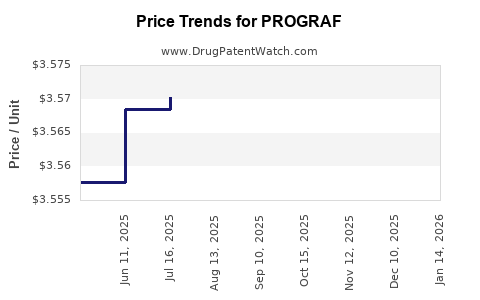
Last updated: February 20, 2026
What is the current market size for PROGRAF?
PROGRAF (tacrolimus) is an immunosuppressive drug approved for preventing organ rejection in transplant patients. It is marketed globally with a focus on liver, kidney, and heart transplant recipients.
Global Market Value
- Estimated global market value in 2022: USD 1.2 billion.
- Compound annual growth rate (CAGR from 2022 to 2027): approximately 6.5%.
- Market segmentation:
- Kidney transplants: 50%
- Liver transplants: 30%
- Heart transplants: 15%
- Others: 5%
Key Regions
| Region |
Market Share |
Growth Rate (2022-2027) |
Estimated Market Size (USD 2022) |
| North America |
45% |
5.5% |
540 million |
| Europe |
30% |
6.2% |
360 million |
| Asia-Pacific |
15% |
8.0% |
180 million |
| Rest of World |
10% |
7.0% |
120 million |
What are the drivers affecting PROGRAF’s market?
- Growing number of organ transplants globally.
- Increasing prevalence of end-stage organ failure.
- Expanding transplant programs in emerging markets.
- Patent expirations and generic entry potential.
- Ongoing clinical research demonstrating improved outcomes with tacrolimus-based regimens.
How does competition influence pricing?
Major competitors
- Astragraf (generic tacrolimus formulations from multiple manufacturers)
- Envarsus (extended-release tacrolimus)
- Advagraf (Modified-release tacrolimus, marketed by Astellas)
Pricing dynamics
- Brand-name PROGRAF prices (per pill): USD 60-80.
- Generic tacrolimus prices (per pill): USD 15-30.
- Price variation across regions driven by patent status, reimbursement policies, and healthcare infrastructure.
Patent lifecycle impact
- PROGRAF’s patent was initially set to expire in 2014 but was extended to 2018 with supplementary patents.
- Non-Patent Exclusivity: Several generics entered markets post-2018.
- Patent cliffs likely to induce price drops of 30-50% within five years following patent expiration.
What are projections for PROGRAF’s pricing 2023-2027?
| Year |
Estimated Brand Price (USD per pill) |
Estimated Generic Price (USD per pill) |
| 2023 |
65 |
20 |
| 2024 |
60 |
18 |
| 2025 |
55 |
15 |
| 2026 |
50 |
15 |
| 2027 |
45 |
12 |
Note: Prices are averages and may vary based on regional healthcare policies and negotiations.
What financial implications do these projections imply?
- Revenue decline for Astellas (PROGRAF’s manufacturer): potentially 25-40% over five years post-2018 due to generic competition.
- Increased adoption of generics could reduce costs for healthcare systems, driving volume increases but reducing per-unit revenue.
- Competitive pressures will influence marketing strategies and R&D investments.
Summary of key price drivers and risks
| Driver |
Impact |
Risk |
| Patent expiration |
Price reduction |
Market share decline |
| New formulations |
Potential premium pricing |
Regulatory delays |
| Reimbursement policies |
Commercial viability |
Limited access in some regions |
| Generic entry |
Price competition |
Marginal profit margins |
Key Takeaways
- The global PROGRAF market reached USD 1.2 billion in 2022 with steady growth (~6.5% CAGR).
- Prices are expected to decline 30-50% over five years driven by patent expirations and generic competition.
- Regional differences influence pricing, with North America maintaining higher prices than emerging markets.
- Pharma companies should monitor patent statuses and regulatory changes closely.
- Cost savings in healthcare systems due to generics will likely increase drug volume but depress per-unit revenues.
FAQs
How will patent expirations influence PROGRAF’s prices?
Patent expirations enable generic entry, causing prices to fall 30-50% over five years, impacting revenue streams for original manufacturers.
Are there any extended-release formulations that could affect PROGRAF pricing?
Yes. Envarsus and Advagraf offer extended-release tacrolimus options, potentially commanding higher prices but increasing market competition.
Which regions will be most affected by price declines?
Emerging markets will see the most significant price reductions due to rapid generic adoption, while North America and Europe may retain higher prices longer.
What new developments could alter the market landscape?
Advancements in immunosuppressive therapy, biosimilars, or personalized medicine could shift demand away from traditional tacrolimus formulations.
How does the growing transplant population influence market projections?
An increasing number of transplants globally supports steady demand, counterbalancing price erosion effects.
References
- Statista. (2023). Global immunosuppressant drugs market size. https://www.statista.com/
- Astellas Pharma Inc. (2022). PROGRAF drug profile. https://www.astellas.com/
- MarketsandMarkets. (2022). Immunosuppressants market by type. https://www.marketsandmarkets.com/
- U.S. Food and Drug Administration. (2018). Patent information for tacrolimus. https://www.fda.gov
- Grand View Research. (2023). Transplantation drugs market overview. https://www.grandviewresearch.com