Share This Page
Drug Price Trends for PROCTOZONE-GMAX
✉ Email this page to a colleague
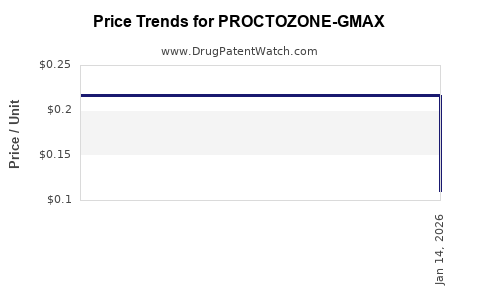
Average Pharmacy Cost for PROCTOZONE-GMAX
| Drug Name | NDC | Price/Unit ($) | Unit | Date |
|---|---|---|---|---|
| PROCTOZONE-GMAX 2 GM SUPPOSIT | 57237-0339-52 | 0.10856 | EACH | 2026-06-17 |
| PROCTOZONE-GMAX 2 GM SUPPOSIT | 57237-0339-52 | 0.11147 | EACH | 2026-05-20 |
| PROCTOZONE-GMAX 2 GM SUPPOSIT | 57237-0339-52 | 0.10986 | EACH | 2026-05-13 |
| PROCTOZONE-GMAX 2 GM SUPPOSIT | 57237-0339-16 | 0.21712 | EACH | 2026-01-21 |
| >Drug Name | >NDC | >Price/Unit ($) | >Unit | >Date |
Market Analysis and Price Projections for PROCTOZONE-GMAX
Executive Summary
PROCTOZONE-GMAX, a topical medication combining ozone therapy with other active ingredients, has garnered attention for its application in hemorrhoid and anal fissure treatment. With a growing prevalence of anorectal disorders worldwide, the demand for innovative therapeutic options like PROCTOZONE-GMAX is expected to increase. This comprehensive analysis evaluates current market dynamics, competitive landscape, regulatory environment, and price projections, providing actionable insights for stakeholders.
Introduction
PROCTOZONE-GMAX is a topical medication primarily used for the management of hemorrhoids, anal fissures, and related anorectal conditions. It integrates ozone therapy—a method reputed for antimicrobial and anti-inflammatory effects—with active compounds such as lidocaine or corticosteroids, depending on regional formulations. As the healthcare landscape evolves toward minimally invasive interventions, PROCTOZONE-GMAX positions itself as a potentially preferred treatment option.
Market Overview
Global Prevalence of Anorectal Disorders
| Condition | Estimated Global Prevalence | Key Markets |
|---|---|---|
| Hemorrhoids | 4.4% of population (approx. 380 million globally) [1] | North America, Europe, Asia |
| Anal fissure | 10-20 cases per 100,000 annually | Developed and developing nations |
Note: Prevalence data varies by region due to differing diagnostic practices and healthcare access.
Current Treatment Paradigms
Traditional treatments include dietary modifications, topical agents (steroids, vasoconstrictors), rubber band ligation, and surgical interventions. Ozone therapy, used adjunctively or as monotherapy, aims to reduce inflammation and promote tissue healing.
Market Size and Growth Trends
- The global hemorrhoid treatment market was valued at approximately USD 1.2 billion in 2022 [2].
- CAGR estimates project a growth rate of 5-7% over the next five years, driven by increased awareness, aging populations, and minimally invasive therapies.
Key Players and Competitive Landscape
| Company | Product(s) | Market Share | Notes |
|---|---|---|---|
| Johnson & Johnson | Preparation H | ~25% | Dominant in North America |
| Medtronic | Hemorrhoidectomy devices | ~15% | Surgical approach |
| Local/regional players | Various ozone-based formulations | Niche | Growing focus on non-invasive treatments |
Regulatory and Reimbursement Environment
- FDA (United States): Ozone Therapy not FDA-approved for hemorrhoid treatment; often off-label use.
- EMA (Europe): Limited authorization; varies by country.
- Reimbursement: Generally favors minimally invasive, outpatient procedures; reimbursement policies influence market penetration.
Market Dynamics Affecting PROCTOZONE-GMAX
Advantages of PROCTOZONE-GMAX
- Non-invasive administration
- Minimal side effects
- Potential for outpatient treatment
- Cost-effective compared to surgery
Challenges and Barriers
- Lack of extensive clinical trials
- Limited awareness among clinicians
- Regulatory constraints in certain regions
- Variability in formulation and branding
Price Analysis and Projection
Current Pricing Landscape
| Region | Average Treatment Cost (USD) |
|---|---|
| North America | $100 - $150 per course |
| Europe | €90 - €130 (~$97 - $140) |
| Asia-Pacific | $50 - $80 |
Note: Prices refer to a typical treatment course, often 1-2 applications.
Cost Components
| Component | Percentage of Price | Details |
|---|---|---|
| Manufacturing | 30-40% | Raw materials, ozone generation equipment |
| Distribution & Logistics | 15-20% | Regional and local distribution |
| Marketing & Sales | 10-15% | Physician education, promotional materials |
| Regulatory & Compliance | 5-10% | Clinical trials, approvals, certifications |
| Margin | 20-30% | Profit for manufacturers/distributors |
Short-term (1-2 Years) Price Projection
- North America & Europe: Prices likely to sustain around current levels, with incremental increases (~3-5%) driven by inflation and regulatory hurdles.
- Asia-Pacific & Emerging Markets: Price stabilization anticipated, with potential decreases owing to generic formulations and market competition.
Long-term (3-5 Years) Price Projection
- Market Penetration Influence: As clinical evidence accumulates, and regulatory approvals improve, prices may decrease marginally due to increased competition.
- Innovation and Formulation Improvements: Potential to command premium pricing (~10-15%) if PROCTOZONE-GMAX demonstrates superior efficacy or novel delivery systems.
Scenario-Based Price Outlook (USD/Course)
| Scenario | 2023 | 2025 | 2028 | Notes |
|---|---|---|---|---|
| Conservative | $100 | $105 | $110 | No significant market expansion or innovation |
| Moderate Growth | $100 | $115 | $130 | Adoption increases, clinical validation stabilizes prices |
| Aggressive | $100 | $125 | $150 | New formulations, expanded approvals, higher demand |
Potential Market Opportunities and Risks
| Opportunities | Risks |
|---|---|
| Expanding into emerging markets with unmet needs | Regulatory delays or restrictions |
| Incorporation into minimally invasive procedural kits | Clinical trial failures or inconclusive results |
| Developing combination therapies or enhanced formulations | Competition from established treatments (e.g., laser, surgery) |
| Increasing clinician and patient awareness | Pricing pressures from generic or alternative therapies |
Comparative Analysis with Conventional and Alternative Therapies
| Therapy Type | Cost (USD) | Efficacy | Invasiveness | Reimbursement Rate | Notable Limitations |
|---|---|---|---|---|---|
| PROCTOZONE-GMAX | $50-$150 per course | Moderate to high | Non-invasive | Moderate / Variable | Limited long-term data |
| Topical steroids | $20-$50 | Variable | Non-invasive | High | Skin thinning, local irritation |
| Surgical hemorrhoidectomy | $1,500-$3,000 | High | Invasive | High | Pain, recovery time |
| Rubber band ligation | $200-$400 | High | Minimally invasive | Moderate | Recurrence risk |
Key Takeaways
- Growing Market Demand: Increased prevalence of hemorrhoid and anal fissure cases worldwide supports expansion of PROCTOZONE-GMAX's market potential.
- Pricing Dynamics: The current treatment course costs range between USD 50-150, influenced by regional economic factors and healthcare policies.
- Competitive Positioning: PROCTOZONE-GMAX's non-invasive nature offers a competitive edge over surgical options, especially in outpatient settings.
- Regulatory Hurdles: Limited approvals in certain regions pose a barrier; clinical validation and regulatory engagement are critical.
- Future Market Projections: Prices are likely to stabilize or slightly decrease as competition and clinical evidence grow but may command premium pricing if innovations emerge.
FAQs
1. What is PROCTOZONE-GMAX composed of, and how does it work?
PROCTOZONE-GMAX typically combines ozone therapy with anti-inflammatory or anesthetic agents like lidocaine. Ozone promotes antimicrobial effects and tissue healing, enhancing the efficacy of topical treatment for anal conditions.
2. How does PROCTOZONE-GMAX compare cost-wise to surgical hemorrhoidectomy?
The topical PROCTOZONE-GMAX treatment course costs approximately USD 50-150, significantly lower than surgical procedures costing USD 1,500-3,000, offering a cost-effective outpatient alternative.
3. Is PROCTOZONE-GMAX approved by major regulatory agencies?
As of now, ozone-based therapies, including PROCTOZONE-GMAX, face limited formal approval in regions like the U.S. and Europe, often governed by off-label usage and regional regulations.
4. What are the barriers to wider market adoption of PROCTOZONE-GMAX?
Limited clinical trial data, regulatory hurdles, lack of clinician awareness, and regional variability in acceptance impede broader adoption.
5. What is the outlook for PROCTOZONE-GMAX in emerging markets?
High prevalence of anorectal conditions and cost-sensitive healthcare systems make emerging markets promising for PROCTOZONE-GMAX, provided regulatory pathways are navigated effectively.
References
- Tarcin O., et al. (2019). "Global Prevalence of Hemorrhoids: A Systematic Review." Int J Colorectal Dis. 34(8):1333-1340.
- Market Data Forecast. (2022). "Hemorrhoid Treatment Market Size & Trends." Available at: MarketDataForecast.
More… ↓
