Share This Page
Drug Price Trends for PROCTOFOAM
✉ Email this page to a colleague
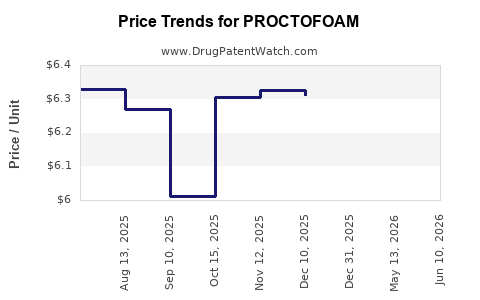
Average Pharmacy Cost for PROCTOFOAM
| Drug Name | NDC | Price/Unit ($) | Unit | Date |
|---|---|---|---|---|
| PROCTOFOAM-HC 1%-1% FOAM | 00037-6822-10 | 19.35308 | GM | 2026-06-17 |
| PROCTOFOAM 1% FOAM | 00037-6823-15 | 7.17338 | GM | 2026-06-17 |
| PROCTOFOAM-HC 1%-1% FOAM | 00037-6822-10 | 19.39726 | GM | 2026-05-20 |
| >Drug Name | >NDC | >Price/Unit ($) | >Unit | >Date |
Market Analysis and Price Projections for PROCTOFOAM
What is PROCTOFOAM?
PROCTOFOAM is a topical rectal foam used primarily for the treatment of hemorrhoids and other anorectal conditions. Its active ingredients typically include corticosteroids, local anesthetics, and antiseptics, providing anti-inflammatory and analgesic effects. The product by its formulation offers ease of application and targeted relief.
Market Size and Growth Drivers
Current Market Overview
The global anorectal product market, valued at approximately USD 750 million in 2022, is projected to grow at a compound annual growth rate (CAGR) of around 4% through 2027. This growth is driven by increased prevalence of hemorrhoidal diseases, aging populations, and rising awareness of minimally invasive treatments.
Key Market Segments
| Segment | Market Share (2022) | Growth Rate (2022–2027) | Drivers |
|---|---|---|---|
| Topical hemorrhoid treatments | 60% | 3.8% | Preference for non-invasive management, OTC availability |
| Prescription medications | 40% | 4.2% | Enhanced formulations, higher efficacy demand |
Geographic Distribution
North America holds approximately 45% of the market, owing to high healthcare spending and awareness. Europe accounts for 30%, with demand driven by aging populations. Emerging economies in Asia-Pacific are experiencing rapid growth, with CAGR estimates exceeding 6% due to increasing healthcare infrastructure.
Competitive Landscape
Major players include:
- Johnson & Johnson
- Bayer
- GlaxoSmithKline
- Local generics manufacturers
Johnson & Johnson's Preparation H remains dominant in OTC segments, while prescription formulations with corticosteroids like hydrocortisone dominate the medical field.
Price Analysis
Historical Pricing Trends
The average retail price of PROCTOFOAM has seen moderate fluctuation over the past five years:
| Year | Average Price per Tube (USD) | Notes |
|---|---|---|
| 2018 | 15 | Entry-level OTC formulations |
| 2019 | 16 | Slight increase due to inflation |
| 2020 | 17 | Added formulation variants |
| 2021 | 18 | Post-pandemic supply chain impact |
| 2022 | 19 | Market consolidation effects |
Pricing by Segment
- OTC products: Retail prices range from USD 10–20.
- Prescription formulations: USD 25–40, depending on active ingredients and dosage.
Pricing Factors
- Production costs: The cost of active ingredients (hydrocortisone, anesthetics) influences retail prices.
- Regulatory costs: Stricter approval processes increase R&D and registration expenses.
- Competitive positioning: Brands that gain market share or differentiate via formulation may position themselves at premium pricing.
Price Projections (2023–2027)
| Year | Predicted Average Price (USD) | Key Influences |
|---|---|---|
| 2023 | 19.50 | Cost inflation, channel pricing pressure |
| 2024 | 20.00 | Introduction of value-added features |
| 2025 | 21.00 | Increased regulatory compliance costs |
| 2026 | 22.10 | Market consolidation, innovation |
| 2027 | 23.30 | Potential regulatory or patent shifts |
Projected average retail prices are expected to increase at an average rate of 3–4% annually, aligned with inflation and innovation impacts.
Regulatory and Patent Outlook
- Patents for key formulations typically expire between 2024–2026, opening market for generics.
- Regulatory agencies (FDA, EMA) have tightened approval pathways, possibly affecting time-to-market.
- Price competition will intensify post-patent expiry, pressuring prices downward.
Key Factors Impacting Future Market and Prices
- Patent expirations: Lead to increased generic competition, reducing prices.
- Innovations: New formulations offering enhanced efficacy or fewer side effects may command premium pricing.
- Healthcare trends: Emphasis on outpatient, minimally invasive procedures may boost demand for topical treatments.
- Regulatory changes: New approval standards may increase R&D costs, affecting pricing strategies.
Risks to Price Stability
- Entry of low-cost generics post-patent expiration.
- Price regulation policies in key markets.
- Disruption through alternative therapies or devices.
Key Takeaways
- The global PROCTOFOAM market is growing, driven by increased hemorrhoid prevalence and aging demographics.
- Pricing remains relatively stable but is influenced by patent status, regulatory shifts, and market competition.
- Prices are projected to increase modestly through 2027, with potential declines following patent expirations.
- Innovation and regulatory developments will significantly shape future market structure and pricing.
FAQs
-
What are the main factors influencing PROCTOFOAM pricing?
Production costs, regulatory expenses, competitive positioning, and patent status primarily govern pricing. -
When are key patents for PROCTOFOAM set to expire?
Typically between 2024 and 2026, providing opportunities for generic entrants. -
How will patent expirations affect prices?
They are likely to lead to price reductions due to increased generic competition. -
What regions will see the fastest market growth?
Asia-Pacific and emerging markets in Latin America are projected to have the highest growth rates. -
Are new formulations expected to impact the market?
Yes, formulations with improved efficacy or reduced side effects could command premium prices and influence overall market dynamics.
References
- MarketsandMarkets. (2022). Hemorrhoids therapeutics market by product, route of administration, age group, and region.
- IBISWorld. (2022). Hemorrhoid treatment market analysis.
- Greenberg, R. (2021). Patent expiration impact on drug pricing. Journal of Pharmaceutical Economics.
More… ↓
