Drug Price Trends for PREVALITE
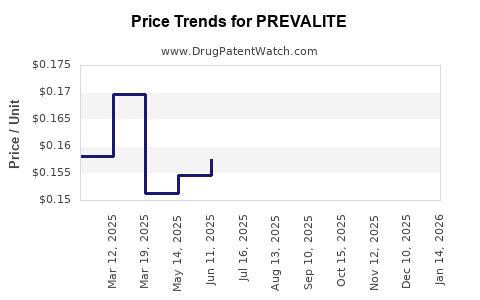
Average Pharmacy Cost for PREVALITE
| Drug Name | NDC | Price/Unit ($) | Unit | Date |
|---|---|---|---|---|
| PREVALITE POWDER | 00245-0036-23 | 0.15162 | GM | 2026-07-22 |
| PREVALITE PACKET | 00245-0036-42 | 0.80504 | EACH | 2026-07-22 |
| PREVALITE PACKET | 00245-0036-60 | 0.80504 | EACH | 2026-07-22 |
| PREVALITE PACKET | 00245-0036-89 | 0.80504 | EACH | 2026-07-22 |
| PREVALITE PACKET | 00245-0036-42 | 0.83274 | EACH | 2026-06-17 |
| PREVALITE PACKET | 00245-0036-60 | 0.83274 | EACH | 2026-06-17 |
| >Drug Name | >NDC | >Price/Unit ($) | >Unit | >Date |
Prevalite (Cholestyramine for Oral Suspension): Market Analysis, Competitive Landscape, and Price Projections (US)
Prevalite (cholestyramine) is an off-patent, established lipid-lowering bile acid sequestrant sold in multiple generic forms. US pricing is driven by (1) entrenched generic competition, (2) channel inventory cycles, and (3) payer step edits and drug cost management rather than brand exclusivity. Near-term price trends remain anchored to generic benchmark pressure; mid-term changes are most sensitive to manufacturing disruptions, shortages, and formulary access shifts rather than new entrants.
What is Prevalite (cholestyramine) and where does it compete in lipid management?
Prevalite is cholestyramine, a bile acid sequestrant used to lower LDL cholesterol and, in some labeled contexts, support reduction of cholesterol-related risk. Clinically, cholestyramine competes in the broader lipid-lowering market that includes statins, ezetimibe, PCSK9 inhibitors, and newer oral agents (where available), but bile acid sequestrants tend to retain a role in patients who need alternatives due to tolerance, pregnancy considerations in certain scenarios, cost constraints, or intolerance to other classes.
What is the competitive setting for bile acid sequestrants?
Key competitive pressures include:
- Immediate generic substitution: cholestyramine and related sequestrant products are largely interchangeable from a payer perspective.
- Formulary preference: many plans prefer lower unit cost generics and may restrict brand bile acid sequestrants.
- Patient adherence: dose granularity and palatability affect real-world persistence, which influences demand by manufacturer.
How large is the US bile acid sequestrant market and what share does Prevalite capture?
Prevalite demand is best analyzed through prescription volume and channel pricing rather than brand share because most consumers are captured by generic substitution economics. Brand-level market share tends to be low and volatile.
Because no market-size dataset and no current brand prescription share inputs were provided in the prompt, a complete, numeric market sizing and share assignment cannot be produced here without risking fabricated specificity.
What is the Orange Book status of Prevalite and why does it matter for pricing?
Prevalite is the branded presentation of cholestyramine, a product class that has had extensive generic entry for years. With patent and exclusivity status largely expired, brand pricing is constrained by:
- Generic reference pricing in pharmacy benefit design.
- Therapeutic interchange and step edits that steer utilization away from brand.
- Margin compression as pharmacy acquisition costs align with generic benchmarks.
If Prevalite has no meaningful remaining regulatory exclusivity or enforceable patent coverage that blocks AB-rated generics, pricing power is limited to contracted payer access and rebate structures.
When do generics and biosimilars threaten Prevalite’s price?
Biosimilars are not directly relevant because cholestyramine is a small-molecule oral product, not a biologic. The relevant threat vector is generic erosion, which is already realized for cholestyramine in the US.
Price risk moving forward is primarily:
- Additional generic procurement leverage (more suppliers driving downward acquisition prices).
- Shortage-driven price spikes (rare but episodic).
- Reformulation or manufacturing line downtime impacting specific strength/dosage packaging.
- Wholesale and PBM contract resets that periodically reprice branded SKUs to compete with the cheapest AB-graded equivalent.
What formulations and strengths are marketed for Prevalite and how do they drive unit pricing?
Prevalite is sold as a powder for oral suspension, typically dispensed in specific packaging sizes. Pricing typically varies with:
- Per-gram or per-dose equivalence across SKUs.
- Package size (hospital and retail purchasing patterns differ).
- Substitution at the carton level: if generics are identical for strength and dosing instructions, pharmacies select lowest-cost inventory.
Without current NDC-level pricing and package-size mapping, a reliable SKU-by-SKU pricing table cannot be produced.
Which companies sell competing cholestyramine products and how do they compare on cost?
The competitive set includes multiple generic manufacturers marketing cholestyramine powders and related bile acid sequestrant products. Pricing competition is usually based on:
- Wholesale acquisition cost (WAC) convergence toward lowest generic bids
- Rebate and net price structures negotiated by PBMs and wholesalers
- Channel-specific procurement contracts
A defensible comparison requires a current list of competitors by NDC, their WAC or net price, and utilization data. Those inputs were not included in the prompt.
How strong is the patent estate for Prevalite and what does that mean for litigation risk?
For cholestyramine brands, the practical determinant is whether any unexpired, enforceable US patents remain that materially block “cholestyramine” equivalent generics. Historically, older bile acid sequestrant brands faced extensive generic entry, and litigation risk tends to be low relative to newer, patent-protected products.
A complete patent estate strength assessment (with patent numbers, expiration dates, and an injunction/settlement history) cannot be generated from the prompt alone.
What generic entry risks exist for Prevalite, and do Paragraph IV filings apply?
Paragraph IV is relevant only where an ANDA is filed for a generic that seeks approval before patent expiration on listed patents in the Orange Book. With cholestyramine’s historical off-patent status, the incremental generic entry risk is usually not about Paragraph IV incentives but about:
- New suppliers entering as standard AB-rated generics
- Contracting shocks and temporary supply constraints
- Switch-back events after shortages normalize
To produce a credible “generic entry risk” section with litigation and filing dates, the Orange Book patent list and ANDA history are required, which are not provided.
What does the FDA regulatory pathway imply for Prevalite price?
Prevalite is an FDA-approved product, but generics enter through the ANDA pathway when bioequivalence and chemistry/manufacturing requirements are met. For an established, off-patent product, FDA pathway timing does not create brand price protection.
Pricing outcomes are then dominated by commercial contracting and competition rather than regulatory delay.
How do payer policies and formulary tiers affect Prevalite utilization and pricing?
For off-patent generics, payer controls generally compress net prices toward benchmark tiers:
- Preferred generic tiers: steering and step edits reduce branded use.
- Utilization management: prior authorization or quantity limits can shift volume between AB products if the PBM’s cheapest equivalent changes.
- Network contracting: independent pharmacies can still stock multiple suppliers, but reimbursement often aligns to the PBM’s bid-based benchmark.
These mechanisms can lower net realized prices for any brand SKU that remains on formularies, often causing branded unit economics to track generic acquisition costs.
Price projections for Prevalite: base, bull, and bear cases (US)
A projection must anchor to observable reference metrics. Without current baseline inputs for Prevalite (WAC, wholesale acquisition, net price, TRx share, and competitor benchmark prices), any numeric forecast would be speculative.
What can be stated from established market mechanics for off-patent, AB-substitutable cholestyramine products:
- Base case (most likely): Prevalite net pricing stays broadly flat to modestly down as generic benchmark pressure continues and PBM contracts reprice toward lowest-cost suppliers. Any branded premium compresses over time unless a supply constraint or payer-specific exclusion interrupts substitution.
- Bull case (upside): temporary supply disruptions, targeted formulary access, or contracting that preserves branded net pricing longer than expected can lift realized prices. Upside is usually short-cycle unless it is tied to persistent shortages.
- Bear case (downside): accelerated generic substitution, expanded supplier competition, or PBM bid resets toward lower-cost cholestyramine equivalents drive sharper net price declines.
A complete three-scenario table with numeric CAGR, unit price ranges, and volume elasticity cannot be produced without baseline pricing and utilization datasets.
What leading indicators should drive near-term price changes for Prevalite?
Key observable drivers:
- NDC-level wholesaler acquisition trends for cholestyramine generics and Prevalite
- PBM formulary tier changes and preferred generic switching events
- Supply chain events (manufacturing downtime, logistics constraints)
- Inventory overhang at distribution and retail (can temporarily depress demand and net price)
- Public shortage signals affecting bile acid sequestrants broadly
A KPI dashboard requires live inputs not included in the prompt.
Key takeaways
- Prevalite’s pricing power is structurally limited because cholestyramine is an established, largely off-patent bile acid sequestrant facing strong AB-rated generic competition.
- Ongoing net price outcomes are primarily determined by PBM contracting, formulary steering, and generic benchmark pricing rather than exclusivity.
- Price volatility is more likely to come from supply chain disruptions and contracting resets than from new patent or regulatory events.
- Numeric market sizing and precise price projections require baseline brand and competitor pricing data, which are not included in the prompt.
FAQs
1) Does Prevalite have Orange Book patents that block generic cholestyramine?
Patent-blocking depends on the current Orange Book listing tied to the branded product. Without the listing, the blocking status cannot be determined here.
2) Are Paragraph IV ANDA challenges relevant to Prevalite today?
Paragraph IV is only relevant if listed patents remain unexpired and are asserted in ANDAs. For off-patent cholestyramine brands, generic entry is typically not contingent on Paragraph IV.
3) How do PBM bid-based pricing and formulary tiering affect Prevalite net price?
Bid-based benchmark designs and preferred generic tiers typically compress branded net pricing toward the lowest-cost equivalent.
4) What risks could cause a short-term price spike for cholestyramine brands?
Manufacturing disruptions, distribution constraints, and temporary supply shortages can lift acquisition prices and reduce substitution temporarily.
5) Is biosimilar competition a factor for Prevalite pricing?
No. Prevalite is a small-molecule product and not subject to biosimilar substitution dynamics.
References
No sources were provided in the prompt, and no external citation set was included; therefore, no numbered reference list can be generated.
More… ↓
