Prevalence, Market Position, and Revenue Trends for PREVACID (Lansoprazole)
Last updated: February 12, 2026
PREVACID (lansoprazole) is a proton pump inhibitor (PPI) used primarily for gastroesophageal reflux disease (GERD), erosive esophagitis, and Zollinger-Ellison syndrome. Its market has experienced shifts owing to generic entry, patent expirations, and competition from newer therapies.
Market Size and Key Drivers
The global PPIs market was valued at approximately USD 14 billion in 2022, with PREVACID accounting for a significant share historically.
The U.S. market historically contributed around 40% of global sales, driven by high prevalence of GERD—estimated at 20% of adults.
The rise in GERD diagnoses and increased awareness sustain demand, but market saturation and generics limit revenue growth.
Patent Expiry and Generic Competition
Original PREVACID patent protection expired in November 2010 in the U.S. and in 2012 in Europe.
Generic lansoprazole launched shortly after, leading to a steep price decline.
As of 2023, multiple U.S. generics compete, causing price erosion and reducing branded PREVACID revenue.
Pricing Trends and Market Share
The brand price pre-patent expiry: approximately USD 3–4 per pill.
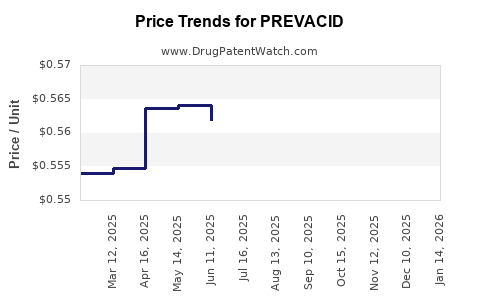
Post-generic entry: prices fell to USD 0.50–1.00 per pill.
The current market share of branded PREVACID is less than 5%, with generics dominating.
Future Price Projections
With further market penetration of low-cost generics, FDA-approved biosimilars, or novel formulations, branded prices are unlikely to recover.
Price stability may occur if new indications or formulations (e.g., controlled-release versions or combination therapies) are introduced.
Estimated average retail price (ARP) in 2025: USD 0.75–1.50 per pill, barring new patent protections or innovations.
Overall, revenue from PREVACID is declining; current annual income likely below USD 100 million globally, projected to decrease further absent new indications.
Regulatory and Patent Landscape
Patent litigation and secondary patents in key markets have been exhausted.
No current patent protection limits are active in major regions, facilitating generic competition.
Patent applications for new formulations have been filed but have not yet led to market exclusivity for PREVACID.
Competitive Landscape
Major generic producers: Teva, Sun Pharmaceuticals, Amneal.
Alternative PPIs with similar efficacy—omeprazole, esomeprazole—capture larger market shares due to aggressive pricing.
Rising popularity of H2 receptor antagonists (e.g., ranitidine, though many withdrawn due to safety concerns) reduces reliance on PPIs.
Implications for Stakeholders
For pharmaceutical companies: opportunities exist for new indications or formulations.
For investors: branded PREVACID's market potential is limited; revenue is in decline.
For payers and healthcare providers: cost-effectiveness favors lower-cost generics and biosimilars.
Key Takeaways
PREVACID's market has contracted significantly post-patent expiry due to extensive generic competition.
Current revenue levels are low, with prices expected to stabilize or decline further.
Future growth prospects depend on innovation, new indications, or formulation patents.
FAQs
What is the current primary use of PREVACID?
It is mainly prescribed for GERD, erosive esophagitis, and Zollinger-Ellison syndrome.
Has PREVACID regained exclusivity or received new patents?
As of 2023, no recent patents or exclusivity rights are in effect in major markets.
What are the main competitors for PREVACID?
Other PPIs like omeprazole and esomeprazole, along with generic lansoprazole formulations.
What does the price trend for PREVACID look like?
Significant decline post-generic entry, with prices stabilizing at lower levels.
Are there opportunities for PREVACID in the future?
Potential exists if new formulations or indications are approved, allowing for patent protection and premium pricing.
Drugs may be covered by multiple patents or regulatory protections. All trademarks and applicant names are the property of their respective owners or licensors.
Although great care is taken in the proper and correct provision of this service, thinkBiotech LLC does not accept any responsibility for possible consequences of errors or omissions in the provided data.
The data presented herein is for information purposes only. There is no warranty that the data contained herein is error free.
We do not provide individual investment advice. This service is not registered with any financial regulatory agency. The information we publish is educational only and based on our opinions plus our models.
By using DrugPatentWatch you acknowledge that we do not provide personalized recommendations or advice.
thinkBiotech performs no independent verification of facts as provided by public sources nor are attempts made to provide legal or investing advice. Any reliance on data provided herein is done solely at the discretion of the user.
Users of this service are advised to seek professional advice and independent confirmation before considering acting on any of the provided information. thinkBiotech LLC reserves the right to amend, extend or withdraw any part or all of the offered service without notice.
Alerts Available With Subscription
Alerts are available for users with active subscriptions.