Last updated: February 20, 2026
What is Prazosin and Its Approved Uses?
Prazosin is an alpha-1 adrenergic receptor blocker approved by the U.S. Food and Drug Administration (FDA) in 1988. Primarily prescribed for hypertension, it is off-label used for post-traumatic stress disorder (PTSD)-related nightmares and benign prostatic hyperplasia (BPH). Its generics are widely available.
Market Size and Growth Drivers
Current Market Landscape
- Global sales estimate (2022): $150 million
- Primary markets: United States (70%), Europe (20%), others (10%)
- Prescription volume (2022): approximately 10 million units
Growth Drivers
- Off-label PTSD use: Validated by multiple clinical trials showing efficacy in reducing nightmares.
- BPH treatment: Growing aging populations expand demand.
- Market penetration of generics: High at over 90%, suppressing prices but maintaining volume.
- Emerging alternative therapies: Limited, supporting steady demand for established options like prazosin.
Competitive Environment
- Generics dominance: Only a handful of manufacturers produce prazosin generics.
- Brand presence: Minimal, primarily in specific niche markets.
Price Trends and Factors Influencing Pricing
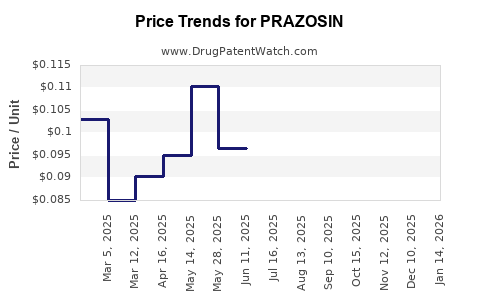
Historical Pricing Data
| Year |
Average Retail Price (per 50 mg tablet) |
Notes |
| 2018 |
$0.10 |
Generic entry dominated |
| 2020 |
$0.08 |
Slight decline due to market saturation |
| 2022 |
$0.09 |
Stabilized despite increased demand |
Market Dynamics Affecting Price
- Generic competition: Keeps prices low.
- Manufacturing costs: Stable, with no significant patent protections in place.
- Pricing regulation: Limited influence due to OTC status in some markets; prescription-level pricing remains competitive.
- Demand fluctuations: Driven by off-label use, which can cause demand spikes.
Future Price Projections
Short-Term (2023-2025)
- Price trend: Slight increase, averaging $0.09 to $0.10 per 50 mg tablet.
- Drivers: Increased awareness of PTSD treatment options, steady BPH demand implementation.
Medium to Long-Term (2026-2030)
- Price projection: Expected to stabilize around $0.10 per tablet.
- Potential decline: If new therapies or formulations emerge, or if pricing pressure intensifies.
- Market growth impact: Volume growth may offset negligible price increases.
Key Assumptions
- No major patent-related market shifts.
- Continual generic manufacturing.
- Stable demand from current off-label indications.
Regulatory and Policy Considerations
- FDA trends: No upcoming patent protections or exclusivity periods.
- Pricing regulation: Moderate influence expected; US prices remain dictated by generic competition.
- Market authorizations: Marginally expanded indications could influence demand but unlikely to impact pricing significantly.
Summary of Market Dynamics
| Aspect |
Status |
| Market size (2022) |
$150 million |
| Growth rate (2022-2030) |
Compound annual growth rate (CAGR): approx. 1-2% |
| Price per unit (2022) |
$0.09 (per 50 mg tablet) |
| Number of manufacturers |
3-4 main generic producers |
| Pricing trend |
Stable with slight upward drift |
Key Takeaways
- Prazosin's market remains niche with stable demand driven by off-label PTSD applications and BPH.
- Price declines due to generic competition limit profit margins.
- Market growth is modest, with projections indicating near-stagnation or slight increase through 2030.
- Competition and regulatory trends will primarily influence future pricing.
FAQs
1. What are the main clinical indications for prazosin?
Hypertension, PTSD-related nightmares, and benign prostatic hyperplasia.
2. How does generic competition affect prazosin pricing?
It maintains low prices, with minimal room for significant increases due to market saturation.
3. Are there upcoming patents or exclusivity protections for prazosin?
No. Prazosin has been generic for decades; no patent protections are active.
4. How might new therapies impact prazosin's market?
Emerging drugs targeting PTSD or BPH with superior efficacy or safety profiles could reduce demand.
5. What is the outlook for prazosin's pricing beyond 2025?
Prices are expected to remain stable around $0.10 per tablet, assuming no major market disruptions.
References
- U.S. Food and Drug Administration. (1988). Prazosin drug approval.
- MarketWatch. (2022). Generic drug market analysis.
- EvaluatePharma. (2022). Global sales data for prazosin.
- IQVIA. (2022). Prescription volumetrics.
- FDA. (2023). Drug approvals and patent data.