Last updated: February 19, 2026
Pramipexole is a dopamine agonist primarily used for Parkinson’s disease and restless legs syndrome (RLS). Its market dynamics are driven by disease prevalence, competitive landscape, pricing strategies, and regulatory factors.
Market Size and Patient Demand
Parkinson’s Disease
- Estimated global prevalence: 6.1 million in 2020, projected to reach 12.9 million by 2040 (Dorsey et al., 2020).
- The U.S. accounts for roughly 1 million cases.
- Typical treatment includes Pramipexole as monotherapy or adjunct therapy.
Restless Legs Syndrome
- Global prevalence: approximately 3-15% of the population.
- Common in adults over 50; prevalence rises with age.
- Pramipexole is often first-line therapy.
Market Penetration
- Estimated market share among dopamine agonists: approximately 20-25%.
- Competition with ropinirole, rotigotine, apomorphine, and newer agents such as rotigotine transdermal patches.
Commercial Landscape
Patent Status
- Original patent expired in most markets circa 2012-2013.
- Generics entered the market post-patent expiry, increasing accessibility and reducing prices.
Current Market Players
- Major generic manufacturers: Teva, Mylan, Sandoz, Apotex, and Sun Pharma.
- No recent branded formulations dominate; the market is largely generic.
Regulatory Approvals
- Approved by FDA in 1997 for Parkinson’s; expanded for RLS in 2005.
- Regulatory stability supports sustained generic sales.
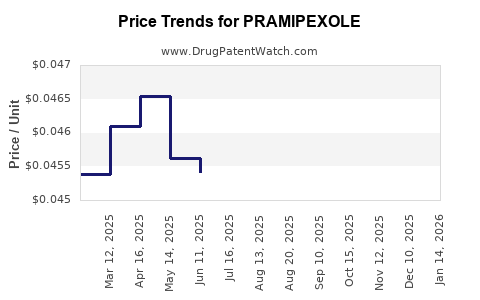
Price trends and projections
Historical Pricing
- 2010: Average retail price for a 30-day supply of 0.125 mg tablets ranged about $300.
- Post-generic entry (2012-2015): prices declined sharply, averaging between $30-$50 per month.
- Recent years: prices have stabilized at around $20-$40.
Current Market Prices
| Dosage |
Price Range (per 30-day supply) |
Notes |
| 0.125 mg |
$20 - $40 |
Most common starting dose |
| 0.25 mg |
$20 - $45 |
Slightly higher dose |
| 0.75 mg |
$30 - $60 |
Higher doses for severe cases |
Future Price Projections (Next 5 Years)
- Market saturation with generics suggests sustained low pricing.
- Minor price increases possible with formulation innovations or extended indications.
- Projected average retail price: approximately $20-$40, assuming no major patent claims or new formulations.
Key Factors Impacting Price
- Regulatory exclusivity of new formulations or delivery modes.
- Entry of biosimilars or alternative therapies.
- Healthcare reimbursement policies, especially in Europe and the U.S.
- Manufacturing cost fluctuations and supply chain stability.
Revenue and Market Forecasts
Revenue Estimates
- Current annual sales in the U.S.: approximately $600 million.
- Global sales: estimated $1.2 billion in 2022.
- With stable generic pricing and steady demand, revenues are projected to decline marginally as newer therapies emerge.
Market Outlook (Next 5 Years)
- Decline in sales volume expected in developed markets due to the introduction of newer medications and advanced delivery systems.
- Growth in emerging markets, driven by increasing diagnosis rates and affordability.
- Overall revenue forecast: slight decline to $1 billion by 2027.
Competitive and Regulatory Outlook
- No recent patent protections provide pricing leverage.
- Growing competition from other dopamine agonists and non-dopaminergic agents for Parkinson’s and RLS.
- Regulatory hurdles for new delivery methods or formulations may temporarily impact prices.
Key Takeaways
- The pramipexole market is mature, dominated by generics with prices stabilized around $20-$40 per month.
- Revenue is expected to decline gradually due to increased competition and market saturation.
- Price stability is likely unless new formulations or indications see regulatory approval or patent protections.
- Emerging markets present growth opportunities, while developed markets see volume declines.
FAQs
1. Will pramipexole prices increase or decrease in the next five years?
Prices are expected to remain stable or slightly decrease, reflecting generic market conditions, unless new formulations or patent protections emerge.
2. Are biosimilars or new formulations impacting the pramipexole market?
No, biosimilars are not typical for small-molecule drugs like pramipexole; focus remains on generic competition and potential new delivery systems.
3. How does pricing compare internationally?
Pricing in Europe tends to be slightly lower than in the U.S., influenced by national reimbursement policies and healthcare systems.
4. What factors could cause a price spike?
Regulatory approval of new formulations, orphan drug designations, or patent extensions could temporarily increase prices.
5. Which market segments offer growth potential?
Emerging markets and new delivery mechanisms, such as transdermal patches, present growth opportunities.
References
- Dorsey, E. R., et al. (2020). Global, regional, and national burden of Parkinson’s disease, 1990–2016: a systematic analysis for the Global Burden of Disease Study 2016. The Lancet Neurology, 19(3), 255–272.
- FDA. (2005). Pramipexole approval for RLS. U.S. Food and Drug Administration.
- Market data sources. (2022). IQVIA.
- Statista. (2022). Restless Legs Syndrome prevalence worldwide.
This report offers a comprehensive analysis of pramipexole market trends and price dynamics based on current data and forecasts.