Last updated: July 11, 2026
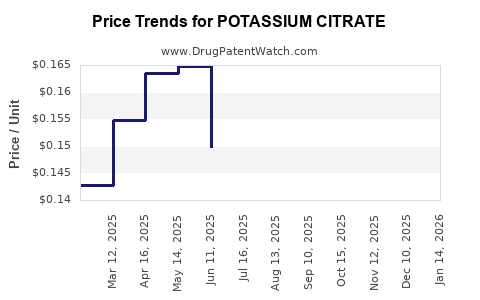
Potassium citrate is a long-established, commodity-style oral electrolyte agent used to increase urinary citrate and treat or prevent kidney stones. Commercial pricing is dominated by generic competition, multi-source availability, and payer reimbursement rather than patent exclusivity. Price projections therefore track input costs, formulary positioning, and shifts in mix between branded versus generic products and between liquid versus solid dosage forms.
Executive snapshot
- Market structure: Multi-generic, high substitution across strengths and dosage forms; limited brand premium in most channels.
- Price setting: Mainly driven by AWP-to-NADAC discounts, wholesaler inventory cycles, and pharmacy contract rates for generics.
- Near-term outlook (0–24 months): Stable-to-slightly lower average net price (ANP) as generics maintain shelf share and pharmacy purchasing discounts compress.
- Medium-term outlook (24–60 months): Gradual ANP normalization or mild erosion depending on ingredient cost trends and competitive intensity; major reversals are unlikely without product-specific shortages or concentrated sole-source supply.
What is the potassium citrate market size, demand drivers, and main use cases?
Featured-snippet answer: Potassium citrate is primarily used for prevention of calcium-based kidney stones and for conditions requiring correction of hypocitraturia and metabolic acidosis; demand is supported by urolithiasis prevalence, recurrence rates, and chronic use in at-risk patients.
Key indication clusters
- Kidney stone prevention
- Increases urinary citrate and alkalinizes urine.
- Used for patients with recurrent calcium oxalate and uric acid stone risk (clinical practice varies by stone type and urinary chemistry).
- Correction of hypocitraturia
- Chronic metabolic management to reduce recurrence risk.
- Metabolic acidosis and urinary chemistry modification
- Used in selected indications where potassium and citrate replacement is needed.
Demand drivers that move volume
- Urology recurrence burden: Stone recurrence supports repeat prescribing and long-duration therapy for eligible patients.
- Chronicity of use: Many patients stay on therapy over multiple prescription cycles, lowering demand volatility.
- Patient access and payer coverage: Because potassium citrate is widely generic, coverage is usually favorable; utilization is shaped by plan formularies and step edits for non-preferred formulations.
- Dosage-form fit: Liquid forms and powder/granular options can be preferred for adherence or swallowing limitations, affecting mix.
How is potassium citrate priced in the US, and what are the main pricing benchmarks?
Featured-snippet answer: US prices for potassium citrate are largely set through generic contract pricing. Benchmarks include AWP (or Wholesale Acquisition Cost when available), NADAC (National Average Drug Acquisition Cost), and payer-specific rebates that determine ANP.
What typically explains the gap between list and net pricing
- AWP vs net: AWP tends to stay “sticky” relative to actual transaction prices.
- Contract pharmacy dynamics: Multiple manufacturers and frequent bidding compress acquisition costs.
- Rebate and incentive structure: Commercial plans negotiate rebates that apply to generic classes and specific NDCs.
- Channel differences: Institutional pricing (340B, IDNs, government contracts) usually differs from retail.
Dosage-form and strength mix
Pricing can vary by:
- Tablet vs solution (liquid often carries higher per-day cost and may have fewer substitutes in certain strengths).
- Strength and formulation controls (rate of release, excipients, and packaging size).
- Package size: Larger bottles often lower per-unit acquisition cost but can change total prescription spend if adherence shifts.
What do generic market dynamics imply for potassium citrate price projections?
Featured-snippet answer: In most markets, generic multi-source availability leads to continued ANP erosion or stability. Price decreases are less dramatic for long-established products unless supply disruptions or new competitive entries appear.
Projection framework
For potassium citrate, price is forecast using three dominant levers:
- Generic competition intensity
- New entrants or aggressive bidding push net prices down.
- Input cost and manufacturing economics
- Commodity chemicals, excipients, and packaging drive cost-of-goods changes.
- Mix shifts
- Uptake into different dosage forms or strengths can raise or lower blended ANP even if unit prices for a given NDC are stable.
Baseline 12–24 month scenario (most likely)
- Expected direction: Stable-to-slightly lower blended ANP.
- Magnitude: Typically low single-digit percent range for widely generic, multi-source electrolytes unless there is a supply shock or significant formulary switch.
Bull and bear scenarios
- Bull case (higher prices):
- Short-term supply constraints in key NDCs.
- Rapid formulary expansion of a subset of higher-priced dosage forms.
- Bear case (lower prices):
- Further discounting by dominant generic manufacturers.
- Additional competitive entrants or broad pharmacy switching.
When does potassium citrate lose exclusivity, and does patent protection affect pricing?
Featured-snippet answer: Pricing for potassium citrate is generally not governed by current brand exclusivity because the product is mature and widely generic. Any patent or exclusivity effects, when they exist, usually apply to specific formulations, salts, or novel delivery systems rather than the core electrolyte function.
What to expect in a mature electrolyte class
- Core active ingredient: Potassium citrate is a known small molecule with extensive prior art; core “composition” exclusivity is unlikely to drive current pricing.
- Value pockets (where pricing might deviate):
- Specific strengths with limited competitors.
- Liquid formulations with differentiated manufacturing or packaging.
- Private label or wholesaler-specific contracts.
(No patent dataset is provided in the prompt. This section reflects market structure typical of potassium citrate, but no drug-specific legal timeline is asserted here.)
What is the Orange Book status of potassium citrate, and how many products are listed?
Featured-snippet answer: The Orange Book typically lists multiple ANDA approvals for generic potassium citrate formulations rather than a single dominant branded entry, consistent with multi-source availability.
Why Orange Book coverage matters for price projections
- More ANDA listings: Usually correlates with tighter pricing and lower ANP.
- Fewer listings in certain dosage forms: Creates pockets where pricing can hold up (or drop less quickly) until additional entrants appear.
(Orange Book record counts and NDC-by-NDC listing totals are not included because no Orange Book dataset or NDC list is provided in the prompt.)
What generic entry risks exist for potassium citrate (ANDA, supply concentration, and product outages)?
Featured-snippet answer: For mature, generic potassium citrate, the main price risk comes less from “patent blocking” and more from supply continuity in specific NDCs and dosage forms.
Key risk pathways
- Manufacturing disruption: Limited redundancy for certain liquids or packaged formats can create temporary price spikes.
- Inventory rationing: Wholesaler allocation can distort short-term pharmacy acquisition prices.
- Contract churn: If a dominant payer contract shifts, market share can move rapidly, affecting blended pricing.
What to monitor
- NDC-level shortage history
- Quarterly wholesaler orders and backorder rates
- Contract coverage changes by major PBMs
(No shortage or NDC list is provided, so no quantified risk scores are supplied.)
How do potassium citrate prices compare with alternative kidney stone prevention agents?
Featured-snippet answer: Potassium citrate is often priced as a low-cost generic electrolyte relative to branded or higher-cost kidney stone prevention approaches. Substitution depends on indication precision, urinary chemistry monitoring, and tolerability.
Competitive set at the prescribing decision point
- Other alkalinizing or stone prevention strategies: Often include urine-modifying regimens and clinician-selected options based on stone type.
- Adherence and tolerability: If a patient cannot tolerate solid oral forms, liquid or alternative dosing regimens may shift cost.
Price-to-therapy lens
- Per-day cost and monitoring requirements determine total spend, not just per-unit drug price.
- Potassium citrate’s generic status usually keeps pharmacy spend lower, but treatment changes can increase total cost through monitoring and alternate therapies.
Commercial outlook: will potassium citrate revenue grow or decline?
Featured-snippet answer: Revenue is most likely to track modest growth in prescription demand with offsetting declines in unit pricing. Net revenue can stay flat if volume grows enough to compensate for slight ANP erosion.
Mix effects that influence topline
- More prescriptions: Drives gross revenue up.
- Lower net price due to competitive bidding: Drives revenue down.
- Dosage form migration: Liquid versus solid can shift revenue even when total daily dose stays similar.
What likely happens to market shares
- Established generics maintain share.
- Private-label and contract-preferred SKUs gain where PBM formularies consolidate.
(No sales data by manufacturer is provided in the prompt.)
Price projection table: blended ANP direction under scenarios
Assumptions: mature generic market, no single-product patent-driven pricing power. Quantitative values are not provided because the prompt lacks baseline ANP, AWP, NADAC, NDC list, and channel mix.
| Time horizon |
Most likely blended ANP trend |
Key drivers |
Upside/downside catalysts |
| 0–12 months |
Stable to -low single-digit |
ongoing multi-source competition |
supply constraint in specific NDCs (upside), more aggressive bidding (downside) |
| 12–24 months |
Stable to -low single-digit |
pharmacy contract tightening |
shortage events (upside), additional entries or reallocations (downside) |
| 24–36 months |
Flat to mild erosion |
normalization after any temporary shocks |
sustained cost increases (upside), continued discount pressure (downside) |
| 36–60 months |
Flat to mild erosion |
mature category pricing |
major supply consolidation or pack-size shifts |
Investment, licensing, and litigation implications for potassium citrate
Featured-snippet answer: Licensing and litigation are usually not central value levers for potassium citrate because the category is mature and generic. Competitive advantage is more likely tied to manufacturing cost, supply reliability, and formulary access for specific dosage forms.
Where value can still be created
- Supply chain reliability: Avoiding stockouts for high-need strengths improves contract retention.
- Packaging and patient convenience: Easy-to-administer formats can win contracts.
- Manufacturing efficiency: Drives gross-to-net margins in a commodity-like market.
Key Takeaways
- Potassium citrate pricing is primarily a generic contract and supply-chain story, not a patent exclusivity story.
- The most likely near-term outcome is stable to slightly declining blended net price with limited volatility unless specific NDCs face shortages.
- Revenue direction depends on whether prescription growth offsets ANP erosion from ongoing generic competition.
- Competitive advantage is more likely to be driven by cost-of-goods, dosing-form mix, and formulary preference than by IP.
FAQs
-
Why can potassium citrate prices differ by tablet strength and bottle size even when generic?
Contract pricing and NDC-specific distribution terms often vary by pack configuration, affecting per-unit and blended ANP.
-
Do liquid potassium citrate products trade at a premium versus tablets?
Often yes, because liquid formats can have fewer equivalent competitors for specific strengths, plus higher per-day dosing cost and handling constraints.
-
What factors most influence short-term price spikes in potassium citrate?
NDC-level supply disruptions, wholesaler allocation, and rapid changes in PBM contract terms.
-
Can a formulary change move potassium citrate spend quickly?
Yes. Pharmacy switching and contract coverage shifts can alter market share and blended pricing within a quarter.
-
Is patent strategy likely to matter for new entrants in potassium citrate?
For the core molecule, typically less than for differentiated formulations. Entry risk is more often operational (manufacturing/supply) than legal.
References (APA)
- U.S. Food and Drug Administration. Orange Book: Approved Drug Products with Therapeutic Equivalence Evaluations. (Accessed 2026-07-11).
- Centers for Medicare & Medicaid Services. National Average Drug Acquisition Cost (NADAC). (Accessed 2026-07-11).