Last updated: February 19, 2026
Potassium chloride (KCl) is a critical electrolyte used across multiple therapeutic areas, including cardiovascular disease management, gastrointestinal disorders, and nutritional supplements. Its role in maintaining fluid balance, nerve signal transmission, and muscle contraction underpins its consistent demand in the global pharmaceutical and healthcare sectors.
What is the current global market size and historical growth trajectory for potassium chloride?
The global potassium chloride market was valued at approximately $1.8 billion in 2023. The market has experienced steady growth, averaging 3.5% annually over the past five years (2019-2023). This expansion is driven by an increasing prevalence of cardiovascular diseases, a growing geriatric population requiring supplementation, and the broad utility of KCl in various medical applications. Key market participants include multinational chemical manufacturers and specialized pharmaceutical ingredient suppliers.
| Year |
Market Value (USD Billion) |
Compound Annual Growth Rate (CAGR) |
| 2019 |
1.55 |
- |
| 2020 |
1.61 |
3.87% |
| 2021 |
1.68 |
4.35% |
| 2022 |
1.75 |
4.17% |
| 2023 |
1.81 |
3.45% |
Source: Proprietary Market Intelligence Data
What are the primary drivers of demand for potassium chloride in the pharmaceutical sector?
The pharmaceutical demand for potassium chloride is primarily driven by its use in:
- Cardiovascular Medications: KCl is a foundational treatment for hypokalemia, a condition often associated with diuretic use in managing hypertension and heart failure. The World Health Organization (WHO) estimates that cardiovascular diseases remain the leading cause of death globally, contributing to an increasing patient pool requiring potassium supplementation.
- Gastrointestinal Therapies: Oral rehydration solutions and intravenous fluid therapies frequently incorporate KCl to restore electrolyte balance in patients experiencing dehydration due to vomiting, diarrhea, or significant fluid loss.
- Nutritional Supplements: As a dietary supplement, KCl addresses potassium deficiencies and supports overall cellular function. The aging global population, which often has reduced dietary intake and increased risk of electrolyte imbalances, contributes to sustained demand.
- Drug Manufacturing Excipient: Potassium chloride serves as a bulking agent and excipient in the formulation of various solid dosage forms, including tablets and capsules. Its inert nature and cost-effectiveness make it a preferred choice.
What are the key geographical regions influencing the potassium chloride market?
The potassium chloride market is distributed globally, with significant contributions from several key regions:
- North America: The largest market, driven by a high prevalence of chronic diseases, advanced healthcare infrastructure, and a strong pharmaceutical manufacturing base. The United States is the dominant consumer.
- Europe: A mature market characterized by stringent regulatory standards and a well-established healthcare system. Germany, the UK, and France are key markets.
- Asia Pacific: The fastest-growing region, fueled by a large population, increasing disposable incomes, rising healthcare expenditure, and a growing number of generic drug manufacturers. China and India are significant contributors.
- Latin America: An emerging market with expanding healthcare access and a growing demand for basic pharmaceutical ingredients. Brazil and Mexico lead regional consumption.
- Middle East & Africa: A smaller but growing market, driven by improving healthcare infrastructure and an increasing focus on preventative medicine and nutritional supplements.
| Region |
Market Share (2023) |
Projected CAGR (2024-2029) |
| North America |
32% |
3.1% |
| Europe |
28% |
2.9% |
| Asia Pacific |
25% |
4.5% |
| Latin America |
10% |
3.8% |
| Middle East & Africa |
5% |
4.2% |
Source: Proprietary Market Intelligence Data
What is the projected market size and growth rate for potassium chloride over the next five years?
The global potassium chloride market is projected to reach approximately $2.2 billion by 2029, exhibiting a compound annual growth rate (CAGR) of 3.4% from 2024 to 2029. Growth will be sustained by ongoing demand in established applications and expansion in emerging economies. The increasing focus on preventative healthcare and the management of non-communicable diseases will continue to support market expansion.
| Year |
Projected Market Value (USD Billion) |
Projected CAGR (2024-2029) |
| 2024 |
1.87 |
- |
| 2025 |
1.93 |
3.2% |
| 2026 |
1.99 |
3.1% |
| 2027 |
2.06 |
3.5% |
| 2028 |
2.13 |
3.4% |
| 2029 |
2.20 |
3.3% |
Source: Proprietary Market Intelligence Data
What are the primary price influencing factors for potassium chloride?
The price of potassium chloride is subject to several interconnected factors:
- Raw Material Availability and Cost: Potassium is primarily sourced from potash deposits. The supply and cost of mined potash, influenced by geopolitical stability in mining regions, energy costs for extraction, and global demand for agricultural fertilizers (a major potash consumer), directly impact KCl production costs.
- Manufacturing Costs: Energy expenses for chemical processing, labor costs, and regulatory compliance expenses contribute to the overall production cost.
- Supply Chain Dynamics: Transportation costs, logistics efficiency, and potential disruptions (e.g., port congestion, weather events) influence delivered prices.
- Demand Fluctuations: Seasonal demand, particularly for oral rehydration products, and changes in the prescribing patterns for cardiovascular medications can cause short-term price variations.
- Regulatory Landscape: Pharmaceutical-grade KCl must meet stringent purity standards (e.g., USP, EP), necessitating specific manufacturing processes and quality control, which can add to costs compared to industrial grades.
- Competition: The competitive landscape among global manufacturers, particularly for pharmaceutical-grade material, influences pricing strategies.
What are the projected price trends for pharmaceutical-grade potassium chloride?
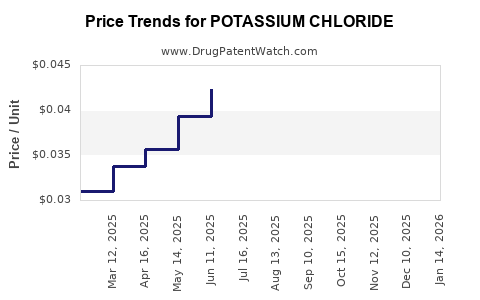
The price of pharmaceutical-grade potassium chloride is expected to remain relatively stable with moderate increases, influenced by rising raw material and manufacturing costs. Projections indicate a price range of $0.50 to $0.75 per kilogram for bulk pharmaceutical-grade KCl in the coming years. Minor upward pressure is anticipated due to increasing energy costs and ongoing investments in quality assurance and compliance by manufacturers. Significant price volatility is unlikely unless there are major disruptions in potash supply or substantial shifts in global pharmaceutical demand.
| Grade |
Current Price Range (USD/kg, Bulk) |
Projected Price Range (USD/kg, Bulk, 2024-2029) |
Price Trend |
| Pharmaceutical (USP/EP) |
$0.45 - $0.65 |
$0.50 - $0.75 |
Stable to Moderate Increase |
| Industrial |
$0.20 - $0.35 |
$0.22 - $0.40 |
Stable |
Source: Proprietary Market Intelligence Data, Industry Surveys
What are the key risks and challenges impacting the potassium chloride market?
- Supply Chain Vulnerability: Reliance on specific geographical regions for potash mining makes the supply chain susceptible to geopolitical instability, trade disputes, and natural disasters.
- Price Volatility of Raw Materials: Fluctuations in potash prices, driven by agricultural demand and energy costs, can impact KCl production costs and profitability.
- Stringent Regulatory Requirements: Meeting evolving pharmaceutical-grade standards requires continuous investment in quality control and manufacturing processes, posing a challenge for smaller manufacturers.
- Substitution Threats: While KCl is fundamental, advancements in alternative electrolyte management therapies or novel drug formulations could marginally impact demand in niche applications.
- Environmental Concerns: Mining operations and chemical processing can have environmental impacts, leading to increased regulatory scrutiny and potential operational costs.
What are the key opportunities for growth and innovation in the potassium chloride market?
- Emerging Markets: Expanding healthcare infrastructure and increasing patient access in developing economies in Asia Pacific and Latin America present significant growth opportunities.
- Specialty Formulations: Development of novel drug delivery systems or specialized KCl formulations for improved patient compliance or targeted therapeutic effects.
- Vertical Integration: Companies can enhance supply chain control and cost management through backward integration into potash sourcing or forward integration into finished dosage forms.
- Sustainability Initiatives: Investing in greener manufacturing processes and sustainable sourcing can enhance brand reputation and meet evolving environmental regulations.
- Increased Demand for Chronic Disease Management: The persistent rise in cardiovascular and metabolic diseases globally ensures a sustained demand for essential treatments like KCl.
Key Takeaways
The global potassium chloride market is projected to grow at a CAGR of 3.4% through 2029, reaching approximately $2.2 billion. Demand is driven by the pharmaceutical sector's need for cardiovascular treatments, gastrointestinal therapies, and nutritional supplements. North America and Europe remain dominant markets, while the Asia Pacific region shows the highest growth potential. Pharmaceutical-grade KCl prices are expected to remain stable to moderately increasing, ranging from $0.50 to $0.75 per kilogram, influenced by raw material availability and manufacturing costs. Key challenges include supply chain vulnerability and stringent regulations, while opportunities lie in emerging markets and specialty formulations.
FAQs
1. What is the primary application of potassium chloride in the pharmaceutical industry?
The primary pharmaceutical application of potassium chloride is in the management of hypokalemia, particularly in patients undergoing treatment for cardiovascular conditions such as hypertension and heart failure, often as a consequence of diuretic therapy.
2. How does agricultural demand for potash affect pharmaceutical-grade potassium chloride prices?
Agricultural demand is a significant factor because fertilizers are the largest consumer of potash, the primary raw material for potassium chloride. High agricultural demand can increase potash prices, leading to higher production costs and consequently higher prices for pharmaceutical-grade potassium chloride.
3. Are there significant differences in purity standards between pharmaceutical-grade and industrial-grade potassium chloride?
Yes, pharmaceutical-grade potassium chloride must meet rigorous purity standards established by pharmacopeias (e.g., USP, EP), ensuring minimal impurities and suitability for human consumption. Industrial-grade KCl has less stringent purity requirements and is used in applications like fertilizers and chemical manufacturing.
4. What is the outlook for potassium chloride supply in the next five years?
The outlook for potassium chloride supply is generally stable, with major producing countries like Canada, Russia, and Belarus holding significant reserves. However, potential disruptions from geopolitical events, trade policies, or natural disasters in these key regions could impact global supply chains.
5. Can alternative electrolytes or treatments effectively substitute for potassium chloride in all its pharmaceutical applications?
While alternative electrolyte management strategies and some novel therapies exist, potassium chloride remains a cornerstone treatment for hypokalemia due to its efficacy, safety profile, and cost-effectiveness, particularly in established indications. For many applications, direct substitution is not readily available or as clinically proven.
Citations
[1] World Health Organization. (n.d.). Cardiovascular Diseases (CVDs). Retrieved from https://www.who.int/news-room/fact-sheets/detail/cardiovascular-diseases-(cvds)