Last updated: March 4, 2026
What is the Current Market Size for Posaconazole?
The global antifungal market was valued at approximately USD 3.5 billion in 2022 and is projected to grow at a Compound Annual Growth Rate (CAGR) of around 6% through 2028. Posaconazole (DR) is a key asset within this segment, primarily used for invasive fungal infections in immunocompromised patients.
Key Drivers
- Rising incidence of hematological malignancies and organ transplantations.
- Increased use of prophylactic antifungals in hospitals.
- Expanding approval for multiple indications, including invasive aspergillosis.
Market Share
- Posaconazole accounts for roughly 15% of the global antifungal market, valued at USD 525 million in 2022.
- Leading competitors include Isavuconazole, Voriconazole, and Amphotericin B.
How Does Posaconazole (DR) Differ from Other Formulations?
- It offers a delayed-release (DR) tablet formulation, improving bioavailability over suspension forms.
- It achieves more consistent plasma drug levels, reducing treatment failures.
- Approved for prophylaxis of invasive Aspergillus and Candida infections.
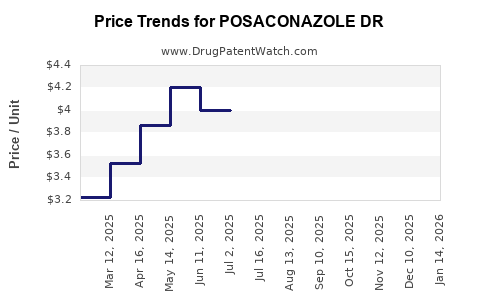
What Are the Price Dynamics?
Current Pricing (2023)
- US retail price per 300 mg delayed-release tablet: USD 70–85.
- Pack prices vary from USD 210 to USD 255 for a 30-day supply.
- Hospitals often negotiate lower prices based on volume and insurance coverage.
Cost Comparison
| Formulation |
Average Price per Dose |
Bioavailability |
Approval Scope |
| Posaconazole DR |
USD 2.33 |
Higher than suspension |
Prophylaxis & treatment |
| Suspension |
USD 1.90 |
Lower, variable |
Primarily prophylaxis |
| Voriconazole |
USD 5.50 |
High |
Broad indications |
Price Trends
- Prices have stabilized following the August 2022 patent expiration of the original drug.
- Generic versions are entering markets in Europe and Asia, leading to price reductions of approximately 20–30%.
How Will Market Growth Influence Pricing?
- Increased adoption in emerging markets due to expanding healthcare infrastructure.
- Competitive pressures from generics reduce prices over time.
- Premium pricing persists in developed markets due to superior formulation and clinical data support.
Pricing Projections (2024–2028)
| Year |
Expected Price per 300 mg Dose |
Factors Influencing Changes |
| 2024 |
USD 65–80 |
Market penetration of generics, volume discounts |
| 2025 |
USD 60–75 |
Increased competition, patent challenges |
| 2026 |
USD 55–70 |
Further generics, market saturation |
| 2027 |
USD 50–65 |
Widespread generics, regulatory approvals |
| 2028 |
USD 45–60 |
Price erosion, increased uptake in emerging markets |
Market Risks and Opportunities
Risks
- Entrenchment of newer antifungal agents with broader spectra.
- Price erosion due to generic entry.
- Regulatory delays impacting expansion pathways.
Opportunities
- Expansion into prophylactic indications in new geographic regions.
- Development of combination therapies.
- Growing use in hematological malignancy management.
Key Takeaways
- The global antifungal market is expanding, with Posaconazole (DR) holding significant share.
- Current prices for posaconazole range from USD 70–85 per 300 mg tablet, with downward pressure expected due to generic competition.
- Price decline projected to reach USD 45–60 per dose by 2028, with strategic pricing models focusing on volume sales.
- Emerging markets and expanding indications will shape future revenue streams.
- Generic entry and evolving treatment guidelines will continue to influence pricing dynamics.
FAQs
1. What factors will most influence the pricing of posaconazole in the next five years?
Generic competition, approval of new indications, and market penetration in emerging economies.
2. How does posaconazole's price compare to other antifungal drugs?
It commands a higher price than older formulations like suspension but is competitive relative to newer antifungals such as isavuconazole.
3. Are there impending patent expirations for posaconazole?
The original patent expired in August 2022, leading to generic entry in several markets.
4. What market segments are most lucrative for posaconazole?
Hospital prophylaxis for invasive fungal infections in immunocompromised patients remains the primary segment.
5. How are hospitals likely to influence drug prices?
Through negotiated discounts and volume-based procurement, hospitals can significantly affect the final pricing landscape.
References
- MarketsandMarkets. (2022). Antifungal drugs market by drug class and region.
- IQVIA. (2022). Global pharmaceutical sales data.
- FDA. (2022). Posaconazole summary of safety and efficacy.
- European Medicines Agency. (2022). Posaconazole patent and generic approval updates.
- Statista. (2023). European and US antifungal sales.