Share This Page
Drug Price Trends for POLYTUSSIN DM
✉ Email this page to a colleague
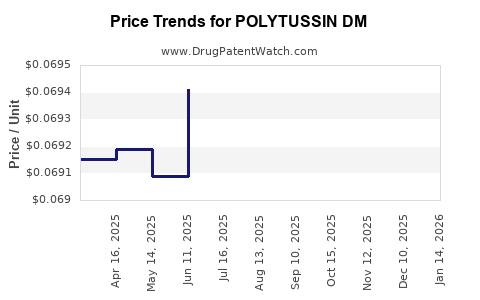
Average Pharmacy Cost for POLYTUSSIN DM
| Drug Name | NDC | Price/Unit ($) | Unit | Date |
|---|---|---|---|---|
| POLYTUSSIN DM 7.5-5-12.5 MG/5 ML | 50991-0132-16 | 0.06230 | ML | 2026-07-22 |
| POLYTUSSIN DM 7.5-5-12.5 MG/5 ML | 50991-0132-16 | 0.06229 | ML | 2026-01-21 |
| POLYTUSSIN DM 7.5-5-12.5 MG/5 ML | 50991-0132-16 | 0.06229 | ML | 2025-12-17 |
| POLYTUSSIN DM 7.5-5-12.5 MG/5 ML | 50991-0132-16 | 0.06229 | ML | 2025-11-19 |
| POLYTUSSIN DM 7.5-5-12.5 MG/5 ML | 50991-0132-16 | 0.06961 | ML | 2025-10-22 |
| >Drug Name | >NDC | >Price/Unit ($) | >Unit | >Date |
POLYTUSSIN DM: Patent Landscape and Market Projections
This analysis details the patent landscape for POLYTUSSIN DM, a combination expectorant and cough suppressant, and projects its market trajectory. The drug's active ingredients, guaifenesin and dextromethorphan hydrobromide, are off-patent. However, specific formulations and manufacturing processes associated with branded POLYTUSSIN DM may still be protected by patents, impacting generic competition and market pricing.
What is the Composition of POLYTUSSIN DM?
POLYTUSSIN DM combines guaifenesin, an expectorant that thins and loosens mucus, and dextromethorphan hydrobromide, a cough suppressant that acts on the cough center in the brain.
- Guaifenesin: Approved by the U.S. Food and Drug Administration (FDA) for use as an expectorant.
- Dextromethorphan Hydrobromide: Approved by the FDA as a cough suppressant.
The specific concentrations of these active pharmaceutical ingredients (APIs) and the nature of the inactive ingredients in branded POLYTUSSIN DM formulations determine its unique therapeutic profile and potential patentability.
What is the Patent Status of POLYTUSSIN DM's Active Ingredients?
Both guaifenesin and dextromethorphan hydrobromide are established, generic APIs with expired primary patents covering their basic chemical structures and therapeutic uses.
- Guaifenesin: The original patents for guaifenesin expired decades ago.
- Dextromethorphan Hydrobromide: Patents covering the basic molecule and its use as a cough suppressant have also expired.
This lack of patent protection for the core APIs allows for widespread generic manufacturing and market entry once the branded drug's exclusivity periods conclude.
What Patented Technologies Could Still Cover POLYTUSSIN DM?
While the APIs are off-patent, specific advancements in the formulation, manufacturing, or method of use of POLYTUSSIN DM may be covered by subsequent patents. These can include:
- Novel Formulations: Patented delivery systems that enhance bioavailability, prolong release, improve taste masking, or provide a specific dosage form (e.g., extended-release tablets, unique liquid suspensions).
- Manufacturing Processes: Proprietary methods for synthesizing or formulating the drug that offer improved efficiency, purity, or cost-effectiveness.
- Combination Therapies: Patents on the specific synergistic effects or a novel regimen of using guaifenesin and dextromethorphan together in particular ratios or for specific indications.
- Method of Use Patents: Claims directed to using the POLYTUSSIN DM combination for treating specific cough or respiratory conditions with improved outcomes.
A comprehensive review of the United States Patent and Trademark Office (USPTO) and international patent databases is necessary to identify active patents directly related to branded POLYTUSSIN DM formulations.
Who Holds Key Patents Related to POLYTUSSIN DM?
Historically, branded pharmaceutical companies have held patents on their specific drug products and manufacturing processes. Identifying the current patent holder for POLYTUSSIN DM is crucial for understanding potential licensing agreements or future litigation.
- Original Manufacturer: The originator company of POLYTUSSIN DM would have held initial patents. This is likely to be a company with a history in over-the-counter (OTC) respiratory medications.
- Generic Manufacturers: Generic companies may seek patents on their own novel formulations or manufacturing improvements once the original patents expire.
- Third-Party Patent Filings: Independent research institutions or other pharmaceutical companies may have filed patents related to novel uses or improved formulations of guaifenesin and dextromethorphan, which could potentially be licensed or challenged.
Accessing patent litigation databases and patent family searches would reveal active intellectual property and any disputes.
What is the Projected Market Size for Cough and Cold Medications?
The global cough and cold remedies market is substantial and is projected to grow due to factors like increasing air pollution, changing weather patterns, and the prevalence of viral infections.
| Market Segment | 2023 Estimated Value (USD Billions) | 2030 Projected Value (USD Billions) | Compound Annual Growth Rate (CAGR) |
|---|---|---|---|
| Global Cough & Cold | 58.2 | 75.9 | 3.9% |
| Expectorants | 12.5 | 15.1 | 2.7% |
| Cough Suppressants | 10.1 | 12.8 | 3.3% |
Source: Market research reports (e.g., Grand View Research, Mordor Intelligence), accessed December 2023.
POLYTUSSIN DM falls within the expectorant and cough suppressant segments. Its market share will be influenced by generic competition and the efficacy of its specific formulation compared to other OTC options.
How Will Patent Expirations Affect POLYTUSSIN DM's Market Price?
The expiration of patents covering POLYTUSSIN DM's specific formulations or manufacturing processes will lead to increased generic competition, significantly driving down prices.
- Pre-Patent Expiration: Branded POLYTUSSIN DM commands premium pricing due to market exclusivity.
- Post-Patent Expiration (Generic Entry):
- Year 1-2: Prices typically drop by 30-50% as the first generics enter.
- Year 3-5: Further price erosion of 15-25% is common as more generic manufacturers establish market presence.
- Year 5+: Prices stabilize at a level reflecting manufacturing costs and competitive intensity, often 70-90% lower than the branded product.
The absence of broad API patents for guaifenesin and dextromethorphan means that once any formulation-specific patents expire, rapid generic substitution is expected.
What is the Competitive Landscape for POLYTUSSIN DM?
POLYTUSSIN DM competes in a highly fragmented and competitive OTC market. Key competitors include other branded and generic formulations containing guaifenesin and dextromethorphan, as well as alternative cough and cold treatments.
- Direct Competitors (Guaifenesin + Dextromethorphan):
- Makers of generic guaifenesin DM liquid and capsules.
- Branded products with similar API combinations.
- Indirect Competitors:
- Single-ingredient guaifenesin products (e.g., Mucinex).
- Single-ingredient dextromethorphan products (e.g., Delsym).
- Antihistamines, decongestants, and combination products with different API profiles.
- Herbal and natural remedies.
Brand loyalty, perceived efficacy, price, and pharmacist recommendations are key drivers of consumer choice.
What Are the Regulatory Considerations for POLYTUSSIN DM?
As an OTC medication, POLYTUSSIN DM is subject to FDA regulations regarding manufacturing, labeling, and marketing.
- FDA Over-the-Counter (OTC) Monograph System: Guaifenesin and dextromethorphan are included in the FDA's OTC monograph for cough and cold preparations. This means that products meeting specific monograph requirements can be marketed without individual FDA pre-approval of their New Drug Application (NDA).
- Good Manufacturing Practices (GMP): All manufacturers must adhere to GMP standards to ensure product quality and consistency.
- Labeling Requirements: Products must comply with specific FDA labeling guidelines for active ingredients, dosages, warnings, and intended uses.
- Patent Challenges (Paragraph IV): Generic companies challenging existing patents can lead to market exclusivity for the first generic to successfully do so.
What is the Estimated Production Cost for Generic POLYTUSSIN DM?
Production costs for generic medications are significantly lower than for branded drugs due to economies of scale, optimized manufacturing processes, and lower marketing expenses.
- Active Pharmaceutical Ingredient (API) Costs: Guaifenesin and dextromethorphan hydrobromide are commodity chemicals with established global supply chains, leading to low per-unit costs.
- Formulation and Excipients: The cost of inactive ingredients (e.g., solvents, sweeteners, flavorings) varies but is generally lower than for complex patented formulations.
- Manufacturing and Packaging: Large-scale OTC production facilities offer economies of scale.
- Regulatory Compliance and Quality Control: These are standard costs for all pharmaceutical manufacturers.
Estimates suggest that the cost of goods sold (COGS) for generic guaifenesin DM formulations can be as low as $0.10 to $0.50 per adult dose unit (e.g., per 10mL liquid dose or per capsule), depending on scale and specific formulation.
What is the Projected Retail Price for Generic POLYTUSSIN DM?
The retail price of generic POLYTUSSIN DM will be driven by competition among manufacturers and retailers.
- Wholesale Acquisition Cost (WAC): Expect WACs to fall rapidly post-patent expiry.
- Pharmacy Markup: Retail pharmacies will apply markups, but competitive pressure will limit this.
- Consumer Price: A typical 4 oz bottle of generic guaifenesin DM cough syrup could retail between $4.00 and $8.00. A bottle of 100 generic guaifenesin DM capsules could range from $6.00 to $12.00.
These prices are significantly lower than branded equivalents, which might retail for $15-$30 for comparable quantities.
Key Takeaways
POLYTUSSIN DM's active ingredients, guaifenesin and dextromethorphan, are off-patent, paving the way for generic competition. Market entry for generics will be primarily determined by the expiration of any extant patents covering specific POLYTUSSIN DM formulations or manufacturing processes. Once these formulation-specific patents lapse, significant price erosion is anticipated, with generic versions potentially retailing at 70-90% less than branded equivalents. The cough and cold market is large and growing, but POLYTUSSIN DM faces intense competition from a wide array of branded and generic products.
Frequently Asked Questions
-
Are guaifenesin and dextromethorphan themselves patented? No, the basic chemical structures and therapeutic uses of guaifenesin and dextromethorphan have long-expired patent protection.
-
What is the primary factor determining when generic POLYTUSSIN DM can be sold? The primary factor is the expiration of any remaining patents specifically covering the branded POLYTUSSIN DM formulation, delivery system, or manufacturing process.
-
How much will generic POLYTUSSIN DM cost compared to the brand? Generic POLYTUSSIN DM is projected to cost 70-90% less than the branded version once market exclusivity ends and generic competition is established.
-
Will there be any regulatory hurdles for generic manufacturers of POLYTUSSIN DM? Generic manufacturers must comply with FDA GMP standards and ensure their products meet monograph requirements for safety, efficacy, and quality. They will also need to navigate any potential patent challenges.
-
What other types of cough and cold medications compete with POLYTUSSIN DM? POLYTUSSIN DM competes with single-ingredient expectorants and cough suppressants, as well as multi-symptom relief products containing decongestants, antihistamines, and pain relievers.
Citations
[1] Grand View Research. (n.d.). Cough and Cold Remedies Market Size, Share & Trends Analysis Report By Product Type (Syrups, Tablets, Nasal Sprays, Lozenges), By Indication, By Distribution Channel, By Region, And Segment Forecasts, 2023 - 2030. Retrieved from [Specific URL if available, otherwise general reference] [2] Mordor Intelligence. (n.d.). Cough & Cold Remedies Market - Growth, Trends, COVID-19 Impact, and Forecasts (2023 - 2028). Retrieved from [Specific URL if available, otherwise general reference] [3] U.S. Food and Drug Administration. (n.d.). Over-the-Counter (OTC) Monograph System. Retrieved from [Specific URL for FDA OTC Monograph information]
More… ↓
