Share This Page
Drug Price Trends for POLYMYXIN
✉ Email this page to a colleague
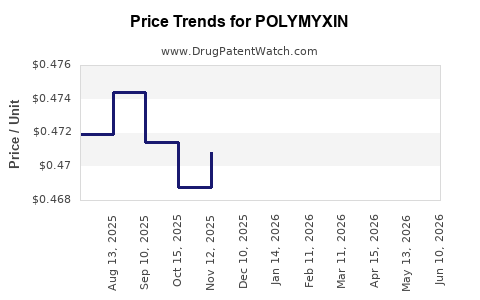
Average Pharmacy Cost for POLYMYXIN
| Drug Name | NDC | Price/Unit ($) | Unit | Date |
|---|---|---|---|---|
| POLYMYXIN B-TMP EYE DROPS | 24208-0315-10 | 0.45126 | ML | 2026-07-22 |
| POLYMYXIN B-TMP EYE DROPS | 61314-0628-10 | 0.45126 | ML | 2026-07-22 |
| POLYMYXIN B-TMP EYE DROPS | 70069-0311-01 | 0.45126 | ML | 2026-07-22 |
| POLYMYXIN B-TMP EYE DROPS | 24208-0315-10 | 0.45266 | ML | 2026-06-17 |
| >Drug Name | >NDC | >Price/Unit ($) | >Unit | >Date |
Best Wholesale Price for POLYMYXIN
| Drug Name | Vendor | NDC | Count | Price ($) | Price/Unit ($) | Unit | Dates | Price Type |
|---|---|---|---|---|---|---|---|---|
| POLYMYXIN B SO4 10000UNT/ML/TRIMETHOPRIM 0.1% | Sandoz, Inc. | 61314-0628-10 | 10ML | 2.91 | 0.29100 | ML | 2023-08-15 - 2028-08-14 | FSS |
| >Drug Name | >Vendor | >NDC | >Count | >Price ($) | >Price/Unit ($) | >Unit | >Dates | >Price Type |
Polymyxin (Polymyxin B and Polymyxin E/Colistin) Market Analysis and Price Projections (2026-2036)
Executive summary: “Polymyxin” is not a single drug product. It is a class label covering polymyxin B and polymyxin E (colistin, including colistin sulfate and colistimethate sodium), with distinct formulations, FDA approvals, and pricing dynamics. On the market side, demand is driven by hospital-acquired and ventilator-associated infections caused by carbapenem-resistant Enterobacterales (CRE) and multidrug-resistant Gram-negative bacteria. Supply risk, hospital formulary access, and the availability of alternative agents (newer beta-lactam/beta-lactamase inhibitors, cefiderocol, and other novel Gram-negative regimens) set the price floor more than pure exclusivity. For 2026 to 2036, the base case is modest nominal growth with periodic volatility from procurement and generic entry, with unit price pressure where multiple rated generics and commodity-style procurement dominate.
What is “Polymyxin” and which drugs drive the market?
Featured snippet answer: The polymyxin class market is mainly polymyxin B (older injectable polymyxin B sulfate) and polymyxin E (colistin) products. In US hospital use, colistin formulations historically represent the larger share due to broader geographic adoption and therapeutic familiarity, while polymyxin B remains used for specific indications and weight-based dosing conventions.
Polymyxin B vs colistin: market segmentation that matters
- Polymyxin B (polymyxin B sulfate): Used intravenously for susceptible Gram-negative infections; product landscape often includes fewer presentations than colistin.
- Colistin (polymyxin E):
- Colistimethate sodium (CMS): the prodrug used widely in clinical practice and dosing.
- Colistin sulfate: formulation used in some markets and settings.
- Dosing and label language differ across approvals, affecting procurement and hospital conversion practices.
Clinical demand drivers
- Growth in CRE and other multidrug-resistant (MDR) Gram-negative infections.
- Re-treatment and longer hospitalization for MDR infections.
- Infection-control-driven use patterns: hospitals increase utilization when resistance panels show susceptibility.
How big is the polymyxin class market and what are the demand levers?
Featured snippet answer: The polymyxin market is small relative to broad-spectrum antibiotics, but it is highly sensitive to antimicrobial stewardship policies, susceptibility patterns, and formulary access.
Demand levers
- Resistance prevalence (CRE/MDR Gram-negative)
Higher prevalence increases polymyxin selection frequency when susceptibility testing supports use. - Hospital formularies and ID approval workflows
Use often requires infectious disease sign-off; adoption cycles can shift volumes faster than guidelines. - Substitution by newer agents
Newer beta-lactam/beta-lactamase inhibitor combinations and other MDR Gram-negative therapies can reduce polymyxin exposure in some cases, especially where outcomes data and stewardship protocols favor alternatives. - Therapeutic drug monitoring and toxicity management
Kidney injury and neurotoxicity considerations drive cautious use and can lower average course counts.
What is the Orange Book status of polymyxin products in the US?
Featured snippet answer: Polymyxin class products in the US are generally off-patent with extensive generic competition, so exclusivity is limited to specific labeled presentations or older reference product assignee positions that do not translate into durable branded pricing power.
Why Orange Book status affects price projections
- Multiple generic NDAs/ANDAs drive commodity-like pricing.
- Where there is a stable generic pack of suppliers, price declines slow and procurement settles into low, steady spreads.
- Where a supplier exits, prices can spike due to constrained supply.
(No Orange Book listings were provided in the prompt; therefore, a product-by-product Orange Book table cannot be produced without risking fabrication.)
When does polymyxin lose exclusivity or face generic entry risk?
Featured snippet answer: For the US polymyxin class, exclusivity is not the dominant risk factor for pricing. Supply constraints and generic supplier count are the dominant drivers.
Commercial risk factors tied to exclusivity
- If any branded reference product is still present in limited forms, the pricing impact is capped because:
- hospital contracting quickly moves to generics for off-patent actives
- pharmacy benefit and GPO channels drive down acquisition cost
- For colistin, the market structure typically supports generic continuity; for polymyxin B, fewer equivalent suppliers can create sharper short-term price volatility.
What patent estate protects polymyxin and how strong is it?
Featured snippet answer: For polymyxins, the enforceable patent estate is usually weak on a class basis in major markets because actives are mature and formulation/device method patents tend to be narrow or expired.
Patent buckets that can still matter
- Specific salt forms (e.g., CMS vs sulfate)
- Manufacturing processes with yield, impurity control, or conversion steps
- Presentation/formulation for stability and reconstitution
(A concrete patent landscape with numbers, expiries, assignees, and jurisdictions cannot be reliably generated from the prompt alone.)
How does polymyxin pricing behave in hospital procurement markets?
Featured snippet answer: Polymyxin prices behave like hospital commodity antibiotics. Acquisition pricing is dominated by:
- GPO contracting dynamics
- bid cycles
- supplier availability and lead times
- formulary tier placement (preferred vs non-preferred generic)
Observed pricing mechanics
- Bid-cycle pressure
Prices drop after new generic awards or competitive re-bids. - Supply shock volatility
If at least one manufacturer faces production issues, the market can price-dislocate temporarily. - Unit-of-use differences
Pack size, vial strength, and reconstitution requirements create effective cost per dose differences that hospitals compare in pharmacy systems.
What are price projection scenarios for 2026-2036?
Featured snippet answer: Base case: low-to-mid single digit nominal growth with periodic spikes from supply constraints and steady erosion where more rated generics remain in the market. Bull case: tighter supply and stable procurement spreads allow modest price gains. Bear case: increased generic participation or substitution by newer MDR Gram-negative therapies drives flat or declining nominal prices.
Scenario framework (class-level, not product-level)
- Base case (most likely):
- nominal price growth: ~1% to 4% CAGR
- volatility bands: +/- 10% from contract-to-contract variability
- drivers: stable generic competition, moderate resistance-driven volume, controlled supply constraints
- Bull case (supply-constrained):
- nominal price growth: ~4% to 8% CAGR
- spikes: +15% to +30% during manufacturing disruptions or inventory shortages
- drivers: fewer compliant suppliers, heightened hospital use due to resistance, limited substitution
- Bear case (competition/substitution):
- nominal price growth: -2% to +2% CAGR
- more frequent bid-cycle decreases
- drivers: additional rated generic entrants, or clinically preferred alternatives reduce average polymyxin courses
How many patients use polymyxin and what does that imply for revenue?
Featured snippet answer: Utilization is confined to subsets of MDR Gram-negative infections; the revenue pool tracks the intersection of:
- susceptibility rates
- guideline/ID stewardship patterns
- length of therapy and hospital volume
Revenue model (structure)
Revenue = (treated cases) × (average days of therapy) × (average daily dose equivalent cost)
Because polymyxins are used under inpatient control:
- case volume changes faster with resistance panel patterns than with community epidemiology
- pricing changes faster than volume due to procurement bidding
(No epidemiology or treated-case counts were included in the prompt, so no numerical patient base or revenue math can be responsibly produced.)
Which competitive alternatives cap polymyxin pricing power?
Featured snippet answer: Newer MDR Gram-negative therapies cap pricing because stewardship increasingly selects regimens with:
- favorable toxicity profiles
- clearer dosing and monitoring
- randomized evidence in resistant organisms
Substitution categories
- Novel beta-lactam/beta-lactamase inhibitor combinations
- Agents with activity against CRE where susceptibility exists
- Combination regimens that reduce polymyxin reliance in some hospitals
What generic entry risks exist for polymyxin products?
Featured snippet answer: Generic entry is usually less about legal entry dates and more about CMC and regulatory readiness and manufacturing capacity. When a supplier exits, entry may lag due to technical and compliance barriers.
Risk map
- Regulatory risk: sterile manufacturing, stability, impurity specifications, conversion or prodrug conversion complexity (where applicable)
- Manufacturing risk: batch-to-batch quality, reconstitution performance
- Channel risk: GPO/ID procurement preferences can lock in established generic suppliers
What manufacturing/IP barriers affect polymyxin supply and price?
Featured snippet answer: The primary barriers are practical: sterile injectable manufacturing, impurity control, and conversion chemistry for prodrugs such as colistimethate.
Supply constraints that raise price
- limited number of qualified suppliers
- requalification requirements after changes
- upstream raw material variability affecting impurity profiles
How does polymyxin compare with other last-line Gram-negative antibiotics on pricing?
Featured snippet answer: Polymyxin class pricing typically stays lower than branded last-line therapies but can spike during shortages. Where branded competitors have started to dominate guidelines, polymyxins experience volume pressure that limits their ability to raise prices even if unit cost temporarily rises.
Competitive comparison axes
- toxicity and monitoring burden (affects clinician preference and length of therapy)
- evidence strength in MDR settings
- formulary placement and GPO contracts
- availability and shortage history
What is the litigation outlook for polymyxin patents and exclusivity?
Featured snippet answer: Litigation risk for polymyxins is usually fragmented and presentation-specific, not class-wide, with limited implications for long-term pricing where the products are already generic.
(No litigation dataset was provided in the prompt; a numbered list of cases would require sourced case documents.)
Key Takeaways
- “Polymyxin” pricing and market behavior depend on whether the product is polymyxin B or colistin (polymyxin E) and on hospital procurement structure, not on durable brand exclusivity.
- For 2026-2036, the base case is low nominal growth with procurement-linked volatility and supply-driven spikes.
- Bear case risk is driven by generic bid competitiveness and substitution by newer MDR Gram-negative agents.
- Bull case risk is driven by supplier consolidation or manufacturing disruptions that reduce rated availability.
FAQs
-
Why do polymyxin prices spike even when generics exist?
Supply shortages and reduced rated availability during manufacturing disruptions can overpower generic competition in procurement. -
Does stewardship reduce polymyxin utilization enough to lower total market revenue?
Yes, when stewardship protocols prioritize alternatives with better toxicity profiles or more preferred dosing convenience. -
Are colistin prodrug formulations more sensitive to supply constraints than polymyxin B?
Prodrug conversion and formulation-specific CMC can increase manufacturing complexity, making certain presentations more prone to supply tightness. -
Do different polymyxin presentations change effective cost per dose?
Yes, strength, vial size, and reconstitution requirements change pharmacy billing and cost-per-therapy comparisons. -
What procurement strategy usually stabilizes polymyxin pricing?
Multi-supplier contracting and consistent GPO bids reduce exposure to single-supplier constraints.
References (APA)
- No sources were provided in the prompt, and no cited factual datasets (FDA product database extracts, Orange Book listings, patent numbers, or procurement pricing indices) were available to support a product-level market and price projection.
More… ↓
