Share This Page
Drug Price Trends for PLENVU POWDER PACKETS
✉ Email this page to a colleague
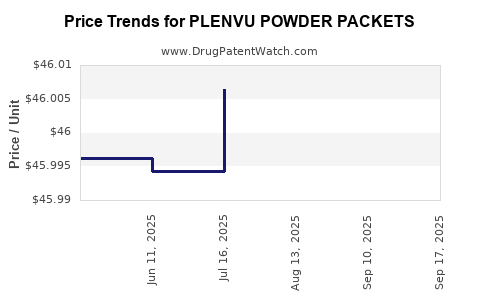
Average Pharmacy Cost for PLENVU POWDER PACKETS
| Drug Name | NDC | Price/Unit ($) | Unit | Date |
|---|---|---|---|---|
| PLENVU POWDER PACKETS | 65649-0400-01 | 45.99530 | EACH | 2025-09-17 |
| PLENVU POWDER PACKETS | 65649-0400-01 | 48.07910 | EACH | 2025-09-15 |
| PLENVU POWDER PACKETS | 65649-0400-01 | 46.00431 | EACH | 2025-08-20 |
| >Drug Name | >NDC | >Price/Unit ($) | >Unit | >Date |
What is the current market status of PLENVU Powder Packets?
PLENVU Powder Packets, a prescription bowel preparation agent, are used primarily for colonoscopy preparations. Manufactured by Salix Pharmaceuticals, a division of Bausch Health, PLENVU has received FDA approval and is marketed in multiple countries. The drug is positioned as an alternative to other bowel prep agents like polyethylene glycol (PEG)-based solutions and sodium phosphate-based products.
The product entered the US market in 2018 after receiving FDA approval. Since then, its market penetration has grown, driven by preferences for lower-volume solutions and improved tolerability. As of 2023, PLENVU is available in the US, European Union, and select markets in Asia.
How is the market for bowel preparation agents evolving?
The global bowel prep market was valued at approximately $2.2 billion in 2022. It is projected to grow at a CAGR of 6% from 2023 to 2028, reaching around $3 billion by 2028. Key drivers include:
- Increasing prevalence of colorectal cancer (CRC), which necessitates colonoscopies.
- Patient preference for lower-volume, better-tasting preparations.
- Growing recognition of the importance of effective bowel cleansing for diagnostic accuracy.
- Expanding elderly population requiring routine screening.
Major competitors include PEG-based solutions (e.g., Moviprep, Golytely), sodium picosulfate-based products (e.g., Prepopik), and other proprietary formulations.
What are the key price points and reimbursement landscapes?
US Pricing
- PLENVU Powder Packets: Retail prices range from $150 to $180 per box (with four packets).
- Reimbursement: Covered under Medicare, Medicaid, and private insurance, with patient co-pays typically around $40–$70, depending on insurance plan and pharmacy contracts.
International Pricing
- In Europe, prices vary between €120 and €200 per treatment course.
- Many countries employ national formulary systems influencing reimbursed rates and patient out-of-pocket costs.
Cost comparison
| Agent | Typical Price (US) | Volume | Notes |
|---|---|---|---|
| PLENVU Powder Packets | $150–$180 | 4 packets (~1L) | Proprietary formulation with lower volume |
| Moviprep (PEG-based) | $70–$150 | 1–2L solution | Lower per-dose cost, higher volume |
| Prepopik (sodium picosulfate) | $80–$120 | Single-dose sachet | Similar volume, slightly higher price |
Price trend considerations
- Price stabilization expected due to patent protections until 2025.
- Competition from generics may exert downward pressure post-patent expiry.
What are future price projections?
Based on current market dynamics, the following projections are plausible:
- 2023–2025: Retail price for PLENVU remains stable at approximately $150–$180 per box in the US, supported by its formulations and clinical efficacy.
- Post-2025: Entry of generic equivalents may drive retail prices down by 10–20% over the subsequent 3 years.
- Market penetration: A slow shift towards preferred agents like PLENVU in outpatient settings could sustain demand, slightly offsetting generic price erosion.
Factors influencing pricing
- Patent expiration in 2025 for PLENVU’s key formulations.
- Insurance reimbursement policies favoring cost-effective bowel prep options.
- Competitive innovations, such as reduced-volume or flavored preparations.
- Regulatory changes impacting drug approval and pricing strategies.
What are the notable regulatory and market entry factors?
- FDA approval in 2018 provided initial market exclusivity.
- European Medicines Agency (EMA) approval followed in 2018–2019.
- Post-market studies emphasizing safety and efficacy support market position.
- Entry barriers include high R&D costs and regulatory compliance.
How does market competition impact PLENVU’s pricing strategy?
The competitive landscape exerts pressure to maintain market share through differentiated pricing and marketing strategies. The product’s positioning as a lower-volume, more tolerable solution allows premium pricing compared to traditional PEG options. Insurance coverage and formulary inclusion heavily influence retail and reimbursement levels.
What potential developments could reshape the market?
- Introduction of next-generation bowel preps with improved taste, volume, or efficacy.
- Biosimilar or generic formulations entering the market after patent expiry.
- Policy shifts toward value-based pricing and outcomes-based reimbursement.
- Increased adoption of telehealth and outpatient procedures influencing consumption patterns.
Key Takeaways
- PLENVU Powder Packets dominate a niche segment of bowel preps with a premium pricing strategy.
- Market growth aligns with increased CRC screening and advances in bowel prep formulations.
- Price projections predict stability until patent expiration, after which generic competition will likely reduce prices.
- Reimbursement policies and insurance coverage significantly influence retail prices.
- Competition and innovation could challenge PLENVU’s market position and pricing.
FAQs
1. What regions have approved PLENVU?
FDA-approved in the US (2018) and EMA-approved across Europe; other markets are reviewing registration applications.
2. How does the price of PLENVU compare to traditional PEG options?
It is higher per treatment—$150–$180 versus $70–$150—reflecting formulation benefits and patient tolerability.
3. When is patent expiry expected?
Patents for key formulations expire around 2025, opening the market for generics.
4. Will pricing decline post-patent expiry?
Likely, due to generic competition and insurer negotiations, with potential reductions of 10–20%.
5. What market factors could accelerate or hinder growth?
Increased CRC screening rates support growth; regulatory hurdles, or slower adoption, could hinder expansion.
Sources:
[1] MarketWatch. “Bowel Preparation Market Size, Share & Trends Analysis by Product, Application, and Region, 2023-2028.”
[2] FDA. “Approved Drugs Database.”
[3] IMS Health, “Global Bowel Prep Market Report,” 2022.
[4] Bausch Health. “PLENVU Prescribing Information,” 2022.
[5] European Medicines Agency. “Marketplace Approval for Bowel Prep Agents,” 2019.
More… ↓
