Share This Page
Drug Price Trends for PHENELZINE
✉ Email this page to a colleague
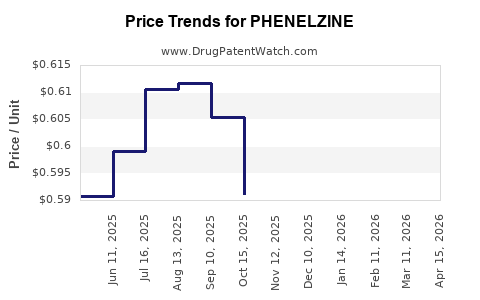
Average Pharmacy Cost for PHENELZINE
| Drug Name | NDC | Price/Unit ($) | Unit | Date |
|---|---|---|---|---|
| PHENELZINE SULFATE 15 MG TAB | 59762-0119-01 | 0.59070 | EACH | 2026-07-22 |
| PHENELZINE SULFATE 15 MG TAB | 59762-0119-01 | 0.59520 | EACH | 2026-06-17 |
| PHENELZINE SULFATE 15 MG TAB | 59762-0119-01 | 0.59387 | EACH | 2026-05-20 |
| PHENELZINE SULFATE 15 MG TAB | 59762-0119-01 | 0.58874 | EACH | 2026-04-22 |
| PHENELZINE SULFATE 15 MG TAB | 59762-0119-01 | 0.57925 | EACH | 2026-03-18 |
| PHENELZINE SULFATE 15 MG TAB | 59762-0119-01 | 0.57121 | EACH | 2026-02-18 |
| PHENELZINE SULFATE 15 MG TAB | 59762-0119-01 | 0.57145 | EACH | 2026-01-21 |
| >Drug Name | >NDC | >Price/Unit ($) | >Unit | >Date |
Market Analysis and Price Projections for Phenelzine
Phenelzine, a monoamine oxidase inhibitor (MAOI) antidepressant, has been a subject of interest in the pharmaceutical market due to its unique mechanism of action and effectiveness in treating certain types of depression. This article delves into the current market status, pricing trends, and future projections for phenelzine, providing valuable insights for industry professionals and stakeholders.
The Global Antidepressant Market Landscape
The global antidepressant market, which includes phenelzine, is experiencing significant growth. As of 2024, the market is valued at approximately $18.72 billion and is projected to reach $30.50 billion by 2031, exhibiting a compound annual growth rate (CAGR) of 7.2%[6]. This growth is primarily driven by the increasing prevalence of depression and other mental health disorders worldwide.
"The Global Antidepressant Market is estimated to be valued at USD 18.72 Bn in 2024 and is expected to reach USD 30.50 Bn by 2031, exhibiting a compound annual growth rate (CAGR) of 7.2% from 2024 to 2031." [6]
Phenelzine's Position in the Market
Phenelzine, marketed under the brand name Nardil, occupies a niche position within the antidepressant market. While it's not a first-line treatment due to its potential for serious side effects and interactions, it remains a valuable option for treatment-resistant depression.
Market Size and Growth
The global Monoamine Oxidase (MAO) Inhibitor Drugs market, which includes phenelzine, is projected to grow at a CAGR of 4.12% over the forecast period of 2022 to 2029[1]. This growth rate, while positive, is lower than the overall antidepressant market, reflecting the specialized nature of MAOIs.
Factors Driving Market Growth
Several factors contribute to the continued demand for phenelzine:
- Increasing patient pool of depression disorders
- Rising geriatric population prone to mental health issues
- Government initiatives to spread awareness about mental health
- Development of novel drugs with fewer side effects
However, the market faces challenges such as:
- Patent expiration of antidepressant drugs
- Poor efficacy and safety profiles of some drugs
Pricing Analysis
Understanding the pricing dynamics of phenelzine is crucial for market participants. Let's examine the current pricing landscape:
Generic Phenelzine Pricing
The cost for generic phenelzine 15 mg oral tablets is approximately $45 for a supply of 60 tablets[2]. This translates to about $0.74 per tablet.
Brand Name Nardil Pricing
The brand name version, Nardil, is significantly more expensive. The cost for Nardil 15 mg oral tablets is around $171 for a supply of 60 tablets[5], which equates to about $2.85 per tablet.
Price Comparison
When comparing the prices:
- Generic phenelzine: $0.74 per tablet
- Brand name Nardil: $2.85 per tablet
This represents a price difference of about 285%, highlighting the significant cost savings that generic versions offer.
Market Dynamics and Competitive Landscape
The phenelzine market is influenced by various factors and players:
Key Market Players
Several pharmaceutical companies are involved in the production and distribution of phenelzine and other antidepressants:
- Eli Lilly and Company
- Pfizer Inc.
- GlaxoSmithKline PLC
- AstraZeneca
- AbbVie Inc.
- Johnson & Johnson
- H. Lundbeck AS
- Sanofi
- Bristol-Myers Squibb
- Alkermes Plc
These companies compete in the broader antidepressant market, with some focusing on developing newer, more targeted therapies.
Market Challenges
Despite its effectiveness for certain patients, phenelzine faces several challenges:
-
Safety Concerns: The Committee noted that phenelzine was associated with potentially serious adverse effects and had a high potential for drug-drug and drug-food interactions[7].
-
Limited Availability: Shortages of phenelzine have been reported in many jurisdictions, including Australia, Belgium, Canada, the United Kingdom, and the United States[7].
-
Monitoring Requirements: Treatment with phenelzine requires careful and specialized monitoring and management, which may not be available in many low- and middle-income settings[7].
-
Cost: Compared to newer antidepressants, phenelzine can be more expensive. For example, a year's supply of phenelzine (60 mg/day) in the UK costs £327.60, compared to £28.86 for amitriptyline (75 mg/day) and £7.04 for fluoxetine (20 mg/day)[7].
Future Market Projections
Looking ahead, several trends are likely to shape the phenelzine market:
1. Shift Towards Newer Antidepressants
While phenelzine will likely maintain its niche in treating resistant depression, the overall trend is towards newer antidepressants with fewer side effects and interactions.
2. Generic Competition
As patents expire, increased generic competition may lead to price reductions, potentially improving access to phenelzine.
3. Research and Development
Ongoing research into depression treatments may lead to new formulations or delivery methods for phenelzine, potentially improving its safety profile.
4. Regulatory Environment
Changes in regulatory policies regarding antidepressants could impact the availability and pricing of phenelzine.
5. Global Market Expansion
The growing awareness of mental health issues in developing countries may lead to increased demand for various antidepressants, including phenelzine.
Regional Market Analysis
The phenelzine market varies significantly across regions:
North America
The United States remains a key market for phenelzine. The US anti-depressant drugs market was valued at $6.9 billion in 2022 and is projected to reach $9.37 billion by 2030, growing at a CAGR of 3.9%[9].
Europe
European markets have seen fluctuations in phenelzine availability. In some countries, it remains an important option for treatment-resistant depression.
Asia-Pacific
Growing awareness of mental health issues and improving healthcare infrastructure in countries like India and China may lead to increased demand for various antidepressants, including phenelzine.
Pricing Strategies and Considerations
For pharmaceutical companies and healthcare providers, several factors should be considered when developing pricing strategies for phenelzine:
-
Production Costs: The challenges in manufacturing the active pharmaceutical ingredient can impact pricing.
-
Competitive Landscape: Prices of alternative antidepressants influence phenelzine's pricing.
-
Regulatory Policies: Government regulations and reimbursement policies play a crucial role in pricing decisions.
-
Patient Access Programs: Implementing patient assistance programs can help balance profitability with accessibility.
-
Value-Based Pricing: Considering the drug's effectiveness in treatment-resistant depression could justify premium pricing in certain markets.
The Role of Generic Manufacturers
Generic manufacturers play a crucial role in the phenelzine market:
-
Increased Accessibility: Generic versions significantly reduce the cost of phenelzine, making it more accessible to patients.
-
Market Stability: Multiple generic manufacturers can help ensure a stable supply, reducing the risk of shortages.
-
Price Competition: Generic competition typically leads to price reductions over time, benefiting healthcare systems and patients.
Impact of COVID-19 on the Phenelzine Market
The COVID-19 pandemic has had complex effects on the antidepressant market, including phenelzine:
-
Increased Demand: The pandemic has led to increased rates of depression and anxiety, potentially boosting demand for antidepressants.
-
Supply Chain Disruptions: Global supply chain issues have affected the production and distribution of many pharmaceuticals, including phenelzine.
-
Telehealth Adoption: The rapid adoption of telehealth services may have influenced prescribing patterns for antidepressants.
Future Research and Development
While phenelzine is an older medication, ongoing research could impact its market position:
-
Formulation Improvements: Research into new formulations could potentially reduce side effects or improve dosing convenience.
-
Combination Therapies: Studies on combining phenelzine with other medications could open new treatment avenues.
-
Precision Medicine: Advances in pharmacogenomics could help identify patients most likely to benefit from phenelzine, potentially expanding its use.
Key Takeaways
- The global antidepressant market is growing steadily, with projections reaching $30.50 billion by 2031.
- Phenelzine occupies a niche position in the market, valued for its effectiveness in treatment-resistant depression.
- Generic phenelzine offers significant cost savings compared to the brand-name version, Nardil.
- The phenelzine market faces challenges including safety concerns, limited availability, and the need for careful monitoring.
- Future market trends include a shift towards newer antidepressants, increased generic competition, and potential research into improved formulations.
- Regional variations in market dynamics and regulatory environments significantly impact phenelzine's availability and pricing.
- The COVID-19 pandemic has influenced the antidepressant market, potentially increasing demand while disrupting supply chains.
- Ongoing research and development could lead to new applications or improved formulations of phenelzine.
FAQs
-
Q: What is the current market size for phenelzine? A: While specific figures for phenelzine are not available, the global Monoamine Oxidase (MAO) Inhibitor Drugs market, which includes phenelzine, is projected to grow at a CAGR of 4.12% from 2022 to 2029.
-
Q: How does the price of generic phenelzine compare to the brand-name version? A: Generic phenelzine costs about $0.74 per tablet, while the brand-name version, Nardil, costs approximately $2.85 per tablet, representing a price difference of about 285%.
-
Q: What are the main challenges facing the phenelzine market? A: The main challenges include safety concerns, limited availability, the need for careful monitoring, and competition from newer antidepressants with fewer side effects.
-
Q: How has the COVID-19 pandemic affected the phenelzine market? A: The pandemic has potentially increased demand for antidepressants due to rising rates of depression and anxiety, but has also caused supply chain disruptions that may affect production and distribution.
-
Q: What future developments could impact the phenelzine market? A: Future developments that could impact the market include research into new formulations, combination therapies, and advances in precision medicine that could help identify patients most likely to benefit from phenelzine.
Sources cited: [1] https://www.databridgemarketresearch.com/reports/global-monoamine-oxidase-mao-inhibitor-drugs-market [2] https://www.drugs.com/price-guide/phenelzine [4] https://www.ncbi.nlm.nih.gov/books/NBK554508/ [5] https://www.drugs.com/price-guide/nardil [6] https://www.coherentmarketinsights.com/industry-reports/antidepressant-market [7] https://list.essentialmeds.org/recommendations/1442/print?format=pdf [9] https://www.insights10.com/report/usanti-depressants-drugs-market-analysis/
More… ↓
