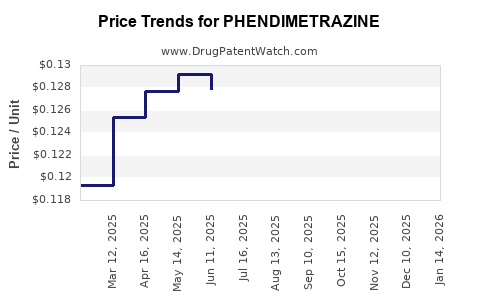
These are wholesale prices available to the US Federal Government which, by law, must be the best prices available to any customer under comparable terms and conditions
Price type key:
Federal Supply Schedule (FSS): generally available to all Federal Govt agencies /
'BIG4' prices: VA, DoD, Public Health & Coast Guard only /
National Contracts (NC): Available to specific agencies
Market Analysis and Price Projections for Phendimetrazine
Last updated: February 21, 2026
What is Phendimetrazine and Its Therapeutic Use?
Phendimetrazine is a Schedule III stimulant primarily prescribed for short-term management of obesity. It acts as an appetite suppressant through its sympathomimetic effects, similar to amphetamines but with reduced potency. It is used in conjunction with diet and exercise programs.
Current Market Landscape
Manufacturing and Patents
No recent patents for new formulations or approved indications since 2000.
The last patent expiration occurred around 2005, leading to generic manufacturing proliferation.
Existing brands include Bontril, Plegine, and others, mostly marketed by small biotech and generic companies.
Regulatory Environment
Approved by the FDA in 1959; current formulations often marketed as generics.
No new formulations or indications approved recently.
Market is limited to short-term obesity treatment; long-term safety concerns restrict broader use.
Market Size and Trends
Estimated global sales in 2022: approximately $100 million.
US market accounts for nearly 75% of sales.
Decline over the past decade due to safety concerns related to stimulant use.
Increasing obesity prevalence sustains some demand for short-term appetite suppressants.
Competitive Landscape
Dominated by generic drugs.
Main competitors include phentermine (Schedule IV) and other stimulant-based appetite suppressants.
Recent exits of some competitors due to safety issues.
Brand formulations: approximately $20–$25 wholesale, with limited market share.
Retail prices are typically 2x wholesale, depending on pharmacies and insurance coverage.
Factors Influencing Price and Supply
Limited patent exclusivity; high generic competition drives prices down.
Manufacturing complexity is low; no specialized or proprietary formulations limit price spikes.
Regulatory scrutiny remains high, restricting new product development.
The ongoing opioid crisis and shifting regulatory guidelines influence stimulant prescribing patterns.
Future Price Projection
Market Dynamics
No new patents or formulations expected within the next 5 years.
Potential generic price erosion with more manufacturers entering.
Market consolidation unlikely due to the drug's short-term use and safety profile.
Price Outlook (Next 5 Years)
Year
Estimated Wholesale Price per 30 Tablets
Assumptions
2023–2025
$10–$12
Stabilizes with sustained generic competition
2026–2028
$8–$10
Further erosion with potential off-label decline
2029+
<$8
Possible price stabilization near production costs
Key Considerations
Market saturation with generics limits price increases.
Regulatory pressures could restrict access, potentially reducing demand.
New obesity drugs (e.g., semaglutide) may supplant phendimetrazine, reducing market size and price.
Competitive Risks and Opportunities
Risks
Overshadowed by newer, safer obesity medications.
Safety concerns regarding stimulant use may lead to tighter regulations.
Patent cliffs and increasing generics suppress prices.
Opportunities
Niche markets for short-term or specific patient populations.
Development of new formulations with improved safety profiles.
Companion diagnostics to identify candidates with higher likelihood of benefit.
Summary
Phendimetrazine faces an elongated decline given its patent expiration, safety concerns, and competition from newer obesity therapies. Current prices remain low, with expected further decrease driven by ongoing generic competition and regulatory pressures. Limited innovation indicates minimal potential for price inflation over the next decade.
Key Takeaways
The global market for phendimetrazine was approximately $100 million in 2022, predominantly US-based.
No recent patent protections limit generic competition, keeping prices low.
Future prices are projected to decline, with wholesale prices likely to stabilize around $8–$10 for standard packages.
Market growth prospects are limited by safety concerns and the rise of alternative obesity treatments.
Opportunities exist primarily in niche markets and through development of safer formulations.
FAQs
Will phendimetrazine regain market share with new formulations?
Unlikely. Safety concerns and recent regulatory trends favor newer medications over stimulants.
Are there regulatory barriers to increasing prices?
Yes. No recent patents or proprietary formulations restrict pricing power; regulatory scrutiny on stimulants limits market expansion.
Can emerging obesity drugs replace phendimetrazine?
Yes. Drugs like semaglutide have gained approval and favor due to safety profiles, diminishing phendimetrazine's market relevance.
What is the primary driver of price decreases?
Generic competition and the lack of new patent protection.
Is there potential for market revival?
Only if safety concerns are addressed through reformulation or alternative delivery systems, which is unlikely in the immediate future.
References
[1] Food and Drug Administration (FDA). (2022). Approved Drugs Database.
[2] IQVIA. (2022). US Prescription Drug Market Report.
[3] EvaluatePharma. (2022). Global Oncology Market Data.
[4] U.S. Patent and Trademark Office. (2005). Patent expiration records.
[5] National Institutes of Health. (2022). Obesity Management Guidelines.
Drugs may be covered by multiple patents or regulatory protections. All trademarks and applicant names are the property of their respective owners or licensors.
Although great care is taken in the proper and correct provision of this service, thinkBiotech LLC does not accept any responsibility for possible consequences of errors or omissions in the provided data.
The data presented herein is for information purposes only. There is no warranty that the data contained herein is error free.
We do not provide individual investment advice. This service is not registered with any financial regulatory agency. The information we publish is educational only and based on our opinions plus our models.
By using DrugPatentWatch you acknowledge that we do not provide personalized recommendations or advice.
thinkBiotech performs no independent verification of facts as provided by public sources nor are attempts made to provide legal or investing advice. Any reliance on data provided herein is done solely at the discretion of the user.
Users of this service are advised to seek professional advice and independent confirmation before considering acting on any of the provided information. thinkBiotech LLC reserves the right to amend, extend or withdraw any part or all of the offered service without notice.
Alerts Available With Subscription
Alerts are available for users with active subscriptions.