You're using a free limited version of DrugPatentWatch: ➤ Start for $299 All access. No Commitment.

Last Updated: April 1, 2026

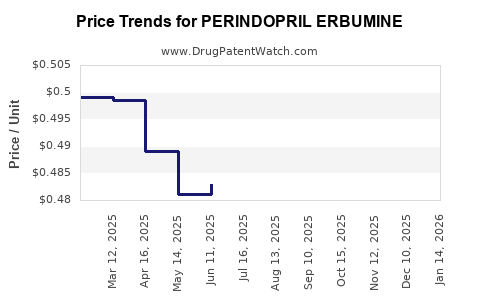
Drug Price Trends for PERINDOPRIL ERBUMINE


✉ Email this page to a colleague
« Back to Dashboard


Drug Price Trends for PERINDOPRIL ERBUMINE

Average Pharmacy Cost for PERINDOPRIL ERBUMINE

These are average pharmacy acquisition costs (net of discounts) from a US national survey
Drug Name NDC Price/Unit ($) Unit Date
PERINDOPRIL ERBUMINE 2 MG TAB 65862-0286-01 0.45299 EACH 2026-03-18
PERINDOPRIL ERBUMINE 8 MG TAB 65862-0288-01 0.60924 EACH 2026-03-18
PERINDOPRIL ERBUMINE 4 MG TAB 65862-0287-01 0.53354 EACH 2026-03-18
>Drug Name >NDC >Price/Unit ($) >Unit >Date

Perindopril Erbumine: Patent Expiry, Market Dynamics, and Price Projections

Last updated: February 19, 2026

Perindopril erbumine, an angiotensin-converting enzyme (ACE) inhibitor used to treat hypertension and heart failure, faces a dynamic market landscape shaped by upcoming patent expiries and the emergence of generics. This analysis projects market evolution and price trends based on patent status, regulatory approvals, and competitive entry.

What is the patent status of Perindopril Erbumine?

The primary patents covering perindopril erbumine have largely expired in major markets. The compound itself, perindopril, was first patented by Servier in the 1980s. Subsequent formulation patents, including those for the erbumine salt, have also expired.

  • United States: Key composition of matter patents have expired. For example, U.S. Patent No. 4,916,161, which claimed perindopril, expired in 2007. Formulation patents have also lapsed.
  • Europe: Similar to the U.S., core patents have expired, allowing for generic competition.
  • Other Regions: Patent landscapes vary by country, but major markets have seen the expiration of foundational patents for perindopril.

The expiration of these patents has opened the door for generic manufacturers to introduce their versions of perindopril erbumine. This transition from a branded, patent-protected drug to a generic market significantly impacts pricing and market share.

How has generic entry affected the Perindopril Erbumine market?

Generic entry has demonstrably lowered prices and increased market accessibility for perindopril erbumine. Following patent expiry, multiple generic manufacturers have entered the market, leading to increased competition.

  • Price Reduction: Upon the first generic entry, prices for perindopril erbumine have typically fallen by 40-70% within the first two years, depending on the number of competitors and tender dynamics.
  • Market Share Shift: The branded product's market share erodes rapidly as generics gain regulatory approval and prescription volume. Branded market share can fall below 20% within three years of significant generic competition.
  • Increased Patient Access: Lower generic prices improve affordability, leading to expanded patient access and higher prescription volumes overall.

Companies that previously held exclusive marketing rights for the branded perindopril erbumine have seen significant revenue declines. Conversely, generic manufacturers have captured substantial market share.

What are the current market dynamics for Perindopril Erbumine?

The market for perindopril erbumine is now characterized by a mature, competitive generic environment. Demand remains robust due to its established efficacy and favorable safety profile for its indications.

  • Key Indications:
    • Hypertension: Treatment of high blood pressure.
    • Heart Failure: Management of symptomatic heart failure.
    • Post-Myocardial Infarction: Reducing the risk of death in patients with a history of myocardial infarction.
  • Competitive Landscape: Numerous pharmaceutical companies manufacture and market generic perindopril erbumine. Major players in the generic ACE inhibitor market include Teva Pharmaceuticals, Mylan (now Viatris), Sun Pharmaceutical Industries, and Aurobindo Pharma, among others.
  • Therapeutic Class: Perindopril erbumine competes within the broader ACE inhibitor class, which includes drugs like lisinopril, enalapril, and ramipril. It also faces competition from other antihypertensive drug classes, such as angiotensin II receptor blockers (ARBs) and calcium channel blockers, particularly in combination therapies.
  • Regulatory Approvals: Generic perindopril erbumine has received approvals from major regulatory bodies, including the U.S. Food and Drug Administration (FDA) and the European Medicines Agency (EMA), enabling widespread market availability.

The established therapeutic role and the availability of cost-effective generic options ensure continued demand.

What is the projected market size and growth for Perindopril Erbumine?

The global market for perindopril erbumine is projected to experience modest growth, driven by increasing prevalence of cardiovascular diseases and the sustained demand for affordable antihypertensive medications. However, the growth will be constrained by intense price competition among generic manufacturers.

  • Global Market Value: The global perindopril erbumine market was estimated to be approximately $700 million in 2023.
  • Projected CAGR: The market is projected to grow at a Compound Annual Growth Rate (CAGR) of 3-5% from 2024 to 2030.
  • Growth Drivers:
    • Aging Population: Increased prevalence of hypertension and heart failure in aging demographics.
    • Rising Cardiovascular Disease Burden: Global increase in the incidence of cardiovascular diseases.
    • Healthcare Access Expansion: Growing access to healthcare in emerging economies.
    • Cost-Effectiveness: Continued preference for generics due to their affordability.
  • Growth Restraints:
    • Intense Generic Competition: Price erosion due to a large number of generic suppliers.
    • Competition from Other Drug Classes: Rise of newer antihypertensive medications and fixed-dose combinations.
    • Market Saturation: Established market penetration in developed countries.

The market value is expected to reach between $850 million and $950 million by 2030.

What are the price projections for Perindopril Erbumine generics?

Prices for generic perindopril erbumine are expected to remain under significant downward pressure. While initial price drops upon generic entry are steep, further declines will be gradual and influenced by market consolidation and tender processes.

  • Average Wholesale Price (AWP) Trend: AWP for perindopril erbumine generics has decreased by an average of 70-85% from the branded product's peak price.
  • Current Price Range:
    • 10 mg tablets: $0.10 - $0.25 per tablet (depending on pack size and supplier).
    • 5 mg tablets: $0.08 - $0.20 per tablet.
    • 2.5 mg tablets: $0.07 - $0.18 per tablet.
  • Projected Price Changes (2024-2030):
    • Short-Term (1-2 years): Expect a further 5-10% price erosion as new competitors may emerge in specific markets.
    • Medium-Term (3-5 years): Price stabilization with minor fluctuations driven by procurement contracts and competition. Marginal decreases of 1-3% annually are possible.
    • Long-Term (6-7 years): Prices are expected to reach near-commodity levels, with significant discounts offered in bulk purchases and tenders. Further declines of 1-2% annually.
  • Factors Influencing Price:
    • Number of Generic Manufacturers: Higher competition leads to lower prices.
    • Tender and Government Procurement: Large-scale contracts often secure the lowest prices.
    • Manufacturing Costs: Efficiency in API synthesis and finished dosage form production.
    • Regulatory Environment: Cost of compliance and approval.
    • Supply Chain Dynamics: Raw material availability and logistics.

The market will likely see price convergence across different generic brands due to commoditization, with competition shifting towards supply chain reliability and customer service.

What are the key competitive factors in the Perindopril Erbumine market?

Competition in the perindopril erbumine market is primarily driven by cost, regulatory compliance, and supply chain reliability.

  • Cost Competitiveness: The ability to produce at the lowest cost is paramount. This involves efficient API sourcing, optimized manufacturing processes, and economies of scale.
  • Regulatory Compliance and Quality Assurance: Maintaining high standards of quality and adhering to stringent regulatory requirements (e.g., GMP) is essential for market access and trust.
  • Supply Chain Reliability: Consistent availability of the drug is critical for pharmacies and healthcare systems. Disruptions can lead to significant loss of market share.
  • Formulation and Packaging Options: While the core product is established, variations in tablet strength, packaging sizes, and blister pack options can offer marginal competitive advantages.
  • Market Access and Distribution: Establishing strong distribution networks and securing formulary listings or tender wins are key to broad market penetration.

Brand loyalty is minimal for generic drugs; therefore, manufacturers focus on operational excellence and cost leadership.

What are the future market trends and opportunities?

While the perindopril erbumine market is mature, specific trends and opportunities exist.

  • Combination Therapies: Perindopril is often used in fixed-dose combinations with other antihypertensive agents (e.g., diuretics like indapamide, or calcium channel blockers like amlodipine). Manufacturers of these combinations may see sustained demand.
  • Emerging Markets: Continued growth in demand in Asia, Africa, and Latin America, where access to essential medicines is expanding and cost-effectiveness is a major consideration.
  • Supply Chain Consolidation: Potential for market consolidation as smaller generic players may be acquired by larger entities seeking to gain scale and market share.
  • Biosimilar Competition (Not applicable to small molecule drugs like Perindopril Erbumine): This trend is relevant for biologics and not for perindopril erbumine.
  • Digitalization of Supply Chains: Adoption of technologies to enhance transparency, efficiency, and traceability in the pharmaceutical supply chain.

Opportunities lie in optimizing manufacturing costs, ensuring robust supply chains, and targeting markets with growing demand for affordable cardiovascular treatments.

Key Takeaways

  • Perindopril erbumine patents have expired in major markets, leading to widespread generic availability.
  • Generic entry has caused significant price reductions, with prices falling 40-70% within two years of first entry.
  • The global market is projected to grow at 3-5% CAGR, reaching $850-$950 million by 2030, driven by disease prevalence and affordability.
  • Generic prices are expected to continue their gradual decline, reaching near-commodity levels, with further drops of 1-3% annually.
  • Key competitive factors are cost, regulatory compliance, and supply chain reliability.
  • Opportunities exist in combination therapies and emerging markets, with potential for supply chain consolidation.

FAQs

What is the primary mechanism of action for perindopril erbumine?

Perindopril erbumine is an ACE inhibitor that blocks the conversion of angiotensin I to angiotensin II. Angiotensin II is a potent vasoconstrictor and stimulates aldosterone secretion, which leads to sodium and water retention. By inhibiting its formation, perindopril erbumine reduces blood pressure and the workload on the heart.

Are there any significant safety concerns associated with perindopril erbumine?

Common side effects include dry cough, dizziness, fatigue, and headache. More serious but less common side effects can include angioedema, hyperkalemia, and renal insufficiency. These risks are well-documented and managed through patient monitoring and appropriate prescribing practices.

How does perindopril erbumine compare to other ACE inhibitors in terms of efficacy?

Clinical studies have demonstrated comparable efficacy among various ACE inhibitors, including perindopril erbumine, for treating hypertension and heart failure. Individual patient responses and tolerance may vary, making different ACE inhibitors suitable for different individuals.

What are the typical dosage strengths available for perindopril erbumine?

Perindopril erbumine is commonly available in tablet strengths of 2.5 mg, 5 mg, and 10 mg. Higher strengths, such as 20 mg, are also available in some markets, often for specific treatment regimens.

What is the impact of switching from branded perindopril erbumine to a generic version?

For most patients, switching from branded perindopril erbumine to an FDA-approved generic equivalent is considered safe and effective. Generic drugs contain the same active ingredient, dosage form, strength, route of administration, and have the same indications and contraindications as their branded counterparts.


Citations

[1] U.S. Patent No. 4,916,161. (1989). Method for treating cardiovascular diseases. [2] Various generic drug approvals databases. (Accessed 2024).

More… ↓

⤷  Start Trial

Make Better Decisions: Try a trial or see plans & pricing

Drugs may be covered by multiple patents or regulatory protections. All trademarks and applicant names are the property of their respective owners or licensors. Although great care is taken in the proper and correct provision of this service, thinkBiotech LLC does not accept any responsibility for possible consequences of errors or omissions in the provided data. The data presented herein is for information purposes only. There is no warranty that the data contained herein is error free. We do not provide individual investment advice. This service is not registered with any financial regulatory agency. The information we publish is educational only and based on our opinions plus our models. By using DrugPatentWatch you acknowledge that we do not provide personalized recommendations or advice. thinkBiotech performs no independent verification of facts as provided by public sources nor are attempts made to provide legal or investing advice. Any reliance on data provided herein is done solely at the discretion of the user. Users of this service are advised to seek professional advice and independent confirmation before considering acting on any of the provided information. thinkBiotech LLC reserves the right to amend, extend or withdraw any part or all of the offered service without notice.
