Share This Page
Drug Price Trends for PENTASA
✉ Email this page to a colleague
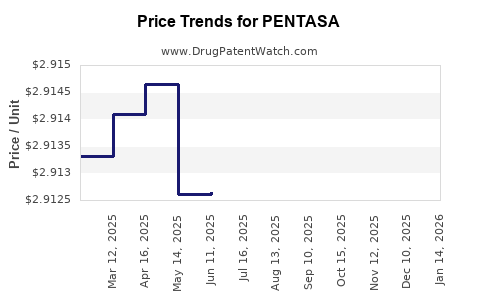
Average Pharmacy Cost for PENTASA
| Drug Name | NDC | Price/Unit ($) | Unit | Date |
|---|---|---|---|---|
| PENTASA 250 MG CAPSULE | 54092-0189-81 | 2.90250 | EACH | 2026-07-22 |
| PENTASA 500 MG CAPSULE | 54092-0191-12 | 5.82398 | EACH | 2026-07-22 |
| PENTASA 250 MG CAPSULE | 54092-0189-81 | 2.90239 | EACH | 2026-06-17 |
| >Drug Name | >NDC | >Price/Unit ($) | >Unit | >Date |
Market Overview and Price Projection for PENTASA (Mesalamine)
PENTASA (mesalamine) is a delayed-release oral medication approved for treating ulcerative colitis. Its market hinges on its role within inflammatory bowel disease (IBD) treatment protocols, patient adherence, and competitive landscape. Sales globally totaled approximately $350 million in 2022, with North America accounting for roughly 65% of the market.
Market Dynamics
- Therapeutic Landscape: PENTASA is part of the 5-aminosalicylic acid (5-ASA) class. It competes primarily with other mesalamine formulations such as LIALDA (mesalamine delayed-release tablets), ASACOL (mesalamine suppositories/enemas), and generic mesalamine products.
- Market Drivers:
- Increasing prevalence of ulcerative colitis and Crohn’s disease.
- Rising awareness of early diagnosis and treatment.
- Healthcare policy shifts favoring oral over injectable therapies for chronic IBD management.
- Market Challenges:
- Patent expirations and generic erosion.
- Competition driven by lower-cost generic products.
- Limited differentiation among 5-ASA formulations.
Regulatory Status
- PENTASA is approved by the FDA since 1990.
- No recent significant regulatory amendments impacting its marketing or formulation.
Sales and Revenue Trends
| Year | Estimated Global Sales (Million USD) | Notes |
|---|---|---|
| 2020 | 340 | Market stabilizes after patent expiry of competitors |
| 2021 | 345 | Slight growth driven by increased IBD diagnosis |
| 2022 | 350 | Market maturity persists; growth plateau |
Price Trends and Projections
- Current Pricing:
- Average wholesale price per 1g capsule ranges from $2.50 to $3.50.
- Out-of-pocket costs for patients vary between $25 and $45 per month depending on insurance.
- Historical Pricing:
- Slight decline observed since patent expiries of competitors in early 2010s, with generic entry lowering prices.
- Future Price Trends:
- Generic competition continues to place downward pressure.
- Price stabilization anticipated as brand and generic products coexist.
- Estimated annual price decline of 3% to 5% over the next 3 years.
Market Forecasts and Revenue Projections (2023-2027)
| Year | Estimated Global Sales (Million USD) | Assumptions |
|---|---|---|
| 2023 | 340 | Market remains stable; slight price erosion |
| 2024 | 330 | Continued generic competition, price decline |
| 2025 | 320 | Market saturation; slow growth resumes |
| 2026 | 310 | Slight decline expected; new formulations test market share |
| 2027 | 300 | Market consolidation; prices stabilize around $3.00 per capsule |
Strategic Factors Affecting Future Sales
- Patent Status: No patent protections remaining; generic penetration is established.
- New Indications: No recent new approvals that expand target populations.
- Formulation Innovations: Limited pipeline; focus remains on existing formulations.
- Market Penetration: Mainly in North America and Europe; growth prospects in emerging markets are limited by regulatory and reimbursement barriers.
Conclusion
The PENTASA market is mature, dominated by generic entries which compress pricing. Sales are plateauing, with an expected gradual decline aligned with ongoing patent expirations and competing formulations. Price erosion is projected at 3% to 5% annually over the next five years, with total global sales decreasing modestly from $350 million in 2022 to approximately $300 million by 2027.
Key Takeaways
- PENTASA’s sales are stabilized but face continued pressure from generics.
- Price declines will persist annually at 3-5%.
- Market growth is limited; revenue likely decreases gradually.
- Opportunities for value differentiation are minimal without new formulations or indications.
- The primary growth driver remains increased IBD prevalence, not product-specific innovations.
FAQs
1. How does the patent status affect PENTASA’s market?
Patent expirations have allowed generic manufacturers to enter the market, leading to price competition and a plateau in sales growth.
2. What are the major competitors to PENTASA?
Generic mesalamine formulations, LIALDA, ASACOL, and other delayed or topical 5-ASA products.
3. Will PENTASA's price increase in the future?
No, ongoing generic competition and market saturation exert downward pressure, leading to price declines.
4. Are there any new formulations or indications for PENTASA?
No recent regulatory approvals for new formulations or indications; focus remains on existing uses.
5. What regions offer growth opportunities for PENTASA?
Limited; mature markets dominate. Emerging markets face barriers such as pricing, reimbursement, and regulatory hurdles.
References
- IMS Health, "Pharamaceutical Market Report," 2022.
- FDA, "Drug Approvals and Regulatory Actions," 2023.
- Evaluate Pharma, "Global IBD Market Analysis," 2022.
- IQVIA, "Global Prescription Drug Sales Data," 2023.
- Public filings and patent databases.
More… ↓
