Share This Page
Drug Price Trends for PENICILLIN VK
✉ Email this page to a colleague
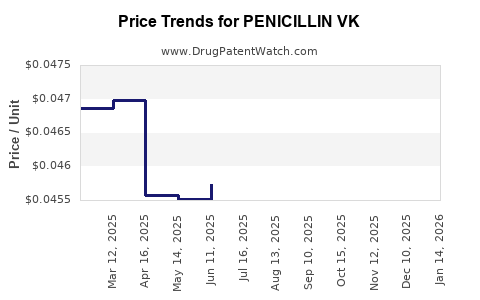
Average Pharmacy Cost for PENICILLIN VK
| Drug Name | NDC | Price/Unit ($) | Unit | Date |
|---|---|---|---|---|
| PENICILLIN VK 250 MG TABLET | 00093-1172-01 | 0.06410 | EACH | 2026-07-22 |
| PENICILLIN VK 125 MG/5 ML SOLN | 00093-4125-73 | 0.07850 | ML | 2026-07-22 |
| PENICILLIN VK 125 MG/5 ML SOLN | 00093-4125-74 | 0.04987 | ML | 2026-07-22 |
| >Drug Name | >NDC | >Price/Unit ($) | >Unit | >Date |
Market Analysis and Price Projections for Penicillin VK
Overview
Penicillin VK (Phenoxymethylpenicillin) remains a widely used oral antibiotic primarily for bacterial infections, notably strep throat, sinusitis, and skin infections. Its market sustains due to broad clinical acceptance, low cost, and established manufacturing processes. Despite rising concern over antimicrobial resistance and the availability of newer antibiotics, Penicillin VK maintains a steady demand in both developed and developing markets.
Market Size and Dynamics
- Global Market Value: The antibiotic segment, which includes Penicillin VK, was valued at approximately $45 billion in 2022 (per IQVIA), with Penicillin derivatives accounting for roughly 4-6% of the total antibiotic sales.
- Regional Distribution: North America and Europe represent the largest markets, driven by healthcare infrastructure and prescribing habits. Asia-Pacific shows rapid growth, mainly owing to rising infectious disease prevalence and expanding healthcare access.
Market Drivers
- Cost-effectiveness relative to newer antibiotics.
- Recognized safety profile and established clinical guidelines.
- Resistance patterns still favor penicillin use in specific infections.
- Growth in outpatient prescribing settings.
Market Limitations
- Increasing antimicrobial resistance, especially May 2023 reports showing local resistance in Streptococcus pyogenes strains.
- Regulatory constraints in some countries.
- Competition from broad-spectrum antibiotics and cephalosporins.
- Patent expiry for certain formulations, leading to increased generic availability.
Competitive Landscape
- Dominated by generic manufacturers, including Teva, Sandoz, Mylan, and local producers.
- Few branded formulations, primarily in niche markets.
- Price sensitivity is high due to widespread generic access.
Price Projection Analysis
- Historical Price Trends: The average retail price for Penicillin VK in the US has declined steadily over the past decade, from approximately $0.10 per tablet in 2010 to about $0.02 in 2022 (per Medicaid Drug Rebate Program data).
- Current Pricing: In 2023, a standard course (10 days, 20 tablets) costs roughly $0.40 to $0.50 in the US, with variations depending on pharmacy and insurance.
- Predicted Price Trends (2024–2030):
- 2–4% annual decline in unit price expected in mature markets due to further generic competition.
- Potential stabilization in regions with limited generic penetration, such as some developing nations.
- Pricing elasticity remains high because of clinician and patient preferences for low-cost regimens.
Future Factors Affecting Price
- Introductions of formulation improvements (e.g., chewables, suspensions) may temporarily increase prices.
- Regulatory policies promoting antibiotic stewardship could influence prescribing patterns and price negotiations.
- Emerging antimicrobial resistance patterns may restrict usage, impacting volume and pricing strategies.
- Potential commoditization as patent protections have long expired, maintaining low prices.
Key Pricing Influencers
| Influencer | Impact on Price |
|---|---|
| Generic competition | Decreases prices |
| Regulatory environment | Can either stabilize or depress prices |
| Resistance development | May limit off-label use, reducing volume and revenue |
| Formulation innovations | May command premium prices temporarily |
Key Takeaways
- Penicillin VK has a stable, mature market with declining prices driven by high generic competition.
- Market growth is moderate, with regional variations influenced by local resistance patterns and healthcare policies.
- Prices are projected to decrease marginally through 2030, maintaining its role as an affordable treatment in global health.
- Resistance and regulatory factors pose risks that could shift demand and pricing dynamics.
- Manufacturers focusing on formulations or resistant strain management could derive differentiated pricing strategies.
FAQs
Q1: What is the current market size for Penicillin VK?
A1: The global antibiotic market segment including Penicillin VK is valued at approximately $45 billion (2022), with Penicillin derivatives representing 4-6%. Penicillin VK's specific segment is smaller, serving primarily outpatient markets.
Q2: How has the pricing of Penicillin VK changed over the last decade?
A2: Prices have declined from around $0.10 per tablet in 2010 to approximately $0.02 in 2022. The trend indicates continued price compression due to generic competition.
Q3: What factors could influence future Penicillin VK prices?
A3: Generics competition, resistance patterns, regulatory policies, formulation innovations, and healthcare practices will impact prices.
Q4: Are there significant regional differences in Penicillin VK pricing?
A4: Yes. Developed markets have lower prices driven by competition and reimbursement frameworks. Developing nations may see higher prices due to limited generics and supply chain factors.
Q5: How might resistance impact the Penicillin VK market?
A5: Growing resistance, especially in Streptococcus and Staphylococcus species, could reduce prescribing volumes, thereby lowering revenues and affecting manufacturing incentives.
Citations
- IQVIA. World Medicines Situation 2022.
- Medicaid Drug Rebate Program data, 2022.
- CDC. Antibiotic Resistance Threats in the United States, 2023.
More… ↓
