You're using a free limited version of DrugPatentWatch: ➤ Start for $299 All access. No Commitment.

Last Updated: January 1, 2026

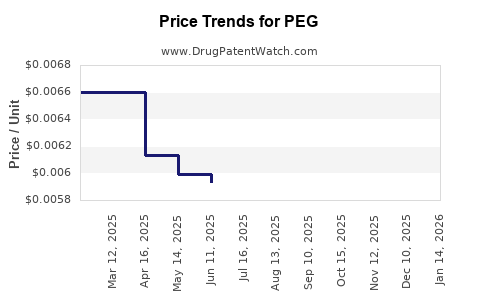
Drug Price Trends for PEG


✉ Email this page to a colleague
« Back to Dashboard


Drug Price Trends for PEG

Average Pharmacy Cost for PEG

These are average pharmacy acquisition costs (net of discounts) from a US national survey
Drug Name NDC Price/Unit ($) Unit Date
PEG-3350 AND ELECTROLYTES SOLN 64380-0766-21 0.00443 ML 2025-12-17
PEG 3350-ELECTROLYTE SOLUTION 10572-0302-01 0.00613 ML 2025-12-17
PEG3350-SOD SUL-NACL-KCL-ASCB-C 100-7.5-2.691-1.015-5.9-4.7G 00093-3560-26 72.81220 EACH 2025-12-17
PEG 3350-ELECTROLYTE SOLUTION 64380-0769-21 0.00613 ML 2025-12-17
PEG-3350 AND ELECTROLYTES SOLN 10572-0100-01 0.00443 ML 2025-12-17
PEG-3350 AND ELECTROLYTES SOLN 64380-0766-21 0.00446 ML 2025-11-19
PEG 3350-ELECTROLYTE SOLUTION 64380-0769-21 0.00569 ML 2025-11-19
>Drug Name >NDC >Price/Unit ($) >Unit >Date

Best Wholesale Price for PEG

These are wholesale prices available to the US Federal Government which, by law, must be the best prices available to any customer under comparable terms and conditions
Drug Name Vendor NDC Count Price ($) Price/Unit ($) Unit Dates Price Type
GOLYTELY Sebela Pharmaceuticals, Inc. DBA Sebela Pharmaceuticals, Inc. 52268-0100-01 4000ML 14.19 0.00355 ML 2024-04-01 - 2029-03-31 Big4
PEG-3350/ELECTROLYTES PWDR Sebela Pharmaceuticals, Inc. DBA Sebela Pharmaceuticals, Inc. 10572-0100-01 4000ML 19.65 0.00491 ML 2024-04-01 - 2029-03-31 FSS
GOLYTELY Sebela Pharmaceuticals, Inc. DBA Sebela Pharmaceuticals, Inc. 52268-0100-01 4000ML 19.66 0.00492 ML 2024-04-01 - 2029-03-31 FSS
PEG-3350/ELECTROLYTES PWDR Sebela Pharmaceuticals, Inc. DBA Sebela Pharmaceuticals, Inc. 10572-0100-01 4000ML 6.95 0.00174 ML 2024-05-15 - 2029-03-31 Big4
SUFLAVE Sebela Pharmaceuticals, Inc. DBA Sebela Pharmaceuticals, Inc. 52268-0550-01 1 88.89 88.89000 EACH 2024-04-01 - 2029-03-31 Big4
PEG-3350/ELECTROLYTES (EQV-NULYTELY) PWDR W/F Sebela Pharmaceuticals, Inc. DBA Sebela Pharmaceuticals, Inc. 10572-0302-01 4000ML 10.36 0.00259 ML 2024-04-01 - 2029-03-31 Big4
SUFLAVE Sebela Pharmaceuticals, Inc. DBA Sebela Pharmaceuticals, Inc. 52268-0550-01 1 108.04 108.04000 EACH 2024-04-01 - 2029-03-31 FSS
>Drug Name >Vendor >NDC >Count >Price ($) >Price/Unit ($) >Unit >Dates >Price Type
Price type key: Federal Supply Schedule (FSS): generally available to all Federal Govt agencies / 'BIG4' prices: VA, DoD, Public Health & Coast Guard only / National Contracts (NC): Available to specific agencies

Market Analysis and Price Projections for PEG (Polyethylene Glycol)

Last updated: July 30, 2025


Introduction

Polyethylene glycol (PEG) is a versatile compound extensively utilized across pharmaceutical, cosmetic, and industrial applications. Its uses include drug delivery systems, laxatives, bioconjugation, and excipients in formulations. The expanding scope of PEG's applications and evolving regulatory landscape shape its market dynamics and influence pricing strategies. This report provides a comprehensive market analysis and price projection for PEG, emphasizing key industry drivers, competitive landscape, regulatory considerations, and future pricing trends.


Market Overview and Segmentation

The global PEG market is segmented based on molecular weight, application, and region:

  • Molecular weight segmentation: Low (≤ 1000 Da), medium (1000–10,000 Da), high (>10,000 Da).
  • Application segmentation: Pharmaceuticals, cosmetics and personal care, industrial, food.
  • Regional segmentation: North America, Europe, Asia-Pacific, Latin America, Middle East & Africa.

The pharma segment dominates, accounting for over 60% of total PEG consumption, driven by its critical role in drug formulation, bioconjugation, and medical devices.


Market Dynamics and Key Drivers

1. Rising Adoption in Pharmaceuticals

PEG's key role as a drug excipient and in drug delivery systems supports ongoing demand. The growth in biologics and biosimilars further amplifies PEG's utilization for PEGylation, enhancing drug stability and half-life. The FDA’s approval of PEG-containing therapeutics, such as PEGylated interferons and monoclonal antibodies, fosters market expansion.

2. Increasing Use in Bio-Pharmaceutical Manufacturing

The surge in biologics and precision medicine strategies underpins the demand for PEG derivatives. PEGylation reduces immunogenicity and improves pharmacokinetics, making PEG indispensable in modern therapeutics.

3. Regulatory and Safety Advances

While PEG is generally regarded as safe, recent scrutiny on potential immunogenicity and allergic reactions influences product development and labeling. Manufacturers are investing in high-purity PEG grades, influencing pricing strategies.

4. Emerging Applications in Cosmetics and Food

Heightened consumer awareness of skin health and dietary supplements maintains consistent demand from cosmetics and food segments.

5. Supply Chain and Raw Material Dynamics

PEG production hinges on ethylene oxide (EO) availability, impacted by petrochemical market fluctuations. Environmental regulations on EO production and the push for greener manufacturing are influencing supply and costs.


Competitive Landscape

Major Players:

  • Dow Chemical Company
  • BASF SE
  • Arrow Fine Chemicals
  • LG Chemical
  • Shin-Etsu Chemical Co., Ltd.

These players compete based on product purity, molecular weight range, application specialization, and production capacity. Recent investments in capacity expansion and R&D focus on high-grade PEG for biomedical applications.

Market Entry Barriers:

  • High capital requirements for manufacturing facilities
  • Stringent regulatory approval processes
  • Established relationships among leading firms and end-users

Regulatory Environment

Regulations across regions influence PEG pricing and availability:

  • United States: FDA regulates PEG grades for pharmaceutical use under various monographs and IND/ NDA pathways.
  • Europe: EMA mandates strict purity standards for PEG in medicines.
  • Asia-Pacific: Rapidly evolving regulatory landscape offers growth opportunities but requires compliance investments.

Regulatory shifts toward higher-purity grades and environmental controls can impact manufacturing costs and hence, prices.


Pricing Trends and Forecast

Historical Pricing Overview

Historically, PEG prices fluctuate based on molecular weight, purity, and application:

  • Low molecular weight PEGs: $2 - $4 per kilogram (kg)
  • Medium molecular weight PEGs: $4 - $8 per kg
  • High molecular weight PEGs: $8 - $15 per kg

Price volatility has been influenced by raw material costs, environmental regulations, and demand surges.

Projected Price Trends (2023-2030)

Based on current market data and industry forecasts, the following trends are anticipated:

  • Moderate Price Stability (2023-2025): Steady demand coupled with raw material cost stabilization will maintain existing price levels.
  • Gradual Price Increase (2025-2030): Anticipated supply constraints from ethylene oxide regulations, coupled with increased investments in high-purity PEG grades for biopharmaceuticals, will drive prices upward.

Forecasted Price Range by 2030:

Molecular Weight Category Expected Price Range (per kg) in 2030 Comments
Low (≤ 1000 Da) $4 - $6 Increased demand for industrial and cosmetic uses
Medium (1000–10,000 Da) $8 - $12 Key growth in pharmaceutical applications
High (>10,000 Da) $15 - $20 Specialized biomedical applications, scarcity

Note: Price increases are expected to be more pronounced for high molecular weight grades due to manufacturing complexities and regulatory pressures.


Market Opportunities and Challenges

Opportunities:

  • Expansion into emerging markets with increasing pharmaceutical R&D investments.
  • Development of environmentally friendly PEG manufacturing processes.
  • Customization of PEG grades for niche biomedical applications.

Challenges:

  • Regulatory hurdles and safety concerns.
  • Raw material price fluctuations.
  • Competition from alternative excipients and delivery systems.

Conclusion

The PEG market exhibits steady growth driven by pharmaceutical innovation, regulatory compliance, and expanding applications in cosmetics and food sectors. Price projections indicate a gradual rise, particularly for high molecular weight grades, aligned with increased biomedical usage and supply chain constraints. Stakeholders should focus on R&D, sustainable manufacturing, and regulatory adaptation to capitalize on emerging opportunities.


Key Takeaways

  • Demand momentum stems from PEG's integral role in biologics and drug delivery.
  • Price projection suggests a CAGR of approximately 3-5% through 2030, influenced by regulatory and raw material factors.
  • Market entry barriers underscore the importance of compliance, capacity, and innovation.
  • Emerging markets offer significant growth potential, particularly in Asia-Pacific.
  • Sustainability initiatives and high purity standards will dictate future pricing and competitiveness.

FAQs

1. What are the main applications driving PEG demand?
PEG is primarily used in pharmaceuticals (drug conjugates, excipients), cosmetics, industrial manufacturing, and food products, with pharmaceuticals representing the largest share.

2. How do regulatory changes affect PEG market prices?
Regulatory requirements for higher purity and safer manufacturing practices can increase production costs, leading to higher prices, especially for biomedical-grade PEG.

3. What factors influence PEG prices in the future?
Raw material costs, environmental regulations, technological advancements, and application-specific demand dynamics will steer pricing trends.

4. Are there alternatives to PEG in pharmaceutical applications?
Yes, alternatives like polyvinylpyrrolidone, polysaccharides, and novel bioconjugates are explored, but PEG remains dominant due to its proven efficacy and versatility.

5. How does the environmental aspect impact PEG manufacturing?
Regulations targeting ethylene oxide emissions and waste management are prompting shift toward greener processes, potentially increasing production costs and influencing prices.


Sources:
[1] MarketsandMarkets, “Polyethylene Glycol Market by Molecular Weight, Application and Region — Global Forecast to 2030,” 2023.
[2] Grand View Research, “PEG Market Analysis & Trends,” 2022.
[3] U.S. Food and Drug Administration, “Guidance on PEG usage in pharmaceuticals,” 2021.
[4] European Medicines Agency, “Regulatory guidelines for PEG excipients,” 2022.
[5] Industry reports and company disclosures.

More… ↓

⤷  Get Started Free

Make Better Decisions: Try a trial or see plans & pricing

Drugs may be covered by multiple patents or regulatory protections. All trademarks and applicant names are the property of their respective owners or licensors. Although great care is taken in the proper and correct provision of this service, thinkBiotech LLC does not accept any responsibility for possible consequences of errors or omissions in the provided data. The data presented herein is for information purposes only. There is no warranty that the data contained herein is error free. We do not provide individual investment advice. This service is not registered with any financial regulatory agency. The information we publish is educational only and based on our opinions plus our models. By using DrugPatentWatch you acknowledge that we do not provide personalized recommendations or advice. thinkBiotech performs no independent verification of facts as provided by public sources nor are attempts made to provide legal or investing advice. Any reliance on data provided herein is done solely at the discretion of the user. Users of this service are advised to seek professional advice and independent confirmation before considering acting on any of the provided information. thinkBiotech LLC reserves the right to amend, extend or withdraw any part or all of the offered service without notice.
