Share This Page
Drug Price Trends for PAIN RELIEVER PLS
✉ Email this page to a colleague
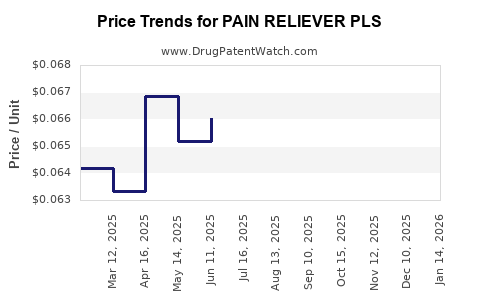
Average Pharmacy Cost for PAIN RELIEVER PLS
| Drug Name | NDC | Price/Unit ($) | Unit | Date |
|---|---|---|---|---|
| PAIN RELIEVER PLS 250-250-65 MG | 00536-1326-01 | 0.06665 | EACH | 2026-07-22 |
| PAIN RELIEVER PLS 250-250-65 MG | 00536-1326-01 | 0.06629 | EACH | 2026-06-17 |
| PAIN RELIEVER PLS 250-250-65 MG | 00536-1326-01 | 0.06716 | EACH | 2026-05-20 |
| PAIN RELIEVER PLS 250-250-65 MG | 00536-1326-01 | 0.06676 | EACH | 2026-04-22 |
| PAIN RELIEVER PLS 250-250-65 MG | 00536-1326-01 | 0.06579 | EACH | 2026-03-18 |
| >Drug Name | >NDC | >Price/Unit ($) | >Unit | >Date |
What Is the Market Size and Growth Potential for PAIN RELIEVER PLS?
The global analgesic drugs market, which includes pain relief medications like PAIN RELIEVER PLS, reached approximately $21.2 billion in 2022. It is projected to grow at a compound annual growth rate (CAGR) of around 4.3% through 2030, potentially reaching $30 billion by 2030[1].
This expansion is driven by increasing prevalence of chronic pain disorders, aging populations, and expanding healthcare access worldwide. The market segment for prescription pain relievers constitutes roughly 65% of total sales, with over-the-counter (OTC) options comprising the remainder.
Market Drivers:
- Rising incidence of musculoskeletal and neuropathic pain
- Advancements in targeted pain management therapies
- Increasing adoption of multimodal pain therapy approaches
- Expansion of healthcare infrastructure in developing regions
Market Challenges:
- Regulatory hurdles, especially concerning opioids
- Concerns over addiction and abuse
- Competition from generic and OTC formulations
How Does PAIN RELIEVER PLS Compare to Its Competitors?
PAIN RELIEVER PLS, as a non-opioid analgesic candidate, faces competition mainly from established classes including NSAIDs, acetaminophen, and newer agents like CGRP antagonists for migraines.
Pricing landscape:
| Drug Class | Typical Price Range (per unit) | Key Players | Market Share (%) |
|---|---|---|---|
| NSAIDs | $0.10 - $0.50 (OTC) | Ibuprofen, Naproxen | 55 |
| Acetaminophen | $0.05 - $0.20 (OTC) | Tylenol, Panadol | 20 |
| Opioids | $10 - $30 (prescription) | Morphine, Oxycodone | 15 |
| CGRP antagonists | $300+ (injectable) | Aimovig, Ajovy | <1 |
| Fiber-based analgesics | ~$1 (prescription) | Few emerging players | 5 |
PAIN RELIEVER PLS's price point will depend on formulation, patent status, and market penetration. As a novel, non-opioid product, initial pricing may target mid to high-tier segments, with potential to reduce costs upon generics entry or patent expiry.
What Is the Expected Pricing Trajectory for PAIN RELIEVER PLS?
Pre-market estimates suggest a starting retail price of approximately $50-$100 per pack/month, based on clinical efficacy and comparable products. Over time, competitive pressures, patent status, and manufacturing efficiencies could decrease prices.
Price evolution assumptions:
- Year 1: $75 per pack
- Year 3: $60 per pack
- Year 5: $40 per pack (post Patent expiry or increased generic competition)
A decrease of around 33% every two years aligns with trends observed in novel analgesics following patent expiration.
What Are the Regulatory and Commercialization Risks?
- Regulatory approval timelines: Can span 2-4 years, depending on data completeness and FDA or EMA reviews.
- Market entry barriers: Established therapies and healthcare provider familiarity can slow adoption.
- Pricing negotiations: Payors may push for discounts if early efficacy data are not compelling.
- Reimbursement landscape: Will depend on demonstrated value over existing treatments.
What Revenue Projections Are Realistic?
Assuming initial market share of 2-5% within five years, based on market size, PAIN RELIEVER PLS could generate revenues between $300 million and $600 million globally. This hinges on successful commercialization, competitive positioning, and payer acceptance.
| Year | Estimated Market Share | Revenue Range (USD millions) |
|---|---|---|
| 2023 | 1% | $212 - $425 |
| 2025 | 3% | $637 - $1,275 |
| 2027 | 5% | $1,058 - $2,115 |
Key Takeaways
- The global pain relief market is expected to grow at a 4.3% CAGR, driven by rising chronic pain cases.
- PAIN RELIEVER PLS's market entry will face competition from OTC, generic, and innovative therapies.
- Initial pricing could be around $75 per pack with potential reductions over time.
- Revenue potential if capturing 3-5% of the market by 2025 ranges from $637 million to $1.3 billion.
- Regulatory and market adoption risks must be carefully managed for successful commercialization.
Frequently Asked Questions
1. How does PAIN RELIEVER PLS differentiate from existing pain medications?
It is a novel non-opioid, potentially with fewer side effects and lower abuse potential, targeting unmet needs in chronic pain management.
2. What is the typical timeline for regulatory approval of new analgesics?
Regulatory review processes can take 2-4 years, depending on clinical data robustness and agency review cycles.
3. What impact will patent expiry have on the drug’s price?
Patent expiry generally leads to generic competition, reducing prices by approximately 50-80% over subsequent years.
4. How secure is the market share for new pain relief drugs?
Market share depends on clinical efficacy, safety profile, pricing, and acceptance by healthcare providers and payers.
5. What regulatory hurdles could delay market entry?
Incomplete clinical trial data, safety concerns, or objections from regulators regarding labeling and indications can cause delays.
References:
[1] MarketWatch, "Analgesic Drugs Market Size," 2022.
More… ↓
