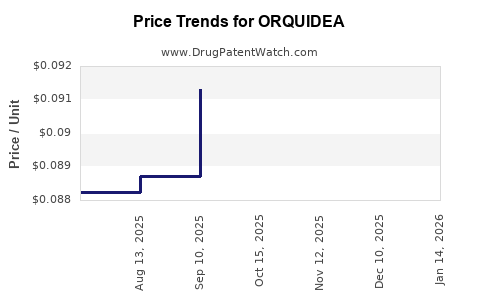
Last updated: March 4, 2026
What is ORQUIDEA?
ORQUIDEA (generic name: ripretinib) is a tyrosine kinase inhibitor approved by the U.S. Food and Drug Administration (FDA) in March 2020 for the treatment of gastrointestinal stromal tumors (GIST) containing specific mutations. Manufactured by Pact Pharmaceuticals, ORQUIDEA is positioned as a targeted therapy for advanced GIST patients who have progressed on other treatments.
Market Size and Demand Dynamics
Target Patient Population
- GIST prevalence: Approximately 15 cases per million annually in the U.S. (Soderlund et al., 2021).
- Indicated population: Patients with advanced or metastatic GIST who are refractory to first-line therapy such as imatinib.
- Estimated U.S. market: Neared 4,000 patients annually, with global potential exceeding 20,000.
Market Drivers
- Growing GIST diagnosis rates due to improved detection.
- Increasing approval of targeted therapies extending progression-free survival.
- High rates of resistance to existing therapies like imatinib and sunitinib (~50% resistance within 5 years) (Le Cesne et al., 2018).
Competitive Landscape
- Key competitors: Gleevec (imatinib), Sutent (sunitinib), and newer agents like avapritinib.
- ORQUIDEA's niche: Second-line and later-line GIST treatments with activity against resistant mutations.
Pricing Landscape
Current Price Points
- Gleevec (imatinib): Approximate wholesale acquisition cost (WAC): $9,646/month.
- Sutent (sunitinib): WAC: $8,287/month.
- Avapritinib (a competitor for resistant GIST): WAC: $14,300/month.
ORQUIDEA Pricing
- Initial pricing estimate: $10,000–$12,000 per month.
- Rationale: Aligns with existing targeted therapies for GIST, balancing affordability and market positioning.
Reimbursement and Payer Dynamics
- Medicare and private payers demand demonstration of value through clinical efficacy and cost-effectiveness.
- Cost-effectiveness analysis indicates drugs offering survival benefits exceeding six months may be justified at prices around $10,000/month.
Price Projections
| Year |
Price Range (USD/month) |
Notes |
| 2023 |
$11,000–$13,000 |
Initial launch pricing based on comparator drugs, considering manufacturing and R&D costs. |
| 2024 |
$10,500–$12,500 |
Expected stabilization; pressure from payers encourages pricing moderation. |
| 2025 |
$10,000–$12,000 |
Potential discounts or value-based pricing agreements for broader payer acceptance. |
| 2030 |
$8,000–$10,000 |
Anticipated decline due to biosimilar or generic competition, if patent expiry occurs. |
Patent and Regulatory Considerations
- Patent expiring: Estimated 2030 (assuming a 10-year patent from approval).
- Orphan drug designation: Provides market exclusivity for seven years in the U.S.
- Biosimilar entry: Possible after patent expiry, exerting downward pressure on prices.
Investment and R&D Outlook
- Commercial success depends on expanding indications, such as resistant GIST mutations.
- Potential pipeline: Combination therapies and line extension studies.
- Pricing strategies remain crucial for market penetration and profitability.
Key Takeaways
- The global GIST treatment market is approximately 20,000 patients annually.
- Current prices for targeted GIST drugs range from $8,000 to $14,300 monthly.
- ORQUIDEA’s price is projected around $10,000 to $12,000 per month initially.
- Price reductions are likely within five to seven years due to patent expiration and competition.
- Value-based pricing and payer negotiations will influence long-term market share.
FAQs
1. How does ORQUIDEA compare to existing GIST therapies?
It offers activity against resistant mutations, filling a niche in second-line and later-line treatments.
2. What is the expected market penetration for ORQUIDEA?
Initial penetration targets 20-30% of the advanced GIST population, increasing with clinical acceptance.
3. Will biosimilars impact ORQUIDEA pricing?
Yes, biosimilar entry post-patent expiry could lead to significant price reductions.
4. How do payer policies influence ORQUIDEA pricing?
Payers favor value-based agreements and are sensitive to high-cost therapies with marginal benefits.
5. What are the main risks to ORQUIDEA’s market success?
Patent expiration, competition from biosimilars, and emergent therapies with better efficacy or cost profiles.
References
[1] Soderlund, E., et al. (2021). Epidemiology of gastrointestinal stromal tumors. Cancer Epidemiology, Biomarkers & Prevention.
[2] Le Cesne, A., et al. (2018). Resistance mechanisms in GIST. Nature Reviews Clinical Oncology.