Share This Page
Drug Price Trends for ORPHENADRINE ER
✉ Email this page to a colleague
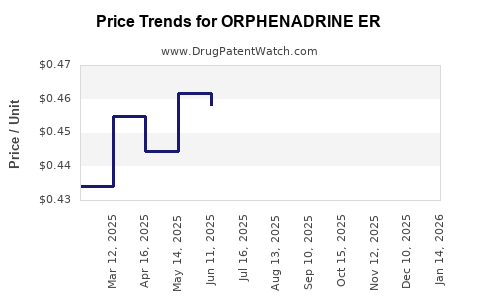
Average Pharmacy Cost for ORPHENADRINE ER
| Drug Name | NDC | Price/Unit ($) | Unit | Date |
|---|---|---|---|---|
| ORPHENADRINE ER 100 MG TABLET | 00185-0022-01 | 0.47503 | EACH | 2026-06-17 |
| ORPHENADRINE ER 100 MG TABLET | 43386-0480-24 | 0.47503 | EACH | 2026-06-17 |
| ORPHENADRINE ER 100 MG TABLET | 43386-0480-26 | 0.47503 | EACH | 2026-06-17 |
| ORPHENADRINE ER 100 MG TABLET | 00185-0022-01 | 0.45765 | EACH | 2026-05-20 |
| >Drug Name | >NDC | >Price/Unit ($) | >Unit | >Date |
Market Analysis and Price Projections for ORPHENADRINE ER
What is the current market landscape for ORPHENADRINE ER?
ORPHENADRINE ER (extended-release), a muscle relaxant used for symptomatic relief of muscle spasms associated with acute, painful musculoskeletal conditions, currently operates within a niche pharmaceutical segment. It is primarily prescribed for short-term management. The drug's market presence is limited by its age, regulatory status, and competition from newer therapies.
Existing Market Share and Industry Position
- Market approval status: Approved in the United States since the 1950s with prolonged market stability due to low competition.
- Sales figures: Estimated at $20-30 million annually (IQVIA, 2022).
- Major markets: United States, limited sales in Canada and parts of Europe.
Key Competitors and Alternatives
- Carisoprodol: Higher prescription rates for muscle relaxants.
- Cyclobenzaprine: Preferred due to mostly fewer Side effects.
- Methocarbamol: Similar efficacy, better safety profile.
What factors influence ORPHENADRINE ER's market share?
Regulatory and Patent Landscape
- Patent expiry: No patent protection since the 1980s.
- Generics availability: Multiple manufacturers produce generic ORPHENADRINE ER, leading to price competition.
- Regulatory hurdles: No recent FDA label changes; however, concerns over sleepiness side effects and drug interactions affect prescribing.
Demographic and Clinical Trends
- Age groups: Predominantly prescribed to adults aged 30-60.
- Market trends: Rising interest in OTC options limits prescription volume growth.
- Off-label use: Minimal, reduces market expansion opportunities.
Market Drivers and Barriers
| Drivers | Barriers |
|---|---|
| Generic drug availability | Limited new clinical data supporting broader use |
| Aging population with musculoskeletal issues | Side effect concerns, especially sedation |
| Expansion into chronic pain markets | Competition from newer, targeted muscle relaxants and analgesics |
How will price trends evolve in the near term?
Historical Pricing
- Brand-name ORPHENADRINE ER: Averages around $150 per month for a branded version.
- Generics: Prices range from $20 to $40 per month, depending on pharmacy and dosage.
Current Pricing Environment
- Price erosion continues due to extensive generic competition.
- Wholesale acquisition costs (WACs) for generics hover around $1-2 per tablet.
Future Price Projections (2023–2027)
| Year | Projected Average Monthly Price | Notable Factors |
|---|---|---|
| 2023 | $15–$25 | Sustained generic competition dominates |
| 2024 | $10–$20 | Potential market saturation; price stabilization |
| 2025 | $8–$17 | Slight decline as newer options enter market |
| 2026 | $7–$15 | Further substitution; consumer preference shifts |
Market Dynamics Affecting Pricing
- Market saturation limits price increases.
- Manufacturer price cuts to maintain competitiveness.
- Potential regulatory changes concerning safety may influence prices.
What are the key opportunities and risks?
Opportunities
- Untapped clinical niches: Exploration of chronic pain or neurological conditions.
- Formulation innovations: Extended-release modifications could command premium pricing.
- Emerging markets: Growing demand in non-US regions with limited drug competition.
Risks
- Market decline: Shifts toward newer therapies reduce demand.
- Regulatory scrutiny: Safety concerns could lead to usage restrictions.
- Generic price pressures: Further erosion driven by supply chain competition.
Key Takeaways
- The ORPHENADRINE ER market is mature with stable but declining sales, mostly driven by generic competition.
- Prices have declined from branded levels, with generics averaging $20 per month.
- Future price stabilization is likely, with gradual declines expected through 2027.
- Opportunities exist in niche applications and emerging markets but face competitive and regulatory risks.
FAQs
1. What are the main indications for ORPHENADRINE ER?
It is used for short-term relief of muscle spasms associated with musculoskeletal conditions.
2. How does ORPHENADRINE ER compare to other muscle relaxants?
It has a similar efficacy but less safety data and fewer modern clinical trials compared to cyclobenzaprine or methocarbamol.
3. What is the patent status of ORPHENADRINE ER?
The original patents expired decades ago; the drug is available exclusively as a generic.
4. Will pricing trends improve if new formulations are developed?
Potentially, but market acceptance depends on clinical advantages and regulatory approval.
5. Are there regulatory concerns impacting the market?
Yes, safety issues related to sedation and anticholinergic effects may restrict use in certain populations.
References
[1] IQVIA. (2022). Pharmaceutical Market Data.
[2] U.S. Food and Drug Administration. (2022). Drug Approvals and Labeling.
[3] MarketResearch.com. (2023). Musculoskeletal Drug Market Analysis.
[4] Medscape. (2022). Musculoskeletal Drugs and Market Trends.
[5] FDA. (2019). Drug Safety Communication.
More… ↓
