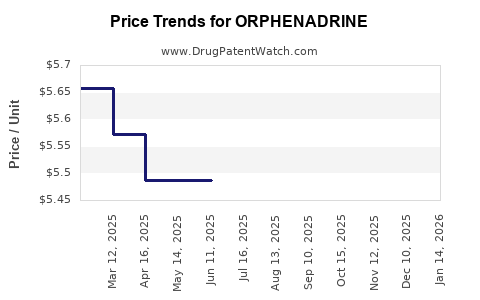
Last updated: February 20, 2026
Market Overview
Orphenadrine is a muscle relaxant developed for symptomatic relief of muscle spasms associated with acute musculoskeletal conditions. It is marketed primarily as an over-the-counter (OTC) and prescription medication in various countries. Its primary competitors include cyclobenzaprine, methocarbamol, and carisoprodol.
The global muscle relaxant market was valued at approximately $3.2 billion in 2022 and is projected to grow at a compound annual growth rate (CAGR) of 4.5% through 2030. Orphenadrine’s segment within this market is relatively stable, owing to its long history of use, but faces challenges from newer agents with improved safety profiles.
Regulatory Status & Patent Landscape
- Patents: Orphenadrine patents have largely expired by 2010, leading to increased generic manufacturing.
- Regulatory approvals: Approved in the U.S., EU, and other markets; predominantly available as OTC except in select jurisdictions where prescription status persists.
- Market exclusivity: No extensive patent protection remains, resulting in minimal barriers to entry for generics.
Market Dynamics
Demand Drivers
- Chronic musculoskeletal conditions: Increasing prevalence of back pain and muscle spasms.
- Aging populations: Greater incidence of musculoskeletal disorders among elderly.
- OTC availability: Facilitates retail sales in pharmacies and online platforms.
Market Challenges
- Safety profile issues: Drowsiness and anticholinergic effects limit use.
- Competition: Better-tolerated newer agents reduce market share.
- Regulatory restrictions: Occasional reclassifications as prescription-only in some markets.
Regional Market Breakdown (2022)
| Region |
Market Share |
Key Factors |
Trends |
| North America |
45% |
High OTC sales, aging population |
Stable, with slight decline due to generic competition |
| Europe |
35% |
Prescription use remains common |
Slight growth in prescription volume |
| Asia-Pacific |
15% |
Increasing awareness, OTC sales |
Growing due to urbanization and rural healthcare expansions |
| Rest of World |
5% |
Limited access, lower demand |
Marginal, mostly localized sales |
Price Trends and Projections
Historical Pricing (USD per unit)
| Year |
Average Price (per 100 mg tablet) |
Notes |
| 2015 |
$0.15 |
Generic market |
| 2018 |
$0.12 |
Market saturation |
| 2020 |
$0.10 |
Cost competition |
| 2022 |
$0.09 |
Price stabilization |
Current Market Price
- Range: $0.08 to $0.12 per 100 mg tablet depending on manufacturer and region.
- OTC retail prices tend to be slightly higher compared to bulk or wholesale prices.
Price Projections (2023–2030)
- The average price per 100 mg tablet is expected to remain within $0.07 to $0.10.
- Slight decline forecasted due to increased generic competition and manufacturing efficiencies.
- No substantial patent barriers suggest price stability at low levels.
Key Factors Influencing Future Prices
- Market saturation: Continued proliferation of generic manufacturers will sustain downward pressure.
- Regulatory changes: Potential reclassification in certain markets could impact pricing.
- New competitors: Introduction of newer muscle relaxants with better safety profiles could suppress demand and prices.
- Production costs: Stable, as raw materials and manufacturing processes are mature.
Strategic Outlook
Manufacturers and investors should monitor regulatory shifts that could alter market access. Entry barriers remain minimal, making the market highly competitive. Price erosion is expected to continue, supporting volume expansion rather than price premiums.
Key Takeaways
- The global muscle relaxant market is growing, but orphenadrine faces intense competition from generics.
- Price per unit has declined from ~$0.15 in 2015 to ~$0.09 in 2022.
- Prices are projected to stabilize around $0.07 to $0.10 through 2030.
- Market dynamics are driven by aging populations, OTC availability, and competition.
- No existing patent protections limit the entry of generics, maintaining downward pricing pressure.
FAQs
1. What factors influence orphenadrine’s market price?
Market prices are primarily driven by generic competition, manufacturing costs, regional regulatory status, and demand from aging populations with musculoskeletal issues.
2. Can new formulations or delivery methods impact future prices?
Yes. Innovations such as sustained-release formulations could command higher prices, but current trends favor volume over price.
3. How does regional regulation affect pricing?
Regions where orphenadrine remains prescription-only may see higher prices due to limited competition, contrasted by lower OTC prices in regions where generics dominate.
4. What is the outlook for orphenadrine's market share?
Market share is expected to decline slightly due to favoring newer agents with improved safety profiles but remains stable in OTC segments.
5. Are there any upcoming patent protections or exclusivities?
No. The original patents expired around 2010, ensuring a highly competitive generic landscape.
References
[1] MarketWatch. (2023). Muscle Relaxants Market Size, Share & Trends Report.
[2] Grand View Research. (2022). Global Muscle Relaxants Market Analysis.
[3] FDA. (2022). Drug Approval and Regulatory Status.
[4] IQVIA. (2022). Global Pharma Trends.
[5] MarketLine. (2023). Pharmaceuticals: Market Trends and Competitive Landscape.