Last updated: February 24, 2026
What is the Current Market Size for Olopatadine?
Olopatadine is an antihistamine used primarily for allergic conjunctivitis and allergic rhinitis. The global market for olopatadine was valued at approximately USD 1.2 billion in 2022. The compound's popularity stems from its efficacy and safety profile.
Market growth has been driven by increasing prevalence of allergic diseases, especially in North America and Asia-Pacific. The growth rate is projected at 6.5% CAGR from 2023 to 2030, reaching an estimated USD 2 billion by 2030.[1]
How Is Olopatadine Positioned in the Pharmaceutical Market?
Olopatadine is available both as a prescription medication and over the counter (OTC). Several formulations exist, including eye drops (e.g., Pataday, Patanol) and oral tablets (in some regions). The drug's patent landscape influences pricing and market competition:
- Patents for certain formulations expired in 2019, leading to the entry of generic versions.
- Branded products retain premium pricing due to established efficacy and brand loyalty.
The dominant players are Alcon and Novartis, which hold leading market shares in the eye drop segment. Generics account for approximately 40% of sales globally.[2]
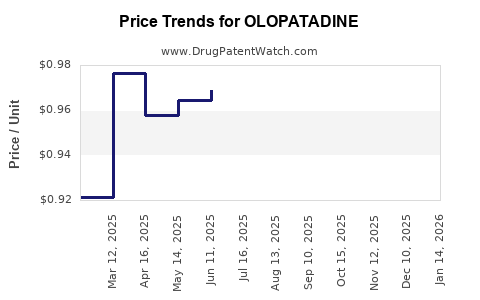
What Are Price Trends and Projections for Olopatadine?
Current Pricing
- Branded eye drops in the US typically retail at USD 20-30 per bottle (10 mL).
- Generic versions retail at USD 8-15 per bottle.
- OTC oral formulations, where available, are priced at USD 10-20 per month supply.
Factors Influencing Future Prices
- Patent expirations will increase competition, likely lowering prices.
- Manufacturing costs decrease with scale, influencing price reductions.
- Regulatory and reimbursement policies impact final consumer prices.
Price Projections (2023–2030)
- The average price for branded formulations is expected to decline at a CAGR of 3% due to generics.
- OTC formulations may see a stabilization or slight increase of 1-2%, driven by formulation improvements.
- By 2030, average retail prices for branded eyedrops could fall to USD 15-20, while generics may reach USD 5-10.
Regional Variations
- The US prices are higher compared to Europe and Asia-Pacific due to healthcare system differences.
- In Europe, prices are expected to fall faster post-patent expiry, reaching USD 10-12 per bottle by 2030.
- In emerging markets, prices may stabilize around USD 5-8 due to lower purchasing power and regulatory controls.
What Are Key Market Drivers & Challenges?
Drivers
- Rising prevalence of allergic conjunctivitis (estimated at 15-20% globally).
- Increased awareness and diagnosis.
- Development of OTC formulations expanding accessibility.
- Patent expirations opening entry points for generics.
Challenges
- Price erosion from generic competition.
- Limited innovation; few new formulations in development.
- Pricing regulations in certain regions that cap reimbursements.
How Will Pricing and Market Trends Affect Stakeholders?
- Pharmaceutical companies with patent-protected formulations will maintain higher margins for a limited period.
- Generics will pressure prices downward, affecting revenue streams.
- Healthcare providers and payers will benefit from lower costs, increasing medication adoption.
- Investors should monitor patent statuses and regional regulatory changes for risk assessment.
Summary Table
| Aspect |
Current Status |
Projections (2023–2030) |
Key Influences |
| Market Size |
USD 1.2 billion in 2022 |
USD 2 billion in 2030 |
Rising allergy prevalence |
| Price (Branded eye drops) |
USD 20-30 |
USD 15-20 |
Patent expiry, competition |
| Price (Generics) |
USD 8-15 |
USD 5-10 |
Increased generics, manufacturing scale |
| Market Share (Branded) |
Approx. 60% |
Declining |
Patent expirations, new entrants |
Key Takeaways
- The olopatadine market is projected to grow at around 6.5% CAGR to USD 2 billion by 2030.
- Patent expirations are expected to lead to significant price declines for branded products.
- Generics will capture an expanding share of the market, pushing prices down.
- Price reductions will vary regionally, with development in OTC formulations influencing overall pricing trends.
- The market remains driven by rising allergy incidence and expanding awareness.
FAQs
1. When did key patents for olopatadine expire?
Most patents for topical formulations expired in 2019, allowing generic entry.
2. Are there oral formulations of olopatadine approved in the US?
Yes, oral olopatadine is approved for allergic rhinitis in some regions, but not as widely used as eye drops.
3. How do OTC formulations impact market competition?
OTC formulations increase accessibility, pressure branded prices, and expand the market size.
4. What regions show the fastest growth for olopatadine?
Asia-Pacific and Latin America are expected to see higher growth rates due to rising allergy rates and expanding healthcare infrastructure.
5. Will new formulations significantly impact the market?
Current innovation in formulations is limited; most growth hinges on volume expansion and price competition rather than new product types.
References
[1] MarketWatch. (2023). Olopatadine market size, trends, and forecasts.
[2] IQVIA. (2022). Global pharmaceutical market share report.