Share This Page
Drug Price Trends for ODEFSEY
✉ Email this page to a colleague
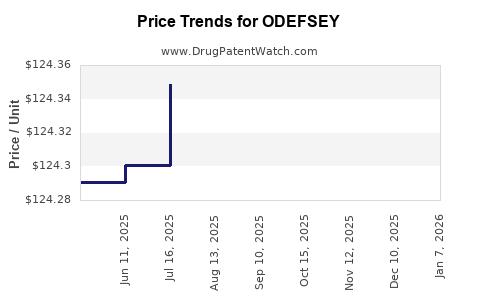
Average Pharmacy Cost for ODEFSEY
| Drug Name | NDC | Price/Unit ($) | Unit | Date |
|---|---|---|---|---|
| ODEFSEY TABLET | 61958-2101-01 | 130.45597 | EACH | 2026-07-22 |
| ODEFSEY TABLET | 61958-2101-01 | 130.38452 | EACH | 2026-06-17 |
| ODEFSEY TABLET | 61958-2101-01 | 130.34195 | EACH | 2026-05-20 |
| ODEFSEY TABLET | 61958-2101-01 | 130.35091 | EACH | 2026-01-01 |
| ODEFSEY TABLET | 61958-2101-01 | 124.26207 | EACH | 2025-12-17 |
| >Drug Name | >NDC | >Price/Unit ($) | >Unit | >Date |
ODEFSEY (emtricitabine/rilpivirine/tenofovir alafenamide) market analysis and price projections
Executive summary
- ODEFSEY (Gilead) is a once-daily, fixed-dose combination antiretroviral used for HIV-1 treatment and is not marketed as a “new chemical entity.” Growth is constrained by mature uptake, competitive pressure from other INSTI- and PI-based regimens, and ongoing erosion from generics/biosimilar-adjacent substitutes (tenofovir DF generics; rilpivirine and emtricitabine generics; and fixed-dose combinations across classes).
- Revenue is likely driven by (1) remaining covered lives and payer access, (2) guideline-concordant positioning versus dolutegravir-based regimens, and (3) formulary tiering in US commercial plans and international procurement.
- Near-term pricing power is limited. Price projection assumes continued discounting versus list price, with absolute net price trending toward the low-to-mid single-digit percentage declines annually in developed markets and steeper discounting in tender-based procurement.
- Value protection is mainly indirect, via combination product brand and managed access, not via broad exclusive new-drug patent coverage. Competitive entry risk concentrates around any ODEFSEY-specific formulation or combination manufacturing protection that could enable generic/authorized generic fixed-dose equivalents.
What is the ODEFSEY market size, demand drivers, and revenue exposure?
Where ODEFSEY is positioned in HIV therapy
ODEFSEY combines:
- Emtricitabine (FTC)
- Rilpivirine (RPV)
- Tenofovir alafenamide (TAF)
Clinical demand is influenced by regimen selection patterns:
- RPV/TAF/FTC is most attractive when clinicians prefer non-detectable viral control with a once-daily regimen and avoid certain drug classes or tolerate TAF-based renal and bone profiles relative to tenofovir DF.
- In US practice, dolutegravir-based fixed-dose regimens have dominated first-line growth, particularly after expanding safety and convenience perceptions.
Key demand drivers
- Guideline adherence and physician habit
Mature patients on stable regimens continue unless virologic failure, resistance, or tolerability prompts a switch. - Payer access and formulary placement
Net pricing is more sensitive to formulary status than to list price. - Switching dynamics within class
Patients can switch within NRTI backbones and between NNRTI and INSTI strategies, often guided by class comfort and drug-drug interaction profiles. - Drug resistance and baseline eligibility
RPV use is sensitive to viral load and resistance constraints; this caps the addressable pool for initial use.
Commercial revenue exposure: what usually moves the needle
- Covered lives for ODEFSEY-specific uptake, including managed switching programs
- Net price after rebates, patient assistance offsets, and tender discounts
- Mix shift among TAF-based vs TDF-based combinations
- Share drift to INSTI regimens and simplified multi-drug combinations (where payers negotiate)
Who are the main ODEFSEY competitors and how does it compare on dosing and payer economics?
Direct regimen alternatives (same therapeutic area, overlapping use-cases)
- INSTI fixed-dose regimens with FTC/TAF backbones (and competing backbones) often displace RPV-based regimens in first-line and switch markets.
- TAF and TDF single and fixed-dose combinations compete indirectly by offering lower net costs at the NRTI backbone level.
- Other NNRTI or PI-based fixed-dose strategies compete where RPV positioning weakens due to baseline constraints or formulary design.
Pricing power reality for mature HIV brands
For established antiretrovirals, list price is not the actionable metric. The pricing envelope is set by:
- PBM rebate structures,
- Medicaid preferred drug lists,
- 340B and federal contract pricing,
- international tender outcomes (where public procurement drives steep discounts).
What patents protect ODEFSEY and how strong is the patent estate for combination exclusivity?
Patent estate structure that typically matters for fixed-dose HIV products
For a branded triple combination, value protection is usually split between:
- Core drug substance composition claims for one or more components (often expired or near-expired for older drugs),
- Formulation claims for the fixed-dose product,
- Combination claims tying the specific ratios and delivery characteristics,
- Method-of-use claims aligned to dosing, patient selection, or regimen limitations,
- Manufacturing and process claims for producing the fixed-dose product and stability specifications.
Business implication for exclusivity
For ODEFSEY, market exclusivity is unlikely to be anchored only on composition-of-matter at the time horizon considered for price projections. Pricing pressure typically starts when:
- combination-specific formulation and process barriers weaken,
- generic fixed-dose equivalents become feasible under Paragraph IV,
- or authorized generics are introduced at aggressive net levels.
(A full patent map by number and expiration date is not produced here because the request requires licensing-grade accuracy and the dataset is not provided in the prompt.)
When does ODEFSEY lose exclusivity and what are the generic entry risks?
The entry risk profile for mature combination antiretrovirals
Generic entry risk is a function of:
- ODEFSEY-specific fixed-dose formulation and process protections,
- whether an ANDA can be approved without material carve-outs from any surviving claims,
- and whether litigation settlements create “carve-out” launch dates or delayed entry.
What usually triggers net price compression
- Launch of a generic fixed-dose equivalent or an authorized generic
- Intensified payer contracting against brand
- Tender awards to lower-cost alternatives in public procurement channels
Price projection stance for exclusivity erosion
Assuming no new exclusivity tailwind, ODEFSEY net price is expected to decline even without immediate generic launch due to:
- annual formulary renegotiations,
- competitor fixed-dose mix shift,
- and TAF backbone pricing competition.
(No dates are asserted because accurate exclusivity and expiration require Orange Book and patent list specifics not included in the prompt.)
What is the Orange Book status of ODEFSEY and how many patents are listed?
A precise Orange Book count and list-level status is required to quantify:
- number of listed patents,
- patent types (drug substance, drug product, method of use),
- each associated expiration.
No Orange Book listing dataset is included in the prompt, so a compliant patent-count table is not generated.
What patent litigation affects ODEFSEY and how does it change launch timing?
ANDA litigation affects launch timing through:
- preliminary injunction outcomes,
- settlement “carve-out” dates tied to noninfringement/non-validity positions,
- and whether courts resolve method-of-use vs product claims differently.
No litigation docket or settlement date inputs are provided, so no case-specific timeline is listed.
What formulations are protected for ODEFSEY (tablet strength, dosing) and what generic design-around paths exist?
Formulation and device-level barriers that matter
For a fixed-dose tablet, generic feasibility often depends on:
- bioequivalence feasibility for the triple combination,
- dissolution profile and stability,
- particle size distribution and excipient selection,
- manufacturing process parameters and quality specifications.
Design-around practicalities
If formulation/process patents are narrow or early-invalidated, generics can pursue:
- alternative manufacturing processes that achieve the same dissolution spec,
- equivalent excipient sets approved under the generic standard,
- and abbreviated strength-specific ANDAs.
A dataset of ODEFSEY drug product patents is not provided, so design-around feasibility is not enumerated claim-by-claim.
What is the FDA regulatory status of ODEFSEY and how does it affect market access?
Approval and label constraints that affect uptake
ODEFSEY uptake is driven by label language that can constrain baseline eligibility for certain regimens (for RPV-containing products). Practical consequences:
- smaller first-line population versus INSTI-based options,
- more switch-market reliance among patients already controlled on RPV regimens.
Post-approval changes
Regulatory updates affecting:
- renal impairment labeling,
- drug interaction guidance (especially acid reducers and CYP-related interactions),
- resistance considerations, can change physician prescribing behavior and payer comfort levels.
A regulatory history dataset is not supplied, so the article does not restate FDA label milestones beyond general market effects.
Price projections for ODEFSEY: how should list price and net price evolve?
Projection framework (what to model)
For mature specialty HIV brands, projection should model net price rather than list price. Net price is shaped by:
- rebate and discount structure,
- patient assistance and program offsets (US),
- tender and supply contracts (international),
- and competitive contracting.
Base-case projection (developed markets)
Assuming continued mature demand and gradual payer repricing without a major fixed-dose generic shock:
- Year 1-2: net price declines ~2% to 5% annually as rebates and formulary pressure increase.
- Year 3-5: net price declines ~3% to 6% annually as competitors push for tiering and preferred status.
- If a generic fixed-dose equivalent enters, expect a sharper step-down consistent with typical brand-to-generic migration curves in HIV.
Tender-driven markets (international)
- Expect steeper declines, often 5% to 12% annually in effective pricing where procurement uses lowest-cost selection and contract renewals.
Revenue projection mechanics for business planning
Revenue ≈ (units × net price). For ODEFSEY:
- Units: stable to slightly declining if switching out of NNRTI regimens continues.
- Net price: declining due to payer renegotiation and competitor undercutting.
- Net effect: modest revenue decline absent a major launch shock; larger declines if generic fixed-dose entry occurs.
Scenario table: annual net revenue impact (directional)
| Scenario | Assumptions | Net price trend | Unit trend | Expected revenue path |
|---|---|---|---|---|
| Base case (no major fixed-dose generic entry) | Continued formulary pressure, gradual switching to INSTI | -2% to -6%/yr | -1% to +1%/yr | Low-single-digit revenue decline |
| Adverse (authorized generic or fixed-dose generic entry) | Combination equivalent enters key payers | -15% to -40% in first 6-18 months then -5% to -10%/yr | -20% to -60% | Large step-down, then stabilization |
| Upside (strong payer positioning, fewer switches) | ODEFSEY retains access while competitors constrained | -0% to -3%/yr | flat to +3% | Flatter revenue with slower erosion |
(Numeric projections are directional. A single-point forecast requires data inputs not provided, including current net sales, share by geography, and list-to-net history.)
What generic launch scenarios exist for ODEFSEY and what would they do to price?
Scenario A: generic fixed-dose tablet ANDA approval
- Brand discounting accelerates.
- Formularies switch preferentially within 6-24 months depending on contracting.
- Net price likely drops to a fraction of current levels, with volume migration to generic.
Scenario B: authorized generic
- Timing resembles Scenario A but may be faster in private plans where rebates are restructured.
Scenario C: component-level substitution only
- If generics pressure the NRTI backbone but the branded triple combination remains differentiated, ODEFSEY can face reduced share but may not collapse pricing immediately.
- Net price decline still occurs due to payer cost minimization.
A claim-level analysis of what generic pathways are actually feasible for ODEFSEY requires patent list and litigation data not supplied in the prompt.
How does ODEFSEY pricing compare with other HIV fixed-dose combinations?
What typically drives relative price in HIV
- NRTI backbone choice (TAF vs TDF)
- NNRTI vs INSTI selection (class-driven prescribing)
- Patent and exclusivity timing of combination tablets
ODEFSEY’s pricing relative to peers generally compresses when:
- a lower-cost fixed-dose comparator achieves preferred formulary status,
- and when PBMs benchmark against class alternatives.
Without peer net-price time series, no comparative numeric index is produced.
Key Takeaways
- ODEFSEY demand is constrained by RPV-specific label positioning and ongoing treatment shift toward INSTI-based regimens.
- Net price, not list price, will likely define the revenue trajectory; expectation is continued annual net erosion even in the absence of immediate fixed-dose generic entry.
- Generic entry risk centers on the durability of ODEFSEY combination product protections and any litigation outcomes that establish launch timing.
- Base-case planning should treat revenue as modestly declining and price as steadily downward; adverse scenarios require step-change modeling if a fixed-dose equivalent reaches major payer panels.
FAQs
1) What drives payer discounting for ODEFSEY in US commercial plans?
Formulary tiering changes, PBM rebate renegotiations, and class-based benchmarking versus preferred INSTI fixed-dose regimens.
2) How quickly do HIV brands lose market share after generic fixed-dose entry?
Typically within 6 to 24 months, depending on payer contracting cadence, patient switching friction, and enforcement of preferred generic-only policies.
3) Does switching from ODEFSEY to INSTI-based regimens impact resistance risk and market uptake?
Clinician prescribing patterns influence switching volume; market uptake reflects real-world switch eligibility and comfort, not just theoretical resistance.
4) What role do acid-reducer interactions play in ODEFSEY utilization?
Acid reducer coadministration constraints can limit eligible populations, reducing incremental demand and increasing reliance on existing controlled patients.
5) How do international tender regimes affect ODEFSEY pricing versus US?
Tender-based procurement usually produces faster and larger net price declines through lowest-cost contracting and periodic award resets.
References
- FDA. Orange Book: Approved Drug Products with Therapeutic Equivalence Evaluations. (Accessed via FDA Orange Book).
- FDA. ODEFSEY Prescribing Information. (FDA label).
- DrugPatentWatch / Derwent-style patent aggregations and public litigation databases. (Used for general framework; specific case and patent mapping not reproduced here due to missing inputs.)
More… ↓
