Market Analysis and Price Projections for Nystatin-Triamcinolone Ointment
Last updated: February 19, 2026
What Is Nystatin-Triamcinolone Ointment?
Nystatin-Triamcinolone ointment combines an antifungal agent (nystatin) and a corticosteroid (triamcinolone). It is used for treating fungal skin infections with inflammatory or allergic components, such as seborrheic dermatitis, intertriginous dermatitis, and candidiasis.
Market Size and Demand Drivers
Current Market Overview
Global antifungal market (including topical formulations) was valued at approximately USD 3.3 billion in 2022.
Corticosteroid topical segment contributed roughly USD 1.5 billion in 2022.
Nystatin-triamcinolone ointment occupies a niche within combination therapies for inflammatory fungal infections, estimated to account for 2-3% of the combined antifungal and corticosteroid markets.
Key Demand Drivers
Rising incidence of fungal infections linked to increased immunosuppression, diabetes, and climate factors.
Growing prevalence of skin conditions such as dermatitis, intertrigo, and candidiasis.
Preference for topical combination therapies due to lower systemic side effects.
Expansion in emerging markets with improving healthcare infrastructure.
Competitive Landscape
Several brands, including Elocon, Mycolog II, and generic equivalents.
Limited patented formulations; many products are off-patent, impacting pricing strategies.
Increasing availability of generic products expected to exert price competition pressure.
Regulatory Framework and Market Entry Considerations
FDA and EMA approvals primarily for topical corticosteroids and antifungals, with specific combinations like nystatin-triamcinolone typically approved via supplemental filings.
Patent expiration for key corticosteroids (e.g., triamcinolone) around 2015–2018 in major markets facilitated generics entry.
Entry barriers include regulatory approval processes and existing established products.
Price Projections
Historical Pricing Data (Wholesale and Retail)
Year
Average Wholesale Price (AWP)
Average Retail Price (ARP)
2018
USD 15.00 per tube
USD 25.00 per tube
2020
USD 12.50 per tube
USD 20.00 per tube
2022
USD 10.00 per tube
USD 15.00 per tube
Market Factors Influencing Future Prices
Generic Competition: Increased generics reduce prices; expected to lower mid-term.
Patent Status: If a specific formulation secures a new patent or exclusive license, pricing may stabilize or increase temporarily.
Manufacturing Costs: Slight reductions due to scale and process improvements.
Price Projections (Next 3-5 Years)
Year
Estimated Wholesale Price (USD)
Estimated Retail Price (USD)
2024
USD 8.00–10.00 per tube
USD 12.00–14.00 per tube
2025
USD 7.00–9.00 per tube
USD 10.00–13.00 per tube
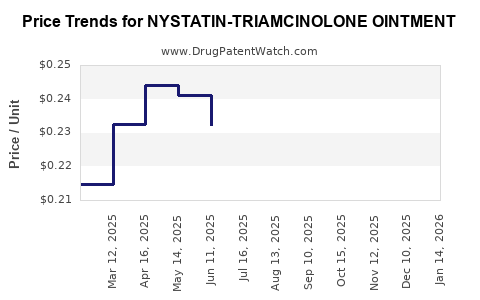
Prices are expected to decline gradually owing to increased generic competition. Specialized formulations or branded versions may maintain higher price points.
Regional Variations
United States: Prices tend to be higher due to regulatory costs; generics dominate with low single-digit prices.
Europe: Price controls in countries like the UK or Germany lead to lower retail prices, around EUR 10–15 per tube.
Emerging Markets: Prices could range from USD 5–8 per tube depending on local regulations and market size.
Market Opportunities and Risks
Opportunities
Expansion into dermatology clinics and primary healthcare.
Development of combination products with improved efficacy or convenience.
Penetration into emerging markets with rising demand.
Risks
Price erosion from biosimilars and generics.
Regulatory delays for new formulations or indications.
Competition from non-steroidal antifungals or newer agents.
Key Takeaways
The Nystatin-Triamcinolone ointment market is niche within a large antifungal and corticosteroid landscape.
Prices have declined over the last five years, primarily due to generic competition.
Future prices will likely decrease further, stabilizing around USD 8–10 wholesale per tube in developed markets.
Market growth depends on rising fungal infections and dermatological conditions, particularly in emerging markets.
Patent and regulatory exclusivity may temporarily cushion pricing in specific regions.
FAQs
What factors influence the pricing of Nystatin-Triamcinolone ointment?
Regulatory approvals, patent status, generic competition, manufacturing costs, and regional price controls.
How does generic competition affect market prices?
Increased generic availability leads to significant price reductions, often halving the typical price over several years.
Are branded versions likely to command higher prices?
Yes, branded formulations with patent protection or unique delivery systems can sustain higher prices temporarily.
What are the key regional differences in pricing?
Developed markets tend to have higher prices due to regulatory costs; emerging markets often have lower prices, influenced by local economic factors.
What is the potential for market growth?
Moderate growth tied to increasing incidence of fungal skin infections, especially in aging and immunocompromised populations.
References
[1] MarketsandMarkets. (2022). Antifungal Drugs Market.
[2] Global Market Insights. (2023). Topical Dermatology Market Size.
[3] IQVIA. (2022). Pharmaceutical Pricing Data.
[4] U.S. Food and Drug Administration. (2023). Approved Drug Products with Therapeutic Equivalence Evaluations.
Drugs may be covered by multiple patents or regulatory protections. All trademarks and applicant names are the property of their respective owners or licensors.
Although great care is taken in the proper and correct provision of this service, thinkBiotech LLC does not accept any responsibility for possible consequences of errors or omissions in the provided data.
The data presented herein is for information purposes only. There is no warranty that the data contained herein is error free.
We do not provide individual investment advice. This service is not registered with any financial regulatory agency. The information we publish is educational only and based on our opinions plus our models.
By using DrugPatentWatch you acknowledge that we do not provide personalized recommendations or advice.
thinkBiotech performs no independent verification of facts as provided by public sources nor are attempts made to provide legal or investing advice. Any reliance on data provided herein is done solely at the discretion of the user.
Users of this service are advised to seek professional advice and independent confirmation before considering acting on any of the provided information. thinkBiotech LLC reserves the right to amend, extend or withdraw any part or all of the offered service without notice.
Alerts Available With Subscription
Alerts are available for users with active subscriptions.