Share This Page
Drug Price Trends for NOVOLOG MIX
✉ Email this page to a colleague
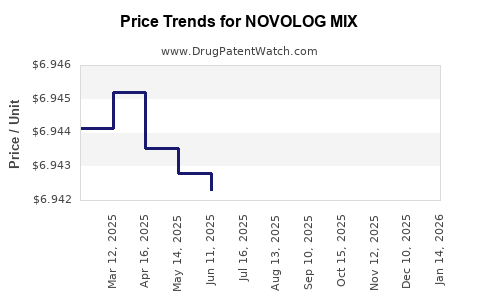
Average Pharmacy Cost for NOVOLOG MIX
| Drug Name | NDC | Price/Unit ($) | Unit | Date |
|---|---|---|---|---|
| NOVOLOG MIX 70-30 VIAL | 00169-3685-12 | 6.92882 | ML | 2026-07-22 |
| NOVOLOG MIX 70-30 FLEXPEN | 00169-3696-19 | 8.94106 | ML | 2026-07-22 |
| NOVOLOG MIX 70-30 VIAL | 00169-3685-12 | 6.93137 | ML | 2026-06-17 |
| >Drug Name | >NDC | >Price/Unit ($) | >Unit | >Date |
What is NOVOLOG MIX and its market positioning?
NOVOLOG MIX comprises insulin analogs designed for diabetes management. It combines rapid-acting insulin (insulin aspart) with intermediate-acting insulin (protamine insulin aspart). Available in two formulations—70/30 and 50/50—it offers flexible dosing options for type 1 and type 2 diabetes.
Manufactured by Novo Nordisk, NOVOLOG MIX holds a significant market share in premixed insulin. Its notable advantages include a pharmacokinetic profile mimicking physiologic insulin release, reduced injection frequency, and compatibility with insulin pumps and pens.
How does NOVOLOG MIX impact the diabetes treatment market?
As of 2023, the global insulin market is valued at approximately $23 billion, with premixed insulins capturing roughly 25% of total sales.[1] NOVOLOG MIX accounts for about 20% of premixed insulin sales globally, equating to approximately $1.15 billion in 2022. The growth rate for premixed insulins averages 4-6% annually, driven by rising diabetes prevalence and patient preference for simplified regimens.
In the U.S., sales of NOVOLOG MIX are estimated at $600-700 million, representing a significant portion of Novo Nordisk’s insulin portfolio.[2] Emerging markets report accelerated growth, with expansion fueled by market entry strategies and increased healthcare infrastructure.
What are current patent and regulatory considerations?
The original patent for NOVOLOG MIX expired in the U.S. in 2013, opening the market to biosimilars. Since then, biosimilar versions have entered markets such as India and the EU, creating competitive pricing pressures.
Regulatory pathways for biosimilars have tightened, requiring comprehensive comparability data. Novo Nordisk maintains exclusivity through formulation patents extending to 2025-2027 in key markets, including patent litigations and patent extensions.
What is the current price landscape for NOVOLOG MIX?
In the U.S., the wholesale acquisition cost (WAC) for a 10 mL carton (100 units/mL pens) averages $300-350. Insurance rebates and patient assistance programs reduce out-of-pocket expenses significantly. The retail price in Europe averages €40-45 per pen, with variations among countries.
Market entry of biosimilars has dampened retail prices by 10-20% in regions with biosimilar availability. In India, biosimilar insulin versions retail at approximately $3-5 per pen, indicating potential for lower pricing in emerging markets.
What are projections for future pricing and market growth?
Projected market growth for premixed insulins (including NOVOLOG MIX) remains 4-6% annually until 2028, driven by increasing diabetes prevalence and patient reliance on insulin therapy. Price competition from biosimilars is expected to reduce prices by 10-15% over the next three years.
Regulatory approval timelines for biosimilar insulins in major markets (U.S., EU, China) remain uncertain, impacting pricing dynamics. Novo Nordisk’s continued investment in formulation patents may sustain limited price erosion through 2025.
What strategic factors influence NOVOLOG MIX's market outlook?
-
Biosimilar Competition: Entry of biosimilar insulins, such as Nurellev (biosimilar insulin aspart), in major markets could decrease prices and market share. However, patent protections and supply agreements can delay biosimilar penetration.
-
Patient and Physician Adoption: Preference for ease of use and predictable glucose control sustains demand. Clinical guidelines favor premixed insulins for certain patient populations, supporting stable sales.
-
Regulatory Developments: Approval of new delivery devices (smart pens, analog monitors) could improve adherence and extend product lifecycle. Patent protections around delivery devices further delay biosimilar impact.
-
Emerging Market Expansion: Growing healthcare infrastructure and affordability improvements support market entry, although price sensitivity remains a challenge.
What are the implications for investors and manufacturers?
Investors should monitor biosimilar approval timelines, pricing policies, and patent litigation outcomes. Manufacturers facing biosimilar competition must innovate in delivery technology and extend patent protections to preserve margins.
For Novo Nordisk, maintaining leadership entails balancing patent strategies with pipeline development, including next-generation insulin analogs or delivery systems.
Key Takeaways
- NOVOLOG MIX accounts for around 20% of premixed insulin global sales, valued at approximately $1.15 billion in 2022.
- Prices in the U.S. average $300-350 per 10 mL carton; biosimilars are reducing prices, especially in regions with biosimilar availability.
- The insulin market is projected to grow 4-6% annually through 2028; biosimilar entry may reduce prices by up to 15%.
- Patent protections and formulation patents are critical factors in market exclusivity and pricing strategies.
- Expanding to emerging markets presents growth opportunities but faces pricing and reimbursement challenges.
FAQs
1. When will biosimilar versions of NOVOLOG MIX be widely available globally?
Biosimilar approval is ongoing in multiple regions. The EU approved biosimilar insulin aspart (Nurellev) in 2022, with broader availability expected over the next 1-2 years, contingent on regulatory and supply chain factors.
2. How will patent expirations affect NOVOLOG MIX pricing?
Patent expirations in 2013, with additional patent protections extending to 2025-2027, influence market exclusivity. Biosimilar entry is expected as patents expire, potentially reducing prices by 10-20% over three years.
3. What innovations could extend NOVOLOG MIX’s market longevity?
Advances in delivery devices, such as smart pens and integration with digital health tools, and development of next-generation insulin analogs, could sustain demand.
4. How does NOVOLOG MIX compare with other premixed insulins in efficacy?
Clinical studies show comparable efficacy and safety profiles with competitors like Humulin 70/30 and Humalog Mix 75/25. Pharmacokinetic features favor flexible dosing and glucose control.
5. What are the primary barriers to growth in emerging markets?
Price sensitivity, reimbursement policies, and limited healthcare infrastructure limit adoption. Local biosimilar availability and pricing strategies also influence market penetration.
[1] IQVIA. "Global Insulin Market Analysis," 2023.
[2] Novo Nordisk Annual Report, 2022.
More… ↓
