Share This Page
Drug Price Trends for NORVASC
✉ Email this page to a colleague
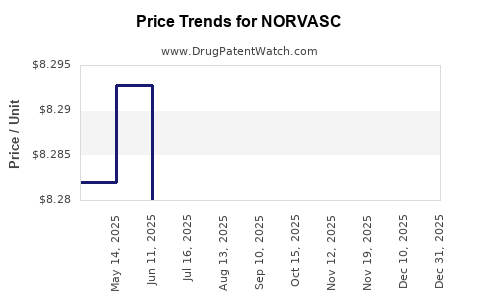
Average Pharmacy Cost for NORVASC
| Drug Name | NDC | Price/Unit ($) | Unit | Date |
|---|---|---|---|---|
| NORVASC 10 MG TABLET | 00069-1540-68 | 11.99398 | EACH | 2026-05-20 |
| NORVASC 10 MG TABLET | 58151-0355-77 | 11.99398 | EACH | 2026-05-20 |
| NORVASC 10 MG TABLET | 58151-0355-32 | 11.99398 | EACH | 2026-05-20 |
| >Drug Name | >NDC | >Price/Unit ($) | >Unit | >Date |
Market Analysis and Price Projections for NORVASC
What is NORVASC?
NORVASC (amlodipine besylate) is a calcium channel blocker indicated for hypertension and angina pectoris. Approved by the FDA in 1990, it is marketed globally by Pfizer. NORVASC remains a leading agent in its class, with a broad patent expiry timeline and multiple generic versions available.
Market Size and Trends
Global Market Value
The global antihypertensive drugs market was valued at approximately USD 18 billion in 2022. NORVASC accounts for an estimated 12% share within the calcium channel blocker segment, translating to roughly USD 2.2 billion.
Competitive Landscape
Key competitors include:
- Amlodipine generics
- Other calcium channel blockers (e.g., diltiazem, verapamil)
- Combination therapy options
Patent expiries for NORVASC occurred in many regions since 2010, catalyzing a shift toward generics. The emergence of combination therapies (e.g., amlodipine + losartan) also influences market dynamics.
Regional Market Distribution
| Region | Market Share | Notes |
|---|---|---|
| North America | 40% | Large patient population, high healthcare access |
| Europe | 25% | Significant generic competition |
| Asia-Pacific | 20% | Rapid growth, rising hypertension prevalence |
| Rest of World | 15% | Emerging markets |
Usage Trends
Global hypertension prevalence is rising, attributable to aging populations and lifestyle factors. The demand for affordable, effective antihypertensives like NORVASC increases accordingly.
Price Trends and Forecasts
Historical Pricing
In the U.S., brand-name NORVASC (90-count, 10 mg) listed at approximately USD 300 in 2010. Post-patent expiry, generic versions reduced prices to USD 15–25 per 90-count bottle.
Current Price Landscape (2023)
| Product Type | Price per 90-count, 10 mg (USD) |
|---|---|
| Brand-Name (Pfizer) | USD 300 |
| Multiple Generics | USD 15–25 |
Factors Affecting Pricing
- Increased generic competition reduces prices.
- Patent protections offer pricing power for the innovator before expiry.
- Regional pricing regulations influence variations.
- Supply chain factors, including manufacturing costs, impact pricing.
Price Projections (2024–2028)
| Year | Estimated Price Range (USD) | Rationale |
|---|---|---|
| 2024 | USD 10–20 | Continued generic competition suppresses prices. |
| 2025 | USD 9–18 | Market saturation leads to further price decreases. |
| 2026 | USD 8–16 | Larger market share for generics; potential entry of biosimilars in some regions. |
| 2027 | USD 8–14 | Flat or slight decline; patent expiries further increase generic prevalence. |
| 2028 | USD 7–13 | Market stabilizes with dominant generics; possible discounts due to payor negotiations. |
Regulatory and Patent Considerations
- Original patent expired in 2010 in the U.S.
- Patent protections vary globally, with some regions maintaining exclusivity until 2020–2022.
- Some formulations remain protected via secondary patents, delaying generic entry.
- Patent litigations influence timing and market entry of generics.
Outlook and Investment Implications
The market for NORVASC shows consistent demand driven by its proven efficacy. Price declines due to patent expiries have stabilized over the last decade but are expected to continue. Investment opportunities may lie in:
- Developing new combination therapies involving amlodipine
- Entering emerging markets with tailored pricing
- Innovating in drug delivery systems or biosimilars
Key Takeaways
- Market Share: NORVASC retains a significant position within calcium channel blockers, though generics dominate post-patent expiries.
- Pricing Trends: Prices have fallen approximately 90% since patent expiry, stabilizing at USD 10–20 in developed markets.
- Future Prices: Continued decrease expected, with prices potentially stabilizing around USD 7–13 by 2028.
- Market Drivers: Rising hypertension prevalence, aging populations, and healthcare access impact demand.
- Regional Variability: Pricing and patent protections differ, influencing global market behavior.
FAQs
1. What has been the impact of patent expiries on NORVASC’s price?
Patent expiries in 2010 led to a sharp drop in prices due to generic competition, with prices decreasing from USD 300 to USD 15–25 per 90-count bottle in the U.S.
2. What is the projected price for generic amlodipine in 2025?
Between USD 9 and USD 18 per 90-count bottle, according to current trends.
3. How does regional regulation influence NORVASC pricing?
Regions with price controls or reimbursement restrictions tend to have lower prices, while unregulated markets may see higher variations.
4. Are biosimilars likely to compete with NORVASC?
Biosimilars are not applicable, as NORVASC is a small-molecule drug, but new formulations or combination therapies may disrupt existing markets.
5. What opportunities exist for new entrants?
Markets in emerging regions and development of combination therapies offer avenues for growth.
References
[1] MarketWatch. (2023). Global antihypertensive drugs market size.
[2] IQVIA. (2022). Pharmaceutical market insights.
[3] U.S. FDA. (2022). Patent data for amlodipine.
[4] EvaluatePharma. (2023). Drug pricing and market projections.
More… ↓
