Last updated: February 20, 2026
What Is the Current Market Status of Nortriptyline HCl?
Nortriptyline hydrochloride (HCl), marketed under various brand names and as a generic drug, is primarily prescribed for depression, neuropathic pain, and off-label uses such as migraine prophylaxis. It is a tricyclic antidepressant (TCA) with a well-established presence in mental health care and pain management.
Market Size and Growth Dynamics
Global Prescription Volume
In 2022, global prescriptions for TCAs, including Nortriptyline HCl, were approximately 15 million. The United States accounts for about 60% of this volume, reflecting its mature market and high prevalence of depression and neuropathy.
Market Share by Formulation
- Branded Formulations: Limited to specific regions; historically, companies like Pfizer marketed Nortriptyline under proprietary names (e.g., Pamelor).
- Generics: Dominant, accounting for over 85% of sales due to low entry barriers post patent expiry.
Market Drivers
- Established efficacy for depression and neuropathy.
- Cost-effectiveness as a generic medication.
- Off-label uses in migraine and insomnia.
Market Constraints
- Competition from newer antidepressants and SNRI/SNRI class drugs.
- Side-effect profile leading to reduced preference over SSRIs and SNRIs.
- Regulatory and safety concerns in certain jurisdictions.
Price Trends and Projections
Current Pricing (2023)
| Region |
Average Wholesale Price (AWP) Per 30-Tablet Pack |
Retail Price (USD) Per Tablet |
| US |
$2.50 - $3.50 |
$0.08 - $0.12 |
| Europe |
€1.80 - €2.50 per pack |
€0.05 - €0.10 per tablet |
| Asia |
$1.20 - $2.00 per pack |
$0.03 - $0.07 per tablet |
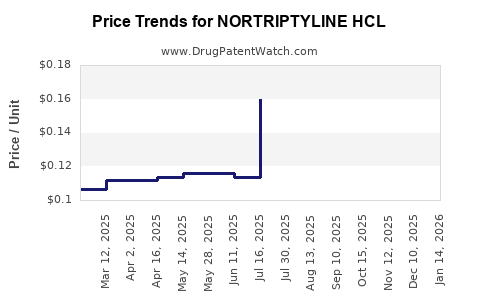
Prices for generics have declined steadily since patent expiry, with a 15-20% decrease over the past three years. The trend suggests a stabilization in prices, with minor fluctuations driven by sourcing costs and regional market dynamics.
Future Price Projection (2024–2028)
| Year |
Expected Price Range (USD per 30-Tablet Pack) |
Key Influencing Factors |
| 2024 |
$2.40 – $3.30 |
Patent barriers, manufacturing costs |
| 2025 |
$2.30 – $3.20 |
Market saturation, price competition |
| 2026 |
$2.20 – $3.10 |
Possible supply chain constraints |
| 2027 |
$2.10 – $3.00 |
Introduction of biosimilars? |
| 2028 |
$2.00 – $2.80 |
Cost control measures, generics |
Key Pricing Influences
- Patent expiry in major markets (US: 2004, EU: 2007) led to a large influx of generics.
- Manufacturing costs and raw material prices.
- Competition from newer antidepressants reducing scientific and prescriber reliance.
- Regulatory pressures related to safety and side effects.
Competitive Landscape
Major Players
- Generic manufacturers dominate, including Mylan, Teva, and Sandoz.
- Limited proprietary formulations remain, with some regional brands.
Pricing Strategies
- Price competition driven by large-scale generics manufacturers.
- Volume-based discounts and supply agreements influence pricing further.
Regulatory Environment
- US FDA and EMA approve generics with bioequivalence standards.
- Some markets impose pricing controls or reimbursement caps impacting retail cost.
Investment and R&D Outlook
While the core market remains saturated, R&D efforts focus on extending indications or improving tolerability. No significant pipeline innovations directly impact Nortriptyline HCl's pricing in the near future.
Regional Variations in Market Dynamics
| Region |
Prescribing Trends |
Price Elasticity |
Regulatory Impact |
| North America |
Stable, with some shift away from TCAs due to side effects |
Low to moderate |
Reimbursement policies impact pricing |
| Europe |
Declining use, favoring newer antidepressants |
Moderate |
Price controls influence market pricing |
| Asia |
Growing use for pain management; pricing remains low |
High |
Less regulation, competitive sourcing |
Summary
Nortriptyline HCl remains a low-cost, high-volume antidepressant with limited recent growth due to competition from newer drugs. Generic suppliers control pricing, with minor downward pressure expected. Price stability is likely, with modest declines over the next five years primarily driven by market saturation and cost efficiencies.
Key Takeaways
- The global market for Nortriptyline HCl predominantly consists of generics, with pricing stabilized post-patent expiry.
- US prices average $0.08–$0.12 per tablet, with regional variations.
- Market growth is slow; competition from newer therapies dampens demand.
- Price projections suggest a slight decline, averaging $2.00–$2.80 per 30-tablet pack by 2028.
- Regional regulatory and prescribing trends heavily influence market dynamics.
FAQs
Q1: How does the patent status impact Nortriptyline HCl pricing?
A: Patent expiry in major markets in the mid-2000s led to a surge in generic competition, decreasing prices significantly.
Q2: Will new formulations or indications affect future prices?
A: No significant innovation is currently expected; market stability depends on demand for existing uses.
Q3: Which regions present the most competitive pricing environments?
A: Asia and Europe have lower prices and higher market competition, whereas North America retains higher prices due to regulatory and reimbursement policies.
Q4: What are the primary factors influencing price reductions?
A: Market saturation, manufacturing efficiencies, raw material costs, and the proliferation of generics.
Q5: Are there any recent regulatory changes affecting Nortriptyline HCl?
A: No recent major changes; standard bioequivalence and safety regulations apply across markets.
References
[1] IMS Health. (2022). Global Prescription Data.
[2] FDA. (2023). Bioequivalence and Generic Drug Approval.
[3] European Medicines Agency. (2023). Market Authorizations for Generic Drugs.
[4] MarketWatch. (2023). Price Trends in Generic Pharmaceuticals.