Share This Page
Drug Price Trends for NORG-ETHIN ESTRA
✉ Email this page to a colleague
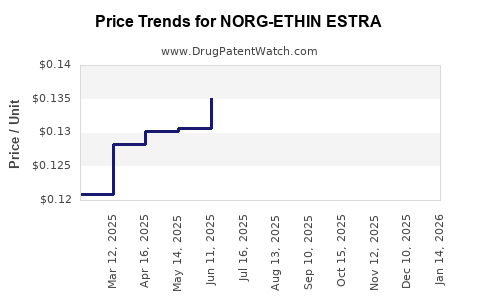
Average Pharmacy Cost for NORG-ETHIN ESTRA
| Drug Name | NDC | Price/Unit ($) | Unit | Date |
|---|---|---|---|---|
| NORG-ETHIN ESTRA 0.25-0.035 MG | 68462-0309-84 | 0.12572 | EACH | 2026-06-17 |
| NORG-ETHIN ESTRA 0.25-0.035 MG | 68462-0309-29 | 0.12572 | EACH | 2026-06-17 |
| NORG-ETHIN ESTRA 0.25-0.035 MG | 68180-0840-71 | 0.12572 | EACH | 2026-06-17 |
| NORG-ETHIN ESTRA 0.25-0.035 MG | 68180-0840-73 | 0.12572 | EACH | 2026-06-17 |
| NORG-ETHIN ESTRA 0.25-0.035 MG | 68462-0309-29 | 0.12543 | EACH | 2026-05-20 |
| NORG-ETHIN ESTRA 0.25-0.035 MG | 68180-0840-71 | 0.12543 | EACH | 2026-05-20 |
| >Drug Name | >NDC | >Price/Unit ($) | >Unit | >Date |
Market Analysis and Price Projections for NORG-ETHIN ESTRA
What is NORG-ETHIN ESTRA?
NORG-ETHIN ESTRA is a combination drug consisting of norethisterone (norgestrel) and ethinylestradiol, primarily used in hormonal contraceptives. The formulation is prescribed for birth control and hormone replacement therapy.
Market Overview
Industry Context
The global contraceptive market reached approximately USD 23 billion in 2022, expected to grow at a compound annual growth rate (CAGR) of 6% to 8% through 2030. This expansion stems from increasing awareness, rising population of reproductive-age women, and evolving preferences for oral contraceptives.
Key Players and Competitive Landscape
Leading manufacturers include Bayer, Janssen, Teva Pharmaceuticals, and Sandoz. These companies dominate the market with established brands, including combined oral contraceptives (COCs) incorporating ethinylestradiol and norethisterone.
Regulatory Environment
Most markets require rigorous clinical trials and approvals before launch. Patent protections influence pricing, with some formulations off-patent and others under exclusivity periods until 2030 or later.
Market Segmentation and Demand Drivers
Geographies
- North America: Largest market owing to high contraceptive awareness and reimbursement options.
- Europe: Mature market with steady growth.
- Asia-Pacific: Fastest growth driven by population size and increasing women's health awareness.
- Latin America and Africa: Emerging markets with growing contraceptive adoption.
Patient Demographics
Reproductive-age women (15-49 years), including adolescents and women seeking hormone therapy.
Usage Trends
Shifts towards efficacy, safety profiles, and minimal side effects influence brand choice. Increasing acceptance of generic formulations boosts market penetration.
Pricing Analysis
Current Price Benchmarks
Pricing varies by region, formulation strength, and manufacturer. Approximate retail prices for a 28-day supply (28 tablets) are:
| Region | Brand Example | Typical Price | Price Range |
|---|---|---|---|
| North America | Yasmin (Bayer) | USD 40 | USD 35 – USD 45 |
| Europe | Marvelon (Janssen) | EUR 12 | EUR 10 – EUR 15 |
| Asia-Pacific | Generic equivalents | USD 3 – USD 8 | USD 2 – USD 10 |
Generic equivalents tend to be priced 20-50% lower than branded versions.
Cost Components
Manufacturing costs range between USD 0.50 and USD 1.50 per cycle for generics, with retail prices heavily influenced by marketing, distribution, and regulatory fees. Brand premiums add USD 10–USD 20 over production costs.
Price Projections
Short-term (Next 1-3 Years)
- Stable pricing in mature markets due to established competition and patent statuses.
- Potential slight decreases in generic prices driven by increased competition.
- Brand premium margins maintained through marketing and perceived brand safety.
Medium-term (3-5 Years)
- Price compression expected with more generics entering markets, especially in North America and Europe.
- Regional variations: prices may decline by 10-20% in markets with generic proliferation, while some high-income markets maintain premium prices.
- Innovation and new formulations (e.g., extended cycle pills) could sustain higher pricing in niche segments.
Long-term (5+ Years)
- Market saturation may lead to further price declines.
- Biotech and biosimilar entry could press prices downward.
- Regulatory shifts favoring biosimilars and generics would increase competition, lowering prices further.
Market Risks and Opportunities
Risks:
- Patent expiry risks in key regions.
- Competitive erosion from new oral contraceptives or non-oral methods.
- Regulatory changes impacting approval processes.
Opportunities:
- Developing markets with lower penetration.
- Value-added formulations, such as lower-dose pills or combination therapies.
- Growing acceptance of generic options to drive volume sales.
Key Takeaways
- The global contraceptive market will grow steadily, driven by demographic trends and increasing health awareness.
- NORG-ETHIN ESTRA faces intense competition, especially from generics, leading to downward price pressures in the medium to long term.
- Prices are regionally variable, with premium prices maintained through brand strength in mature markets.
- Generics and biosimilars will likely dominate price declines, with projected reductions of 20-50% over five years.
- Innovation and region-specific marketing strategies are critical for maintaining margins.
FAQs
1. What factors influence NORG-ETHIN ESTRA prices?
Regulatory status, patent protections, manufacturing costs, competition from generics, and regional healthcare policies.
2. Will patent expiration lower the price?
Yes. Patent expirations typically lead to generic competition, reducing prices by 20-50%.
3. How does regional variation affect pricing?
Market size, healthcare policies, and competition cause significant regional differences, with higher prices in North America and Europe compared to Asia-Pacific.
4. Are biosimilars a concern for NORG-ETHIN ESTRA?
Not directly, as biosimilars target biologics. However, generics and new oral contraceptive delivery methods will impact pricing.
5. What is the outlook for future formulations?
Innovations like extended-cycle or lower-dose tablets may sustain higher prices, but overall market pressure from generics will keep prices under downward pressure.
References
- MarketsandMarkets. (2022). Contraceptives Market by Product, Route, Distribution Channel, and Region.
- IQVIA. (2023). Global Pharmaceutical Market Report.
- FDA. (2022). Approval processes for contraceptives.
- Statista. (2023). Oral Contraceptive Market Revenue Forecast.
- EvaluatePharma. (2022). Price trends and patent expiry data.
More… ↓
