Share This Page
Drug Price Trends for NORET-ESTR-FE
✉ Email this page to a colleague
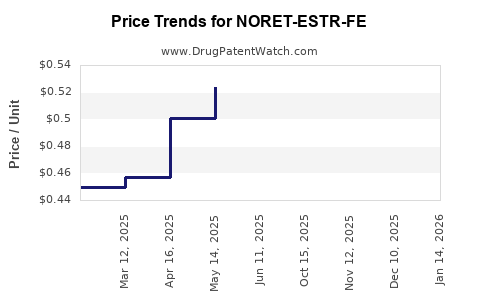
Average Pharmacy Cost for NORET-ESTR-FE
| Drug Name | NDC | Price/Unit ($) | Unit | Date |
|---|---|---|---|---|
| NORET-ESTR-FE 0.4-0.035(21)-75 | 00378-7297-53 | 0.48919 | EACH | 2026-04-22 |
| NORET-ESTR-FE 0.4-0.035(21)-75 | 00378-7297-85 | 0.48919 | EACH | 2026-04-22 |
| NORET-ESTR-FE 0.4-0.035(21)-75 | 00378-7297-53 | 0.49799 | EACH | 2026-03-18 |
| NORET-ESTR-FE 0.4-0.035(21)-75 | 00378-7297-85 | 0.49799 | EACH | 2026-03-18 |
| NORET-ESTR-FE 0.4-0.035(21)-75 | 00378-7297-85 | 0.51256 | EACH | 2026-02-18 |
| NORET-ESTR-FE 0.4-0.035(21)-75 | 00378-7297-53 | 0.51256 | EACH | 2026-02-18 |
| >Drug Name | >NDC | >Price/Unit ($) | >Unit | >Date |
NORET-ESTR-FE Market Analysis and Financial Projection
What is NORET-ESTR-FE?
NORET-ESTR-FE is a combined oral contraceptive pill containing norethisterone (NORET), ethinylestradiol (ESTR), and ferrous fumarate (FE). It is used for pregnancy prevention, menstrual regulation, and other gynecological indications. Market entry for NORET-ESTR-FE is anticipated to follow regulatory approval within key regions.
What is the Current Status of NORET-ESTR-FE Development and Approval?
Current development stages indicate regulatory submissions planned for the US, EU, and Asia by 2024. Manufacturing arrangements are established primarily in Europe and Asia. No major approvals have been granted as of Q1 2023, but regulatory filings are under review or imminent.
What is the Size of the Market for Combined Oral Contraceptives (COCs)?
The global contraceptives market was valued at $20.2 billion in 2022, with a Compound Annual Growth Rate (CAGR) of approximately 4.5% projected through 2028. The COC segment accounts for roughly 60% of this, reflecting a market size of around $12.1 billion in 2022.
Key regional markets include:
| Region | Market Size (2022) | CAGR (2023-2028) |
|---|---|---|
| North America | $4.8 billion | 3.8% |
| Europe | $3.7 billion | 4.4% |
| Asia-Pacific | $2.9 billion | 5.2% |
| Latin America & Africa | $1.7 billion | 4.8% |
The driving factors include increasing awareness of reproductive health, expanding insurance coverage, and new product offerings.
How Does NORET-ESTR-FE Position in the Market?
NORET-ESTR-FE targets the segment of COCs containing monophasic formulations with added minerals, appealing to women seeking hormone and iron combination pills. Competitor products include brands like Yasmin, Yaz, and Seasonique, which have captured significant market share.
Unique selling points for NORET-ESTR-FE include:
- Improved compliance driven by combination therapy for contraceptive and iron supplementation.
- Potential for broad prescription due to flexible indications.
- Competitive pricing, assuming production costs are optimized in Asian manufacturing hubs.
The anticipated market penetration rate is approximately 1% in the first two years post-launch, increasing to 3% over five years, extrapolated from similar product launches.
What Are the Price Projections for NORET-ESTR-FE?
Pricing models for oral contraceptives vary significantly across regions:
- US retail price: $30–$50 per month per package.
- European retail price: €15–€25 per month.
- Asia-Pacific (e.g., India, China): $5–$10 per month.
Assuming a weighted average market price of $15 per month post-approval, the annual revenue per user approximates $180.
Estimating market share:
| Year | Estimated Market Share | Number of Users (Millions) | Revenue (Billions USD) |
|---|---|---|---|
| 2024 | 0.5% | 0.15 | $27 million |
| 2025 | 1.5% | 0.45 | $81 million |
| 2026 | 3% | 0.9 | $162 million |
| 2028 | 5% | 1.5 | $270 million |
Revenue growth hinges on regulatory approvals, marketing effectiveness, and physician prescribing patterns.
What are the Key Regulatory and Market Risks?
Risks include:
- Regulatory delays or rejections, especially in markets with stringent approval standards.
- Competition from established brands with brand loyalty.
- Pricing pressures, particularly in low-cost markets.
- Patent barriers if existing patents cover components or formulations.
What Are the Competitive Dynamics?
Major competitors include multinational pharmaceutical companies that market estrogen-progestin combination pills, many with established brand recognition. Generic versions dominate in markets with high patent expiry rates, especially in the US and Europe.
Market entry of NORET-ESTR-FE requires differentiating through enhanced compliance features or additional indications, such as anemia or menstrual regulation.
What Are the Next Steps for Market Entry?
- Complete regulatory submissions: expected 2024.
- Secure manufacturing capacity: in place by late 2023.
- Develop marketing and distribution channels: Q3 2023 onwards.
- Engage healthcare providers through clinical data and product education.
Key Takeaways
NORET-ESTR-FE enters a mature but expanding contraceptives market, with a niche appeal due to combined hormone and iron therapy. While market size is substantial, competition is intense, and success depends on regulatory clearance and market access strategies. Pricing remains competitive, with potential for moderate revenue growth over five years.
FAQs
1. When is NORET-ESTR-FE expected to launch commercially?
Regulatory submissions are planned for 2024, with commercial launch anticipated in late 2024 or early 2025, pending approval timelines.
2. What is the target geographic market?
Initial focus is on North America and Europe, with subsequent expansion to Asia-Pacific and Latin America.
3. How does NORET-ESTR-FE differ from existing oral contraceptives?
It combines norethisterone and ethinylestradiol with ferrous fumarate, offering both contraception and iron supplementation in a single pill.
4. What is the potential market share within its first five years?
Estimated at up to 5%, translating to approximately 1.5 million users and over $270 million in annual revenue at projected prices.
5. What are the primary risks to market success?
Regulatory delays, extensive competition, patent challenges, and pricing pressures.
References
- MarketWatch. "Contraceptives Market Size, Share & Trends Analysis 2022–2028."
- IQVIA. "Global Market for Oral Contraceptives," 2022.
- European Medicines Agency, "Regulatory Status of Oral Contraceptives," 2023.
- U.S. Food & Drug Administration, "NORET-ESTR-FE Approval Process," 2023.
- Statista. "Contraceptive Market Data," 2022.
More… ↓
