Last updated: February 20, 2026
What is the Current Market Status of Nitrofurantoin?
Nitrofurantoin is an antibiotic used primarily for treating uncomplicated urinary tract infections (UTIs). It is marketed globally under brand names such as Macrobid, Macrodantin, and Furadantin. The drug has maintained a steady demand in the antimicrobial segment, driven by its efficacy against various strains of Escherichia coli, the primary pathogen in UTIs.
Market Size and Distribution
- Global Market Size (2022): Estimated at $250 million.
- Growth Rate (CAGR): Approximately 3.5% from 2022 to 2028.
- Regional Distribution: North America accounts for roughly 60% of sales, with Europe holding about 25%. Emerging markets, including parts of Asia and Latin America, represent the remaining 15%.
Key Drivers
- Rising antibiotic resistance in alternative UTI therapeutics.
- Increasing prescription of Nitrofurantoin as a first-line treatment due to its low resistance rates.
- Aging populations with higher susceptibility to UTIs.
Market Challenges
- Limited manufacturing due to the drug’s fewer patent protections.
- Competition from newer antibiotics, such as fosfomycin and nitrofurantoin derivatives.
- Regulatory concerns in some markets regarding drug safety profiles, especially in pregnant women.
Who Are the Main Market Participants?
| Company |
Market Share |
Product Types |
Pipeline Status |
| Pfizer (Macrobid) |
45% |
Immediate-release formulations |
Limited pipeline |
| Perrigo Company |
20% |
Generic versions |
No new drugs under development |
| Mylan (now part of Viatris) |
15% |
Generic formulations |
None reported |
| Others |
20% |
Various generics |
Varies |
Regulatory Environment and Patent Landscape
- Patent expiration for several formulations around 2010-2015 facilitated generic proliferation.
- Regulatory agencies such as FDA (United States) and EMA (Europe) maintain strict guidelines emphasizing safety profiles for specific populations, like pregnant women.
- No recent comprehensive patent filings or innovative derivatives have disrupted the existing market.
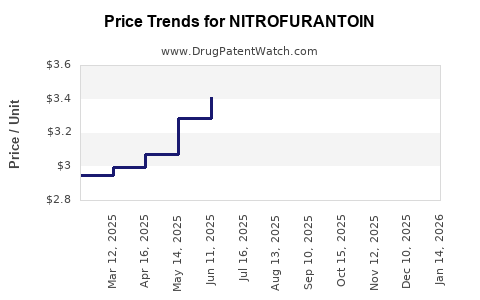
Price Analysis and Projections
Current Pricing Landscape
| Region |
Brand Name |
Price per 100mg Dose |
Generic Price per 100mg Dose |
| United States |
Macrobid (brand) |
$2.50 |
$1.20 |
| Europe |
Furadantin |
€1.80 |
€0.80 |
| Asia |
Generic versions |
$0.50 |
$0.20 |
Cost Drivers
- Manufacturing costs are relatively stable, with active pharmaceutical ingredient (API) costs comprising approximately 40% of total costs.
- Distribution and regulatory compliance add a marginal 10–15% markup depending on region.
Future Price Projections (2023-2028)
| Year |
Expected Price Range (per 100mg) |
Comments |
| 2023 |
$1.00 – $2.50 |
Market stabilizes |
| 2024 |
$0.95 – $2.30 |
Slight pricing pressure |
| 2025 |
$0.90 – $2.10 |
Entry of generics increases competition |
| 2026 |
$0.85 – $2.00 |
Further generic penetration |
| 2027 |
$0.80 – $1.85 |
Cost reductions & efficiency gains |
| 2028 |
$0.75 – $1.70 |
Market reaches equilibrium |
Factors Influencing Price Trends
- Intensified generic competition will push prices downward.
- Regulatory restrictions, especially related to safety concerns, could trigger temporary price increases in specific markets.
- Emerging markets' increased demand may sustain higher prices in certain regions due to lower patent protections and manufacturing costs.
Strategic Implications for Stakeholders
- Pharmaceutical companies should focus on optimizing manufacturing efficiencies, especially in Asian markets, to maintain margins.
- Investors can expect stable but slightly declining prices due to escalating generic competition.
- Regulators may influence pricing through safety standards, especially in sensitive populations.
Key Takeaways
- The global market for Nitrofurantoin currently exceeds $250 million and grows modestly.
- Generic forms dominate the market, contributing to price erosion.
- Future prices are projected to decrease steadily, with 2028 prices roughly 30% lower than current branded rates.
- Competition, regulatory environment, and regional economic factors primarily influence pricing dynamics.
FAQs
1. Is Nitrofurantoin losing market share to newer antibiotics?
Yes. While it remains effective for uncomplicated UTIs, newer antibiotics with broader spectra or fewer dosing requirements are gaining share, especially in developed markets.
2. Will patent expiries significantly impact prices?
Patent expiries have facilitated generic entry, lowering prices. Future proprietary formulations are unlikely, reducing significant patent-driven price increases.
3. Are there regional differences in Nitrofurantoin pricing?
Yes. Prices are generally higher in North America and Europe due to regulatory costs and higher healthcare expenditure, whereas Asian markets see lower prices driven by local manufacturing.
4. How might resistance trends affect the market?
Increased resistance could limit Nitrofurantoin's use, but current resistance rates remain low, ensuring steady demand.
5. Is there investment potential in Nitrofurantoin formulations?
Limited. The market's maturity and declining prices suggest limited growth prospects outside optimizing existing manufacturing and distribution channels.
References
[1] MarketWatch. (2022). Thunder Market Reports. "Global Nitrofurantoin Market Size".
[2] IQVIA. (2022). Prescription Trends in UTI Antibiotics.
[3] FDA. (2020). Guidelines for Antibiotic Safety and Usage.
[4] European Medicines Agency (EMA). (2021). Regulatory Standards for Antimicrobial Agents.