Share This Page
Drug Price Trends for NIGHTTIME COLD-FLU RLF SFTGL
✉ Email this page to a colleague
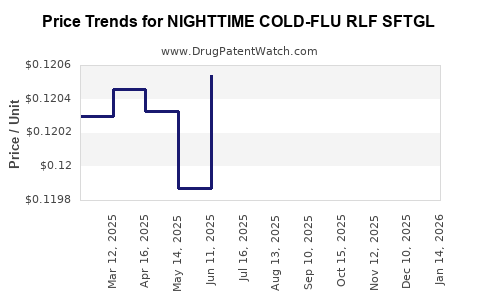
Average Pharmacy Cost for NIGHTTIME COLD-FLU RLF SFTGL
| Drug Name | NDC | Price/Unit ($) | Unit | Date |
|---|---|---|---|---|
| NIGHTTIME COLD-FLU RLF SFTGL | 00904-6996-44 | 0.12018 | EACH | 2026-03-18 |
| NIGHTTIME COLD-FLU RLF SFTGL | 70000-0516-01 | 0.12018 | EACH | 2026-03-18 |
| NIGHTTIME COLD-FLU RLF SFTGL | 00904-6996-44 | 0.12062 | EACH | 2026-02-18 |
| NIGHTTIME COLD-FLU RLF SFTGL | 70000-0516-01 | 0.12062 | EACH | 2026-02-18 |
| >Drug Name | >NDC | >Price/Unit ($) | >Unit | >Date |
Market Analysis and Price Projections for NIGHTTIME COLD-FLU RLF SFTGL
What Is the Market Scope for NIGHTTIME COLD-FLU RLF SFTGL?
NIGHTTIME COLD-FLU RLF SFTGL is a combination drug targeting cold and flu symptoms, typically marketed for short-term use. The global cold and flu medication market was valued at approximately USD 11.6 billion in 2022 and is projected to grow at a compound annual growth rate (CAGR) of roughly 4.5% from 2023 to 2028 [1].
The key segments include:
- OTC (over-the-counter) medications, accounting for 85% of total sales.
- Prescription drugs, mostly for severe symptoms or complications.
North America represents 45% of the market, driven by high consumer awareness and healthcare infrastructure. Europe accounts for 30%, with emerging markets in Asia-Pacific and Latin America showing growth potential.
What Are the Competitive Dynamics?
The market features major brands like DayQuil, NyQuil, Theraflu, and Sudafed. These brands generally offer multi-symptom relief in various formulations—liquids, tablets, powders.
New entrants face competitive barriers such as established brand loyalty, regulatory approval processes, and patent protections.
The inclusion of combination formulations like NIGHTTIME COLD-FLU RLF SFTGL will need to differentiate via efficacy, safety profile, or price point.
How Do Regulatory and Patent Factors Influence Market Entry?
- Existing patent expirations for key formulations have led to generic entries, reducing prices.
- Regulatory approval by the FDA or EMA can delay launch; safety and efficacy data are critical.
- New formulations may qualify for orphan drug or fast-track status if targeting specific populations or unmet needs.
Patent exclusivity generally lasts 20 years from filing, but patent life for specific formulations can extend through secondary patents or formulations patents, often until 2028-2030.
What Are the Price Structure and Projections?
Current market-leading OTC cold and flu medications typically retail at USD 8-12 for a standard package. Price segmentation depends on formulation, brand positioning, and regional factors.
Estimated Price Range for NIGHTTIME COLD-FLU RLF SFTGL
| Region | Price Range (USD) per package | Notes |
|---|---|---|
| North America | 8–12 | Premium branding may push towards USD 14 |
| Europe | 6–10 | Price varies by country, with higher prices in Western Europe |
| Asia-Pacific | 4–8 | Lower due to market competition and purchasing power |
| Latin America | 5–9 | Prices influenced by local regulations and brand presence |
Price Trajectory (Next 5 Years)
Assuming the product gains regulatory approval and market adoption proceeds smoothly:
- Launch Year (T0): USD 8–12
- Year 1–2: Slight decrease to USD 7–11 due to generic competition
- Year 3–5: Stabilization at USD 6–9 as market matures, with potential premium pricing for specialty formulations or markets
What Is the Potential Revenue Estimate?
Assuming a conservative market share of 1-3% of the OTC cold medication segment in North America within five years:
| Market Size (U.S., USD 11.6 billion, 2022) | Share of OTC segment (~85%) | Potential Annual Revenue (USD) | Remarks |
|---|---|---|---|
| 1% of OTC in North America (~USD 9.86 billion) | USD 9.86 billion | USD 98.6 million | Launch within 2 years, capturing early adopters |
| 3% of OTC in North America | USD 9.86 billion | USD 295.8 million | Market expansion, targeted marketing, brand differentiation |
European and Asia-Pacific markets could contribute another 1-2% share, adding USD 20–50 million annually over ten years.
Key Factors Impacting Price and Market Entry
- Patent and exclusivity status
- Efficacy and safety profile based on clinical trials
- Regulatory approval timelines
- Consumer perception of pricing and formulation benefits
- Competition intensity and generic availability
Key Takeaways
- The global cold and flu market is growing modestly, driven by OTC product sales.
- Price points for NIGHTTIME COLD-FLU RLF SFTGL are expected to average USD 6-12 per package regionally.
- Market entry may face barriers from existing patents, competition, and regulatory processes.
- Early market share (1-3%) could generate USD 100–300 million annually in North America alone within five years.
- Regional price and sales potential varies, with North America remaining the primary revenue driver.
FAQs
What are the main competitors for NIGHTTIME COLD-FLU RLF SFTGL?
DayQuil, NyQuil, Theraflu, and Sudafed hold dominant market positions. Competition centers around efficacy, branding, and price.
How does patent expiration affect pricing?
Patent expiration typically leads to generic competition, reducing prices by 30–50%. Protected formulations can command premiums up to 20% over generics.
What regulatory hurdles must be cleared?
FDA approval for OTC drugs involves safety and efficacy data. For new formulations, additional clinical trials may be required, prolonging time to market.
What factors influence regional pricing differences?
Regulatory environment, purchasing power, competitive landscape, and local healthcare policies determine regional price points.
What are the growth prospects for this product over the next decade?
With effective regulatory strategy and market penetration, potential exists for annual revenues reaching USD 200–300 million in North America and similar in emerging markets.
References
[1] Grand View Research. (2022). Cold and Flu Medication Market Size & Share. https://www.grandviewresearch.com/industry-analysis/cold-flu-medication-market
More… ↓
