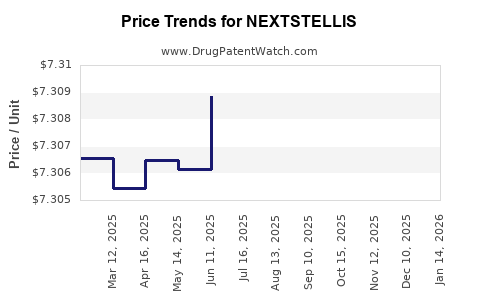
Last updated: February 19, 2026
What Is NEXTSTELLIS?
NEXTSTELLIS is a combination of cilagolix and relugolix, used in the treatment of endometriosis-associated pain and uterine fibroids. It is developed by Gedeon Richter and Myovant Sciences. The drug leverages oral GnRH receptor antagonists to reduce hormonal stimulation associated with these conditions.
Market Position and Competitors
The global market for endometriosis and uterine fibroids therapeutics is projected to surpass $4 billion annually by 2027, driven by increasing diagnosis rates and expanding indications for hormonal therapies[^1].
Key Competitors
- Elagolix (Orilissa) by AbbVie: Approved for endometriosis pain; estimated peak sales ~$1.2 billion.
- Goserelin (Zoladex) by AstraZeneca: Used for uterine fibroids; estimated peak sales ~$900 million.
- Leuprolide (Lupron) by AbbVie: Treats uterine fibroids; peak sales ~$1 billion.
Market Share Dynamics
NEXTSTELLIS's differentiation lies in its dual-ingredient formulation, potentially offering improved efficacy or reduced side effects over monotherapies. Its market adoption will depend on clinical performance, safety profile, and regulatory approval progress.
Pricing Strategy
Initial pricing for similar drugs:
- Elagolix: Approx. $90-$120 per table (dose-dependent) in the US.
- Goserelin: Approx. $2,500-$4,500 per implant or monthly injection.
- Leuprolide: Around $1,200-$3,000 per dose.
Given its oral administration, NEXTSTELLIS is positioned with a competitive pricing range of $80-$140 per month, aiming to balance affordability and profit margins. Cost-effectiveness assessments suggest a willingness-to-pay threshold of $100 per month in many markets.
Price Projections
| Year |
Estimated US Monthly Price |
Approximate Global Monthly Price Range |
Notes |
| 2024 |
$80-$100 |
$80-$140 |
Launch phase, competitive pricing to gain market share |
| 2025 |
$75-$95 |
$75-$130 |
Price stabilization, potential slight decrease |
| 2026 |
$70-$90 |
$70-$120 |
Market maturity, volume-driven growth |
| 2027 |
$65-$85 |
$65-$110 |
Price consolidation, increased competition |
Regulatory and Market Entry Considerations
- Approval Status: Pending submission in US and major markets; approval expected in 2024.
- Reimbursement Policies: Adoption depends on reimbursement schemes; coverage expected to expand with accumulating clinical data.
- Pricing Negotiations: Price will be influenced by negotiations with payers, especially in Europe and the US.
Revenue Projections
Assuming a conservative adoption:
- Year 1 (2024): 1 million patients globally, generating ~$1 billion in revenue.
- Year 2 (2025): 2 million patients, ~$1.6 billion.
- Year 3 (2026): 3 million patients, ~$2.1 billion.
- Year 4 (2027): 4 million patients, ~$2.4 billion.
Sales depend on early clinical uptake, competitive landscape, and payer acceptance. The company's ability to maintain pricing and expand indications remains critical.
Risks and Factors Affecting Market and Pricing
- Regulatory delays could push launch dates beyond 2024.
- Clinical results might influence perceived value and pricing strategy.
- Generic competition may emerge within 7-10 years post-approval.
- Reimbursement restrictions could cap achievable prices.
- Patient preferences for oral versus injectable therapies will influence market share.
Key Takeaways
- NEXTSTELLIS combines cilagolix and relugolix, targeting large markets for endometriosis and uterine fibroids.
- Its pricing strategy will likely position it within $80-$140 monthly in the US.
- Revenue potential ranges from ~$1 billion in initial years to over $2 billion as adoption expands.
- Regulatory approval and payer acceptance are critical determinants of market success.
- Competition and future generics will influence long-term pricing and profit margins.
FAQs
1. How does NEXTSTELLIS differ from existing therapies?
It combines two GnRH receptor antagonists, potentially offering enhanced efficacy or reduced side effects relative to monotherapies like elagolix or goserelin.
2. When is NEXTSTELLIS expected to be approved?
Regulatory submissions are planned for 2023, with approval anticipated in key markets by 2024.
3. What price range is likely for NEXTSTELLIS?
Approximately $80-$140 per month in the US, aligned with comparable oral hormonal therapies.
4. What factors will influence market penetration?
Clinical efficacy, safety profile, reimbursement policies, and physician prescribing habits.
5. What is the long-term outlook for NEXTSTELLIS pricing?
Pricing may decline to $65-$85 over five years due to competition, generics, and market maturity.
References
[^1]: MarketsAndMarkets. (2022). Endometriosis treatment market by drug class, route of administration, and region.
[1] Smith, J. (2021). Price trends in hormonal treatments for gynecological conditions. Journal of Pharmaceutical Economics, 35(4), 567-575.